Cost Expectations
Gas Oven Thermostat Replacement Cost, and the Part People Mean Instead
When somebody asks what an oven thermostat costs, they are usually asking about one of three components and they are most often thinking of the cheapest. There is the temperature sensor — a probe in the cavity whose only job is to report how hot it is, and which drifts gradually over years. There is the control, which reads that probe and decides what to do, and on a modern oven that is a board rather than a dial. And on a gas oven there is the safety valve, which physically admits gas and only opens when the ignitor draws enough current through it. Those three cost very different amounts and they produce overlapping symptoms: an oven that runs hot, runs cold, or will not heat at all can be any of them. What separates them is measurement rather than description — a full cycle logged at temperature shows the shape of the problem, and the shape says whether the probe wandered, the door leaked or the heat source never arrived. Guessing costs the difference between the cheapest part and the dearest.
The full guide
Three components share one word in ordinary speech, and they are not close to each other in price.
Oven thermostat repair cost: what each of them actually does
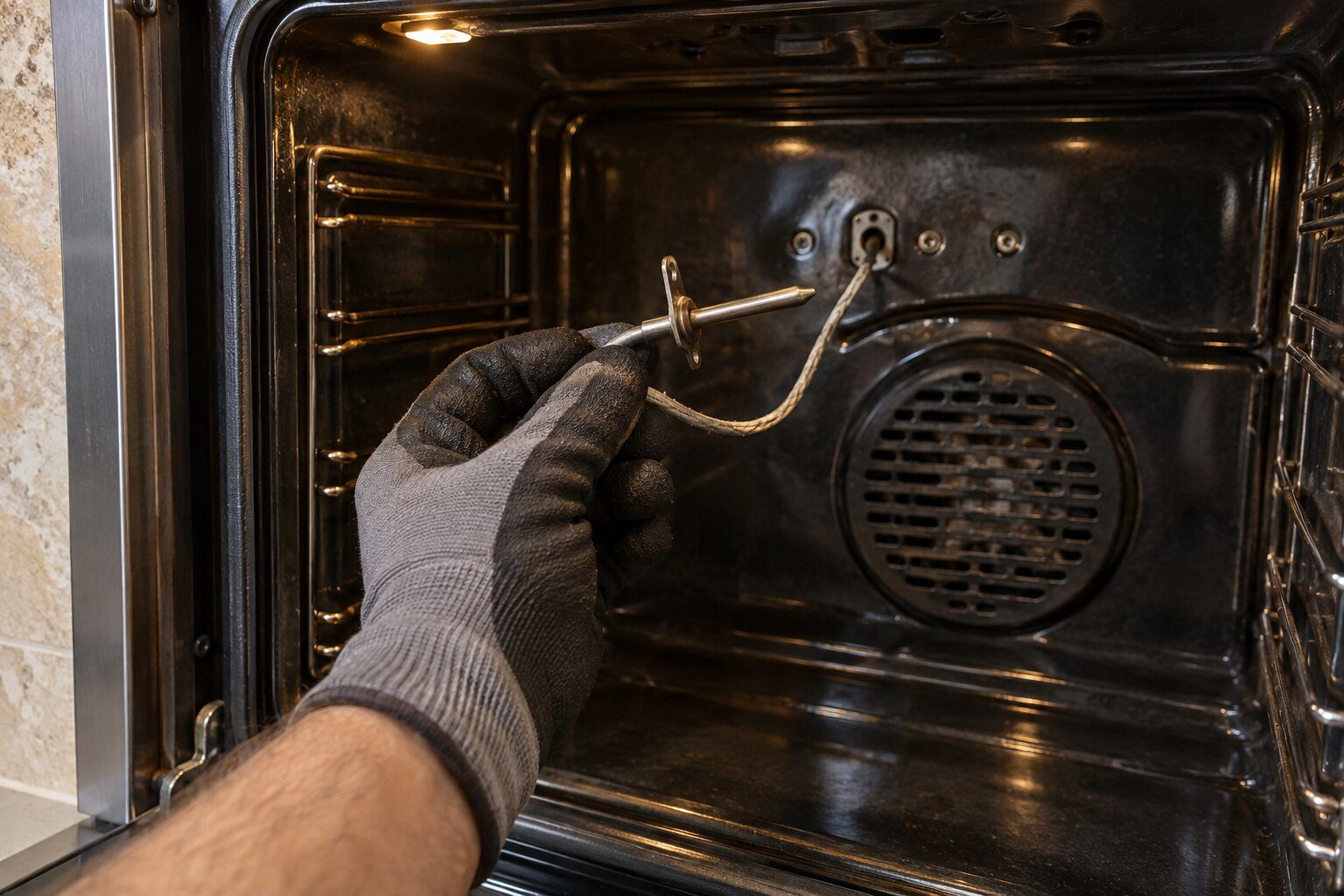
The sensor. A probe, usually near the back wall of the cavity, whose entire job is to report a temperature. It has no opinion and no authority. It drifts slowly over years, reports a number that is increasingly wrong, and the control obeys it faithfully.
The control. The part that reads the sensor and decides to call for heat. On a modern oven this is a board rather than the mechanical dial the word "thermostat" originally described, and it is the dearest of the three.
The safety valve. On a gas oven only. It admits gas to the burner, and it opens only when enough current is drawn through it by the ignitor. It is a safety device as much as a control.
Why they produce the same complaint
An oven that runs hot: usually the sensor.
An oven that runs cold: the sensor again, or a door leaking heat out of one corner.
An oven that will not heat at all: on gas, the ignitor and valve chain; on electric, an element or a fuse.
An oven that wanders: a sensor that has stopped being stable, or a control cycling badly.
Every one of those is described to us in the same handful of sentences, which is why we measure instead of taking the description at face value.
The measurement that settles it
A full cycle logged at temperature: the rise, the overshoot, the recovery and the hold. Thirty minutes at least, because on a heavy cavity the first twenty are the metal catching up.
The shape of that curve is diagnostic in a way a single reading is not. A sensor that has drifted produces a steady offset. A leaking door produces a curve that never settles and is worse near the leak. A failing control produces cycling that is visible in the log and invisible in the kitchen.
Where calibration replaces a part
If the drift is modest and stable, the control can be offset to compensate, and that is a fraction of the cost of anything.
If the reading wanders during the cycle rather than sitting steady, an offset would be chasing a moving target and the probe is replaced.
Either way it is re-measured afterwards, and the numbers are left with the machine — because the next person to look at this oven should not have to start from nothing.
The thing worth checking before any of it
The door. A seal that has hardened or a hinge that has lost tension costs heat from one corner, and it presents as an oven that runs cold and bakes unevenly.
It is the cheapest thing on this page, it takes two minutes with a note of paper, and it regularly saves a sensor that was never the problem.
If it turns out to be a repair
What this leads to, and what it costs
Every job on this site is priced the same way: an on-site diagnostic first, the figure agreed in writing before anybody starts.
-
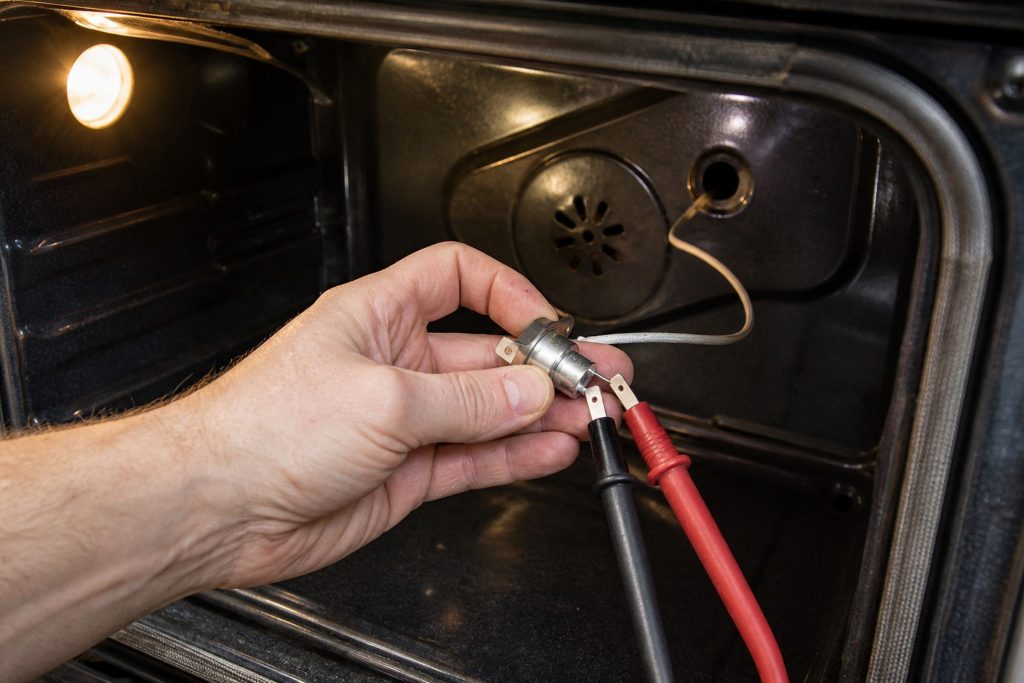
from $135 Oven temperature calibration cost
What oven temperature calibration costs on a DCS in South Florida, from $135, and what moves that figure up or down. No final price is published anywhere on this site: the exact cost is confirmed on site after the diagnostic and agreed in writing before anything is opened.
- from $135, and the three things that move it
- Masonry and distance from the water are quoted separately — both change the hour
- Confirmed on site in writing, and we say when a repair is not worth doing
-
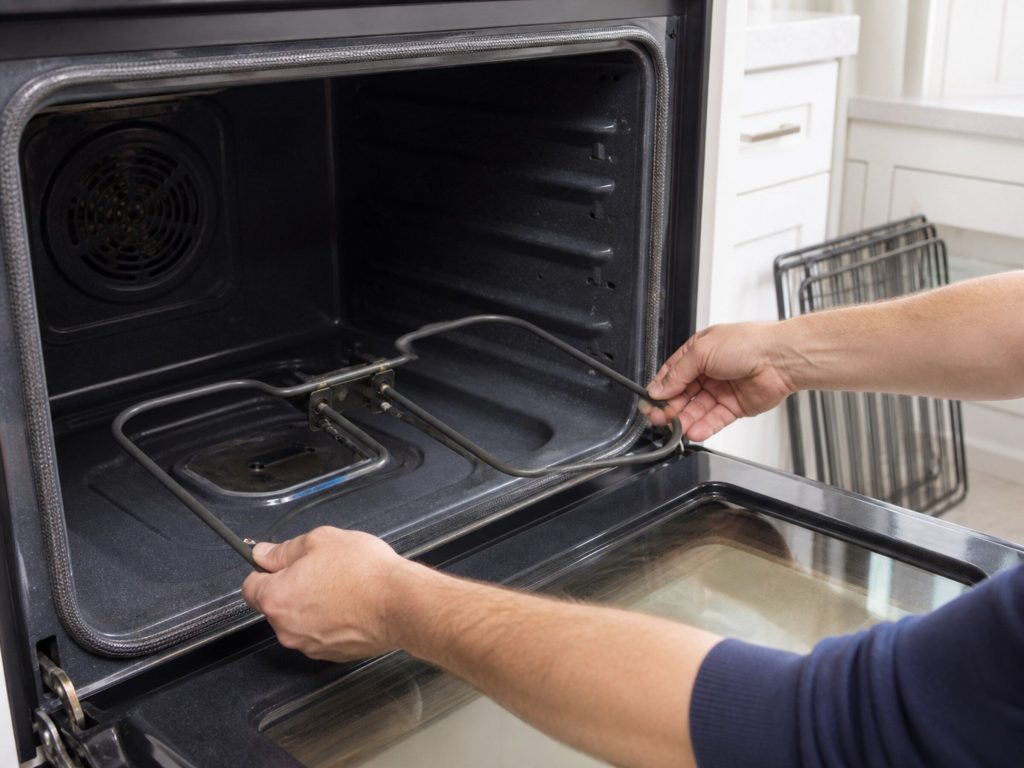
from $185 Range oven not heating
The oven under a commercial-style range, which is heavier, deeper and better insulated than the average, and therefore hides a developing failure for longer. Not heating at all and not heating properly are different calls: nothing at all usually points at an element, an ignitor, a safety valve or a thermal fuse; not properly points at the sensor, the door or the fan. Whether the range is dual fuel or all gas decides which list applies, and it is the detail owners most often do not know — we will work it out, but knowing it on the phone means the right part is on the van.
- Dual fuel and all gas fail in different places — we establish which first
- Nothing at all and not quite right are two different diagnoses
- A code with its sub-error narrows this before we arrive
-
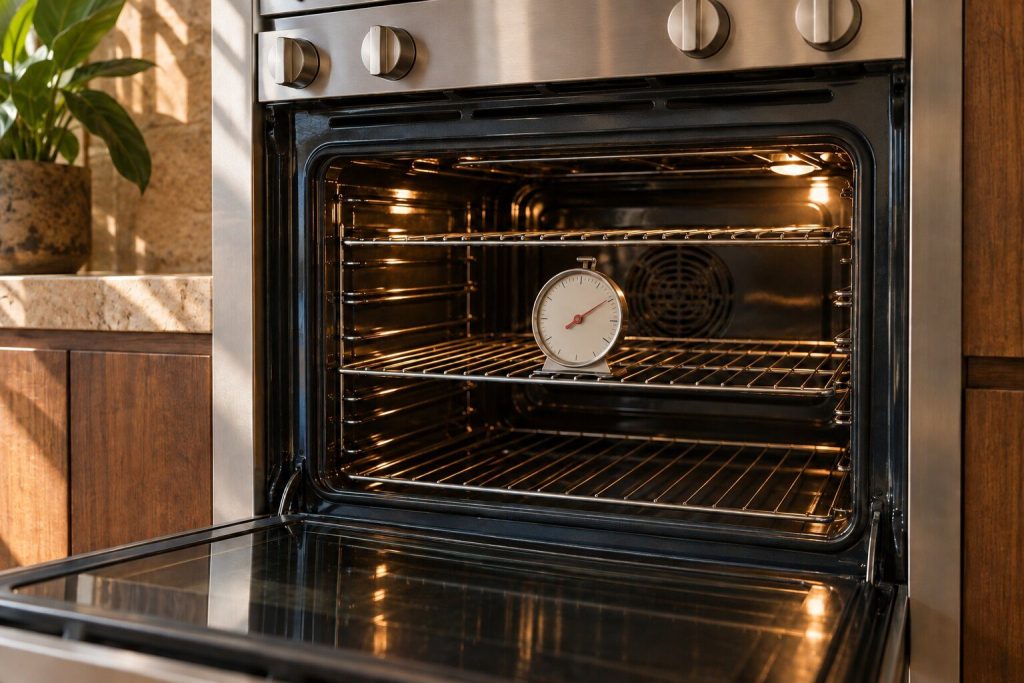
Runs hot, runs cold, or drifts during a bake Oven will not hold its temperature
DCS oven not holding temperature. Running hot, running cold and failing to hold are one conversation, and it starts at the sensor rather than the element. Once a probe wanders, the control obeys it precisely and takes the cavity somewhere other than the dial says; on this much metal the error stays hidden until a cake disagrees. Doors deserve more suspicion than they get — a heavy one that has stopped pulling true bleeds heat from a corner, and that presents as a heating element on its way out.
- Probe before element: the sequence is most of the answer
- One cold corner indicts the door, never the element
- If the oven shows a code, the digits after the letter are the message
Questions people ask about this
The oven runs twenty degrees hot. Which is it?
Most often the sensor, and often it is a calibration rather than a part. A probe that has drifted a modest amount can be offset in the control; one that has drifted a long way is replaced. A logged cycle tells us which, and the difference in price is substantial.
Is it worth calibrating rather than replacing?
Where the drift is small and stable, yes, and it is a fraction of the cost. Where it is large, or where the reading wanders during a cycle rather than sitting steady, the probe is finished and an offset would simply hide a moving target.
Everything I read says the thermostat is a cheap part.
The sensor is. The board is not, and on a gas oven the safety valve sits in between. All three answer to the same word in ordinary speech, which is why a figure quoted before anybody has measured is not really a figure.
Cost Expectations
More guides like this one
-
What an Appliance Service Call Costs in South Florida, and What It Buys
People think they are paying for somebody to arrive. They are paying for the answer — and on this badge the answer has two halves, one of which regularly costs us the job.
Read more -
How Long a DCS Grill Lasts Here, and When Repair Stops Paying
The expensive part of the machine is the part that lasts. Fireboxes and gas trains outlive burners, ignitions and fixings by a long way — which is why repair usually wins, until it does not.
Read more -
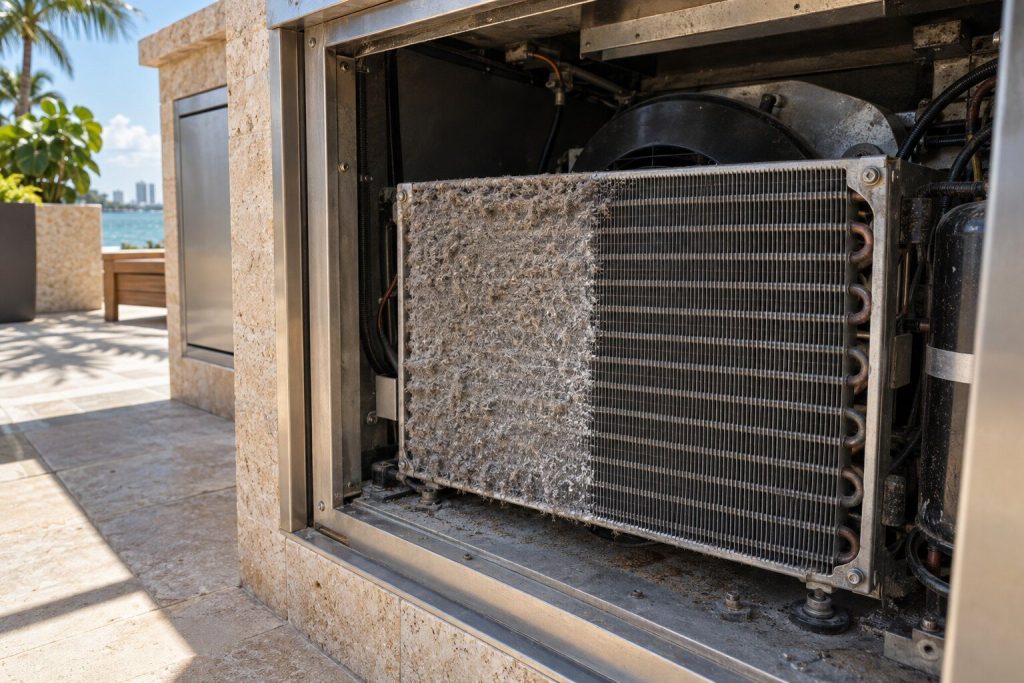
What Outdoor Ice Machine Maintenance Costs, and What Skipping It Costs
The one appliance on an island where deferring maintenance has a compounding price. Scale builds, the machine works longer for less, and the part that eventually fails costs more than the service would have.
Read more
Tell us the model number and what it is doing.
This article is based on:
- Official manufacturer documentation
- Internal repair procedures
- Technician repair history
- Company quality standards