Appliance
DCS outdoor kitchens
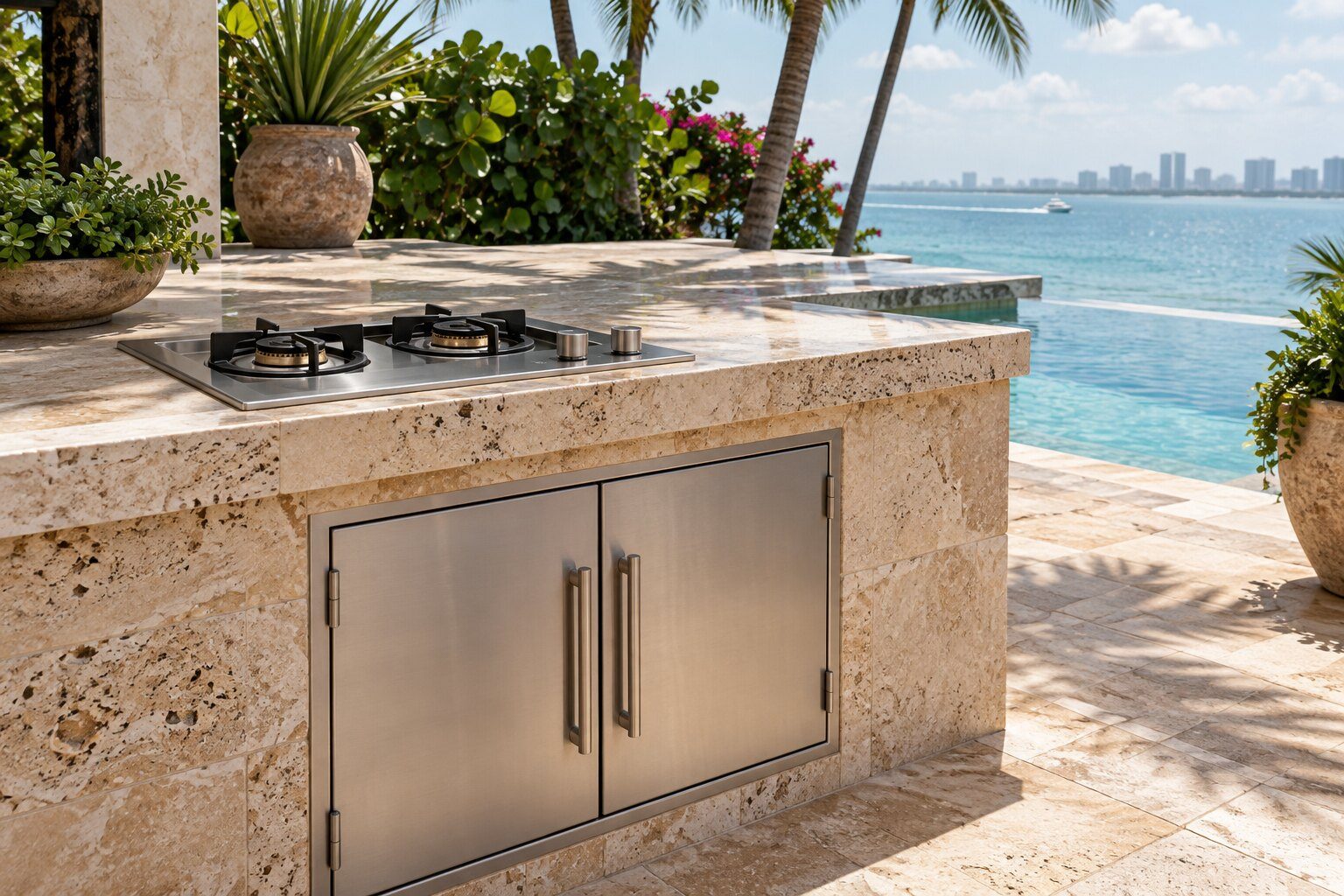
The grill is the part people photograph; the rest of the island is the part that generates the calls. A DCS outdoor kitchen is a run of separate machines sharing one gas manifold and one stone surround — side burners and power burners for a pot, a warming drawer, access doors and drawer stacks, sometimes a vent hood over the whole thing. Each has its own failure and its own access, and they fail in an order the climate sets rather than one the catalog does. Doors and drawers seize long before anything gas-fired stops working, because the hardware is what the rain and the salt reach first.
- 5 symptoms we are called out to
- From $95 diagnostic, credited to the repair
- 59 cities and neighborhoods covered
- OEM parts available on order
The short version
What this equipment is, for a repair
Configurations
Side and power burners, warming drawers, doors and drawers
Access
Planned before the visit, not discovered on arrival
Parts
OEM, available on order
Diagnostic
From $95, credited to the repair
What goes wrong with it
Symptoms we are called out to on DCS outdoor kitchens
Each one covers the likely causes in the order they are worth checking, and what to do in five minutes before booking anything.
-
Gas can be smelled with the burners off Smell of gas at the grill
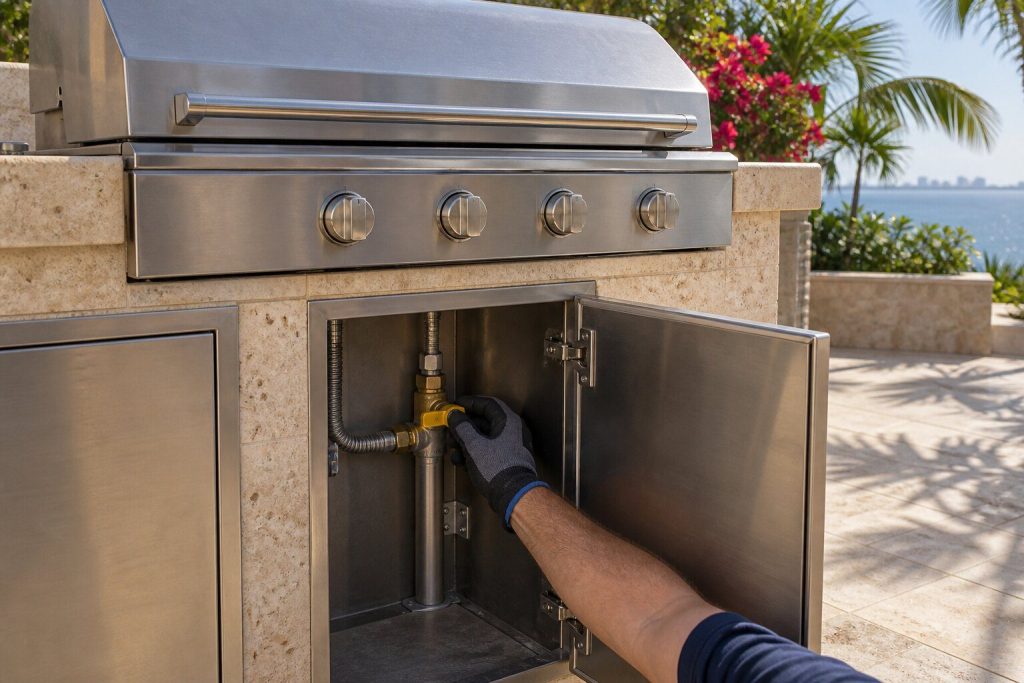
Smell of gas at a DCS grill or outdoor kitchen. This is the one page on the site with no troubleshooting on it. Gas with a dial on and the burner unlit is one thing; gas with everything shut off is another and a more serious one. Outdoors in salt air a joint that was sound three seasons ago is not automatically sound now, and the fittings under a stone island are the ones nobody has looked at since the mason closed it up.
- Shut the supply off at the cylinder or the wall valve and leave it off
- No ignition sources nearby — that includes the grill's own ignitor
- We do not diagnose this by telephone and we do not ask you to test it
-
The grill is fine and the side burner is dead Side burner will not light
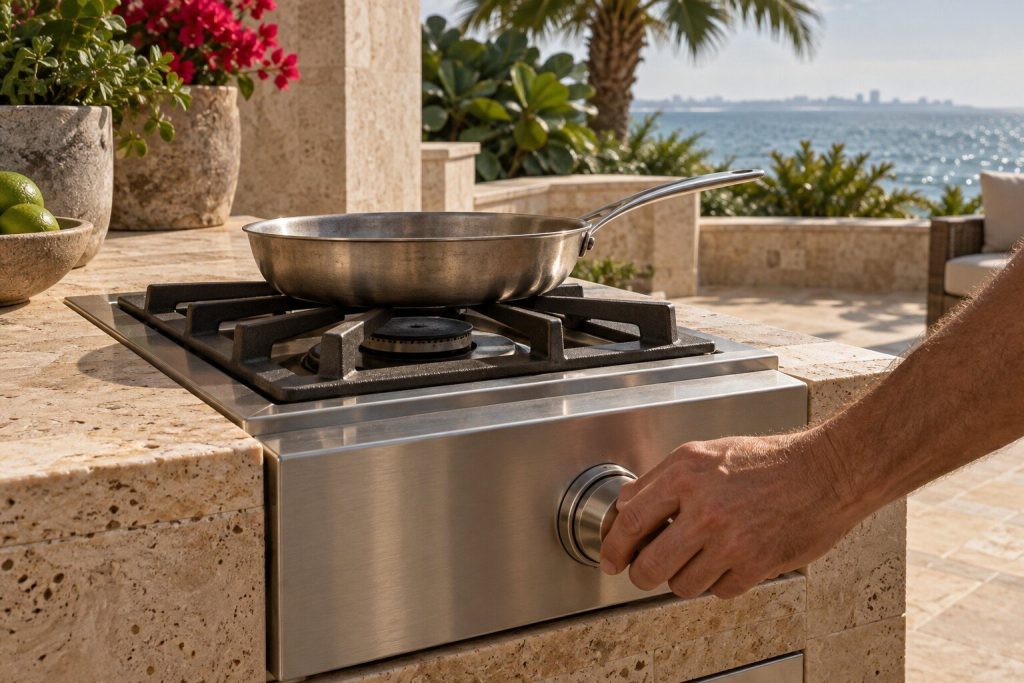
DCS side burner not working while the grill beside it is perfect. That combination is good news for the diagnosis, because it takes the shared supply out of the picture in one sentence: a manifold feeding a working grill is a manifold that is working. What is left is the side burner's own valve, its own ignition and its own burner — and those sit lower, closer to the splash, and are used a fraction as often, which in this climate is a risk rather than a protection.
- The grill working proves the supply, which is half the diagnosis free
- Side burners sit low and collect what the grill never sees
- Little use means long idle spells, and idle is when the nests arrive
-
Stiff, sticking, or no longer opening at all Outdoor drawers and doors seized
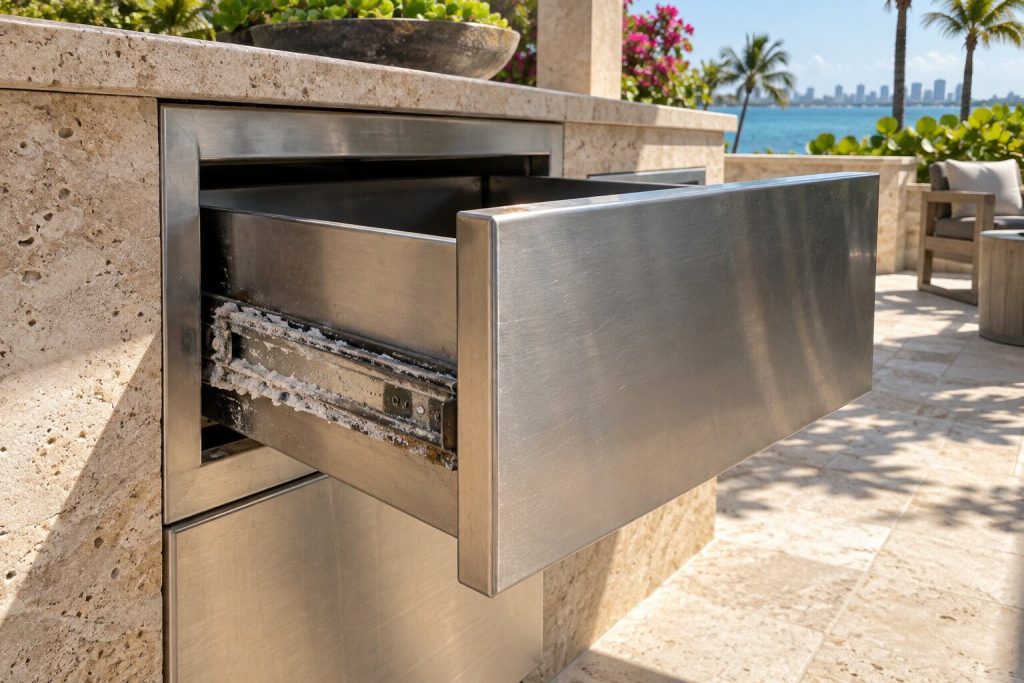
DCS outdoor kitchen drawers stuck. Hardware is what salt reaches first, and it fails in a predictable sequence: stiff, then sticky, then forced, then a bent drawer front or a frame pulled out of square. Catching it at stiff is inexpensive. Catching it after somebody has put their shoulder into a stuck drawer is a different order of work, and it is why the opening question when you ring is which of those two you have.
- Reluctant and immovable are separate repairs at separate prices
- A pitted runner does not come back with cleaning; it is replaced
- Forcing one is what turns hardware into cabinet repair
-
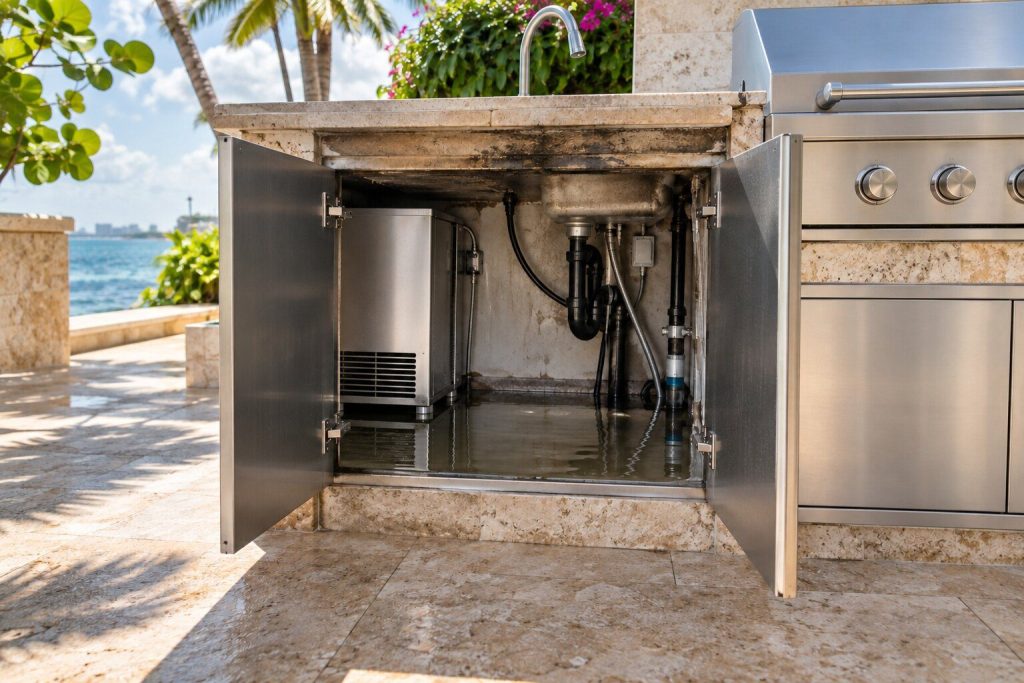
Standing water in the base of the island Water inside the outdoor cabinet
Water in a DCS outdoor kitchen cabinet. An outdoor island is designed to shed water rather than to exclude it, so a little after heavy rain is not automatically a defect — where it collects and whether it leaves are the questions. Water sitting in the base of a cabinet that houses gas fittings and electrical connections is a different matter from water running through and away, and this is one of the few cosmetic-looking problems on the site that we would rather see sooner than later.
- Shedding water is the design; holding it is not
- A gas island with standing water in it is ruining fittings you cannot see
- Constant water rather than after-rain water is usually plumbing or irrigation
-
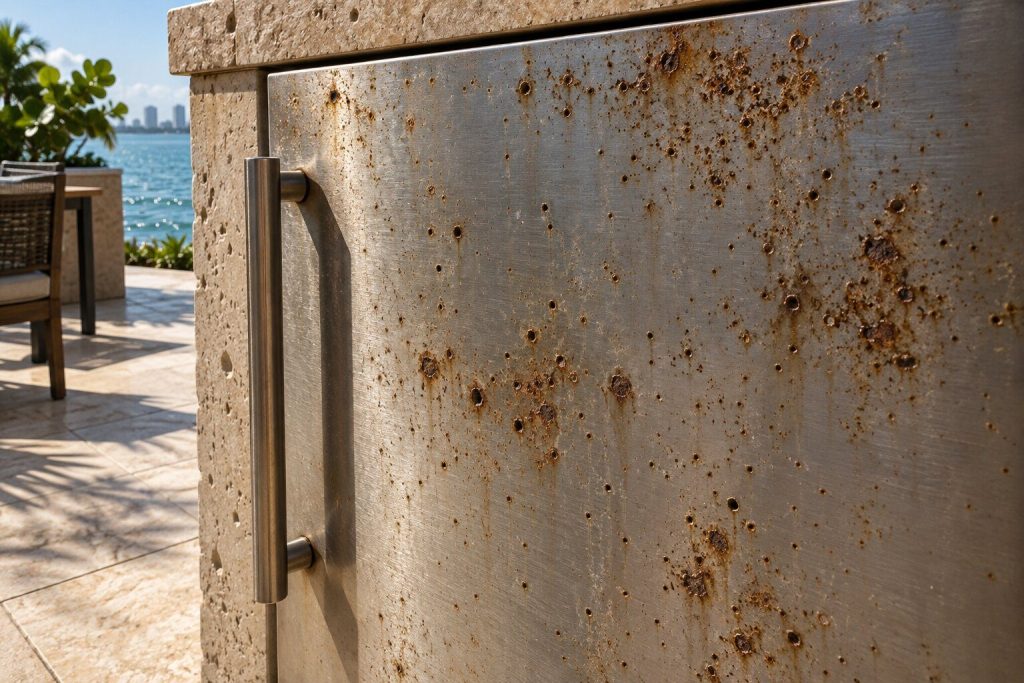
Brown speckling on doors, handles and fixings Outdoor stainless is pitting and rusting
DCS outdoor stainless rusting. Outdoor-rated stainless resists salt; it does not ignore it. Brown speckling on a door or a handle is cosmetic and is slowed a great deal by rinsing with fresh water and drying, and there is no shame in a waterfront grill showing it. What is not cosmetic is corrosion around the vents, the hinges, the mounts and the fixings — those are the parts holding cabinets square and seals true, and they are the ones worth acting on.
- Speckling on a face is cosmetic; corrosion at a fixing is structural
- Fresh water and drying does more than any polish
- Distance from the water is the real interval — four blocks is not four miles
What we do on it
Repairs we carry out on DCS outdoor kitchens
Starting figures for this equipment in South Florida. The exact cost is confirmed after an on-site diagnostic — and this is not the whole list of what can go wrong, so call if your problem is not here.
-
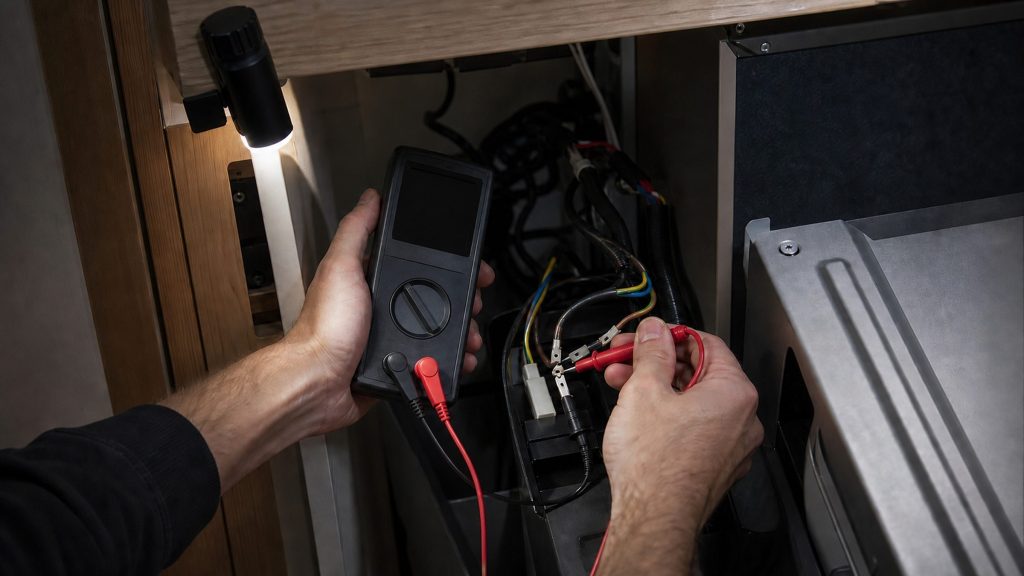
from $95 Diagnostic visit
Establishing the problem itself, with nothing quoted until it is established. Two questions come before the symptom on this badge. Is the machine indoors or outdoors — because the indoor line answers in a decoded code and the outdoor line has no codes whatsoever, so the whole method changes. And what is it sitting in — masonry, joinery or a cart — because that, not the problem, sets the length of the visit. Whatever we find is written down with a figure beside it before a spanner is picked up. The charge comes off the repair when you go ahead; when our recommendation is to stop spending money on the machine, you get that recommendation and pay the same.
- Indoors or outdoors decides the method: a code to decode, or flame and smell to read
- Nothing quoted until the problem is established, and the charge comes off the repair
- Told plainly when the machine has stopped being worth the money
-
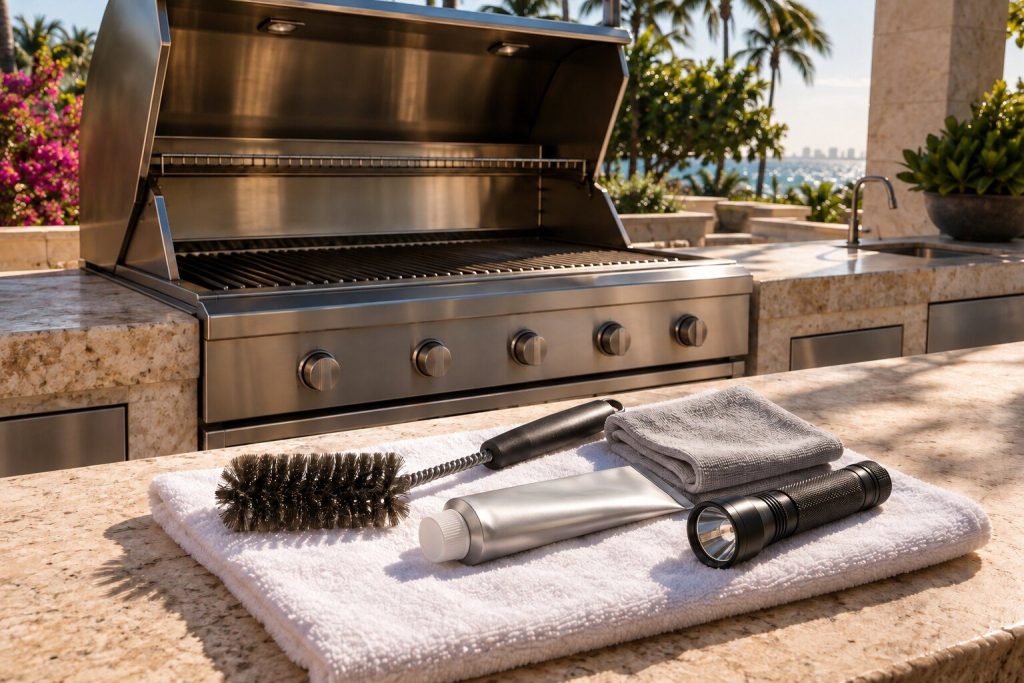
from $175 Appliance maintenance
The visit that is booked rather than called in. Outdoor cooking equipment in this market does not fail on a schedule set by hours of use — it fails on one set by salt, rain and the months it spends under a cover with humidity trapped underneath. A maintenance visit is where burners come out and get looked at before they are the reason dinner stopped, where the grease path is cleared before it is a fire, where drawer runners are treated before they pit, and where an undercounter refrigerator's condenser is cleaned before August asks it for everything. Indoors it is the ordinary and useful work: seals, hinges, sensor accuracy, filters, and the parts of a high-output range that quietly drift.
- Built around salt and season rather than around hours of use
- The grease path is treated as a fire question, because that is what it is
- Findings written down, so next year's visit starts from evidence
-
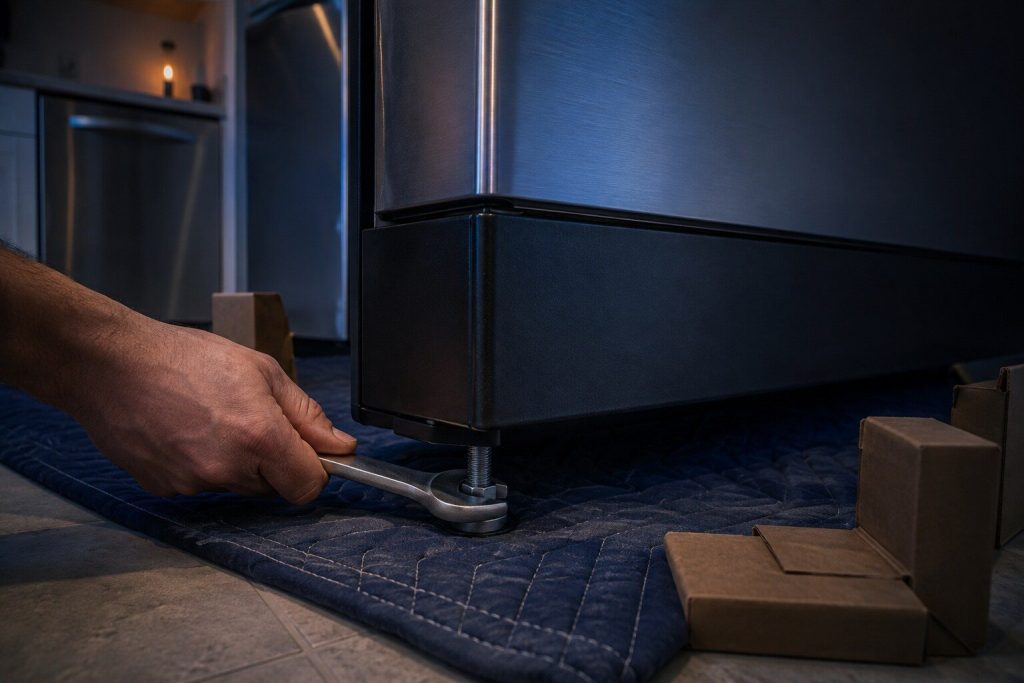
from $245 Appliance installation
Putting a machine into a space somebody else built. On this brand that is rarely a delivery and usually a fit: a grill head into a masonry cutout, a beverage center into an island with a ventilation path that has to actually work, a wall oven into a tall run, a cooktop into stone that does not forgive a second attempt. The measuring happens before anything is ordered, not after it arrives. Where an existing cutout is wrong for the machine that is meant to go into it, we say so while it is still a drawing — that conversation is cheap and the alternative is a slab with a hole in the wrong place.
- Measured against the cutout that exists, not the one in the brochure
- Ventilation and clearance treated as part of the install, because they decide whether it works
- Gas connection and leak check done properly and documented
-
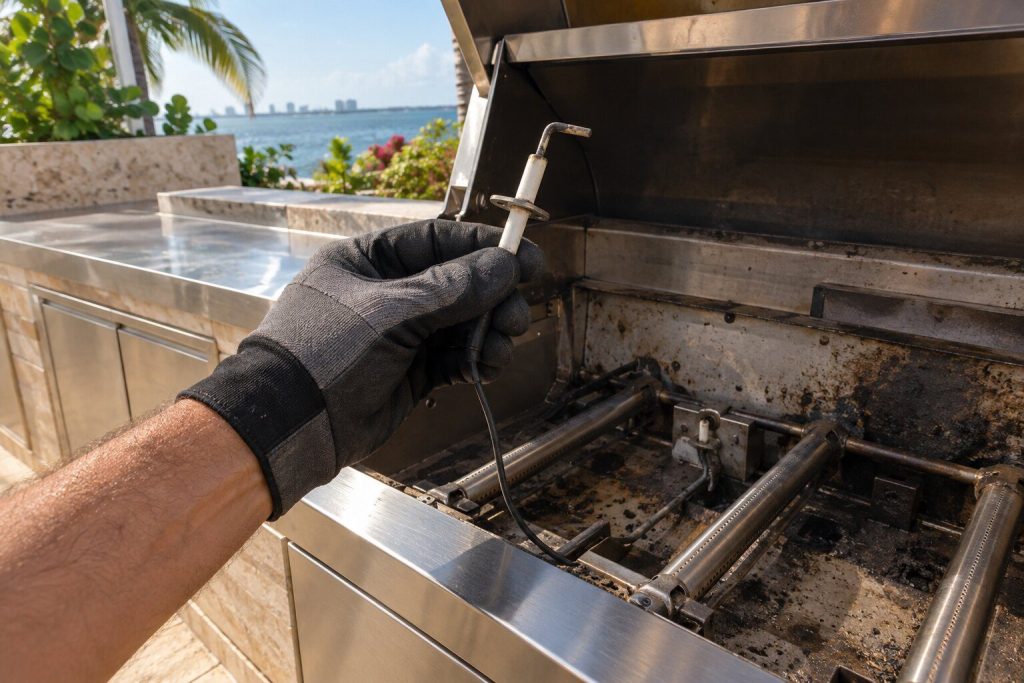
from $135 Ignition and electrode service
Everything between the button and the flame. On the coast this is the fastest-ageing system on an outdoor kitchen: ceramic insulators absorb salt and crack, electrode gaps move, earth paths corrode where they are bolted to a firebox, and battery modules sit in a damp compartment for years. The symptom is almost always the same — clicking with no light, or lighting on the fourth press instead of the first — and the cause is almost never the same twice. We service the path rather than swapping the part that is easiest to reach.
- Ceramic, electrode, wire, earth and module — a path, not a part
- Lighting on the fourth press is a problem, not a personality
- The same service covers the island's side and power burners
-
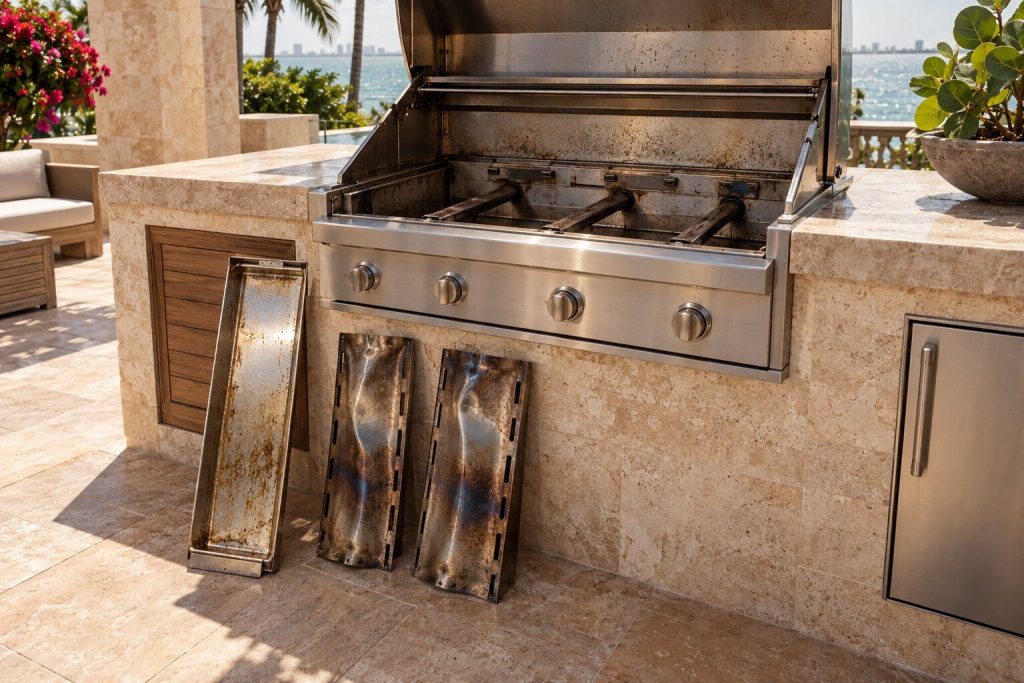
from $165 Grease management service
The service that is sold as cleaning and is really fire safety. A grill is designed to take rendered fat away from the flame — radiants spread the heat and shed the drippings, a tray collects what comes through, a channel takes it somewhere it can be emptied. When any part of that path is loaded, missing or refitted wrong, fat arrives on the burners instead, and the result is the flare-ups people describe as the grill 'getting angry'. In this market we see this most on grills that are spotless on the grates and untouched underneath. It is the cheapest work on an outdoor kitchen and the one with the highest consequence.
- Flare-ups at every cook are a grease path problem, not a cooking technique problem
- Radiants refitted the wrong way round defeat the whole design
- The single highest-consequence, lowest-cost job on this site
-
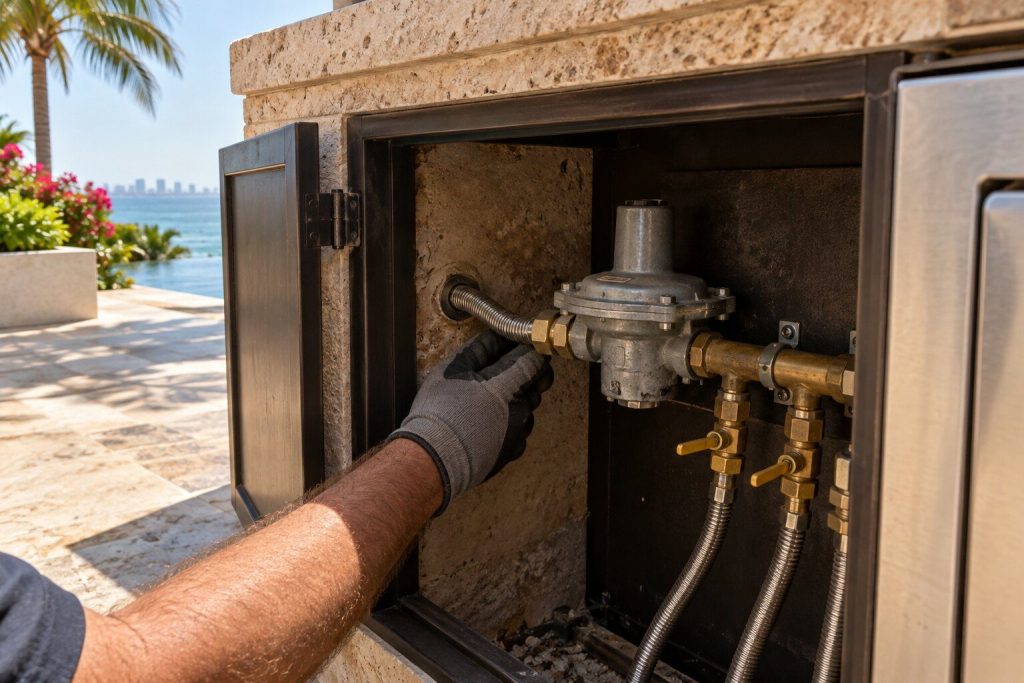
from $155 Gas supply and regulator service
Everything upstream of the burner, which is where a large share of outdoor problems actually live. Weak flame on every burner at once, a grill that will not reach temperature, a cylinder that empties faster than it should, a limiting device that trips every time the valve is opened quickly — none of those are the grill. Under an island the fittings, the flexible connector and the manifold live in a space nobody has looked at since the mason closed it, in air that corrodes. We test rather than guess, and where the answer belongs to a gas contractor rather than to us, we say that.
- All burners weak at once is a supply question, not a burner question
- The fittings under an island are the ones nobody has ever seen
- Where it belongs to a gas contractor, we say so instead of improvising
-
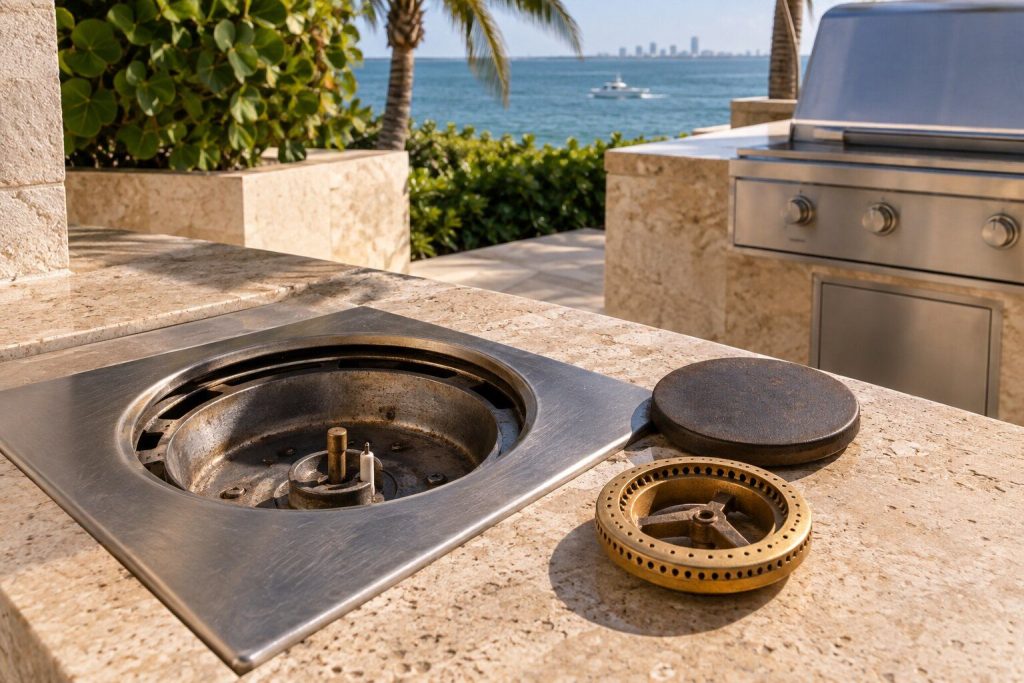
from $145 Side and power burner repair
The burners in the island that are not the grill. They sit lower, closer to the splash and the rain, and they are used less often — which sounds like an advantage and is not, because a burner that stands unused for four months in this climate collects everything. Insects nest in the venturi, the ports carbon up from one boil-over and are never cleared, and the ignition takes the same salt as the grill's does with none of the use to keep it dry. When one of these is dead and the grill beside it is perfect, the diagnosis is already half done.
- Dead on its own with the grill fine: the supply is not the problem
- Low and close to the splash — they collect what the grill never sees
- Little use is a risk factor here, not a protection
-
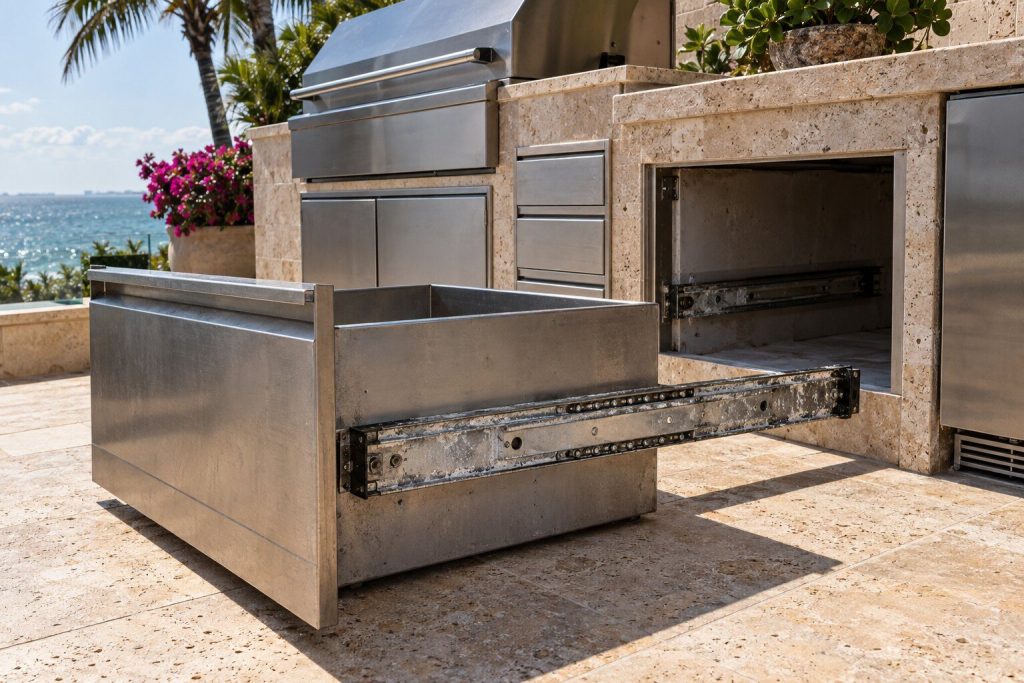
from $135 Drawer and door hardware service
The part of an outdoor kitchen that fails first and is budgeted for last. Runners, hinges, latches and fixings are the hardware salt reaches, and once a runner has pitted, cleaning does not bring it back. The progression is predictable: stiff, then sticky, then forced, then a bent drawer front or a frame pulled out of square. Catching it at stiff is inexpensive. Catching it after somebody has put their weight behind a stuck drawer is not, and it is why we ask on the phone whether it is stiff or stuck.
- Stiff and stuck are different jobs and different prices
- A pitted runner is replaced, not cleaned — cleaning buys weeks
- Forcing a stuck drawer is what turns hardware into cabinet work
-
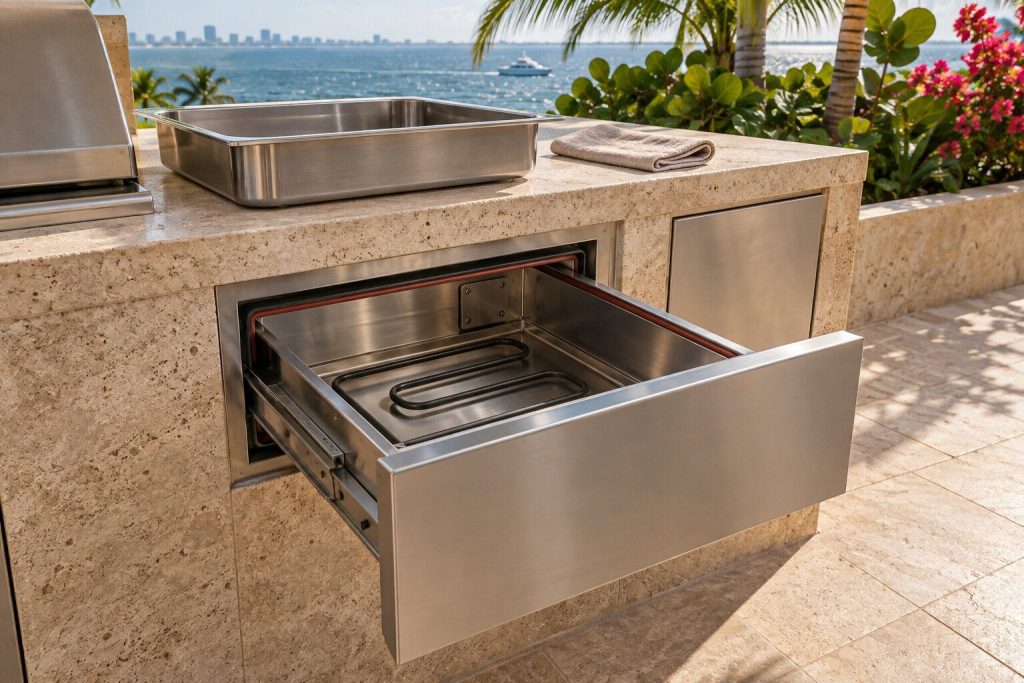
from $165 Outdoor warming drawer repair
A heated compartment in an island that gets rained on. The two things it must do — hold a low temperature accurately and keep weather out of its own electrics — are in tension outdoors, and the problems follow from that. A drawer that has stopped heating is usually the element, the thermostat or the connection to a drawer that moves every time it is used; a drawer that heats unevenly is usually the seal or the runner letting it sit crooked. Water inside is its own category and is worth acting on quickly, because it does not stay a warming drawer problem for long.
- The supply flexes every time the drawer opens — that is where breaks happen
- Uneven heat is usually geometry rather than the element
- Water inside is urgent on a heated outdoor compartment
-
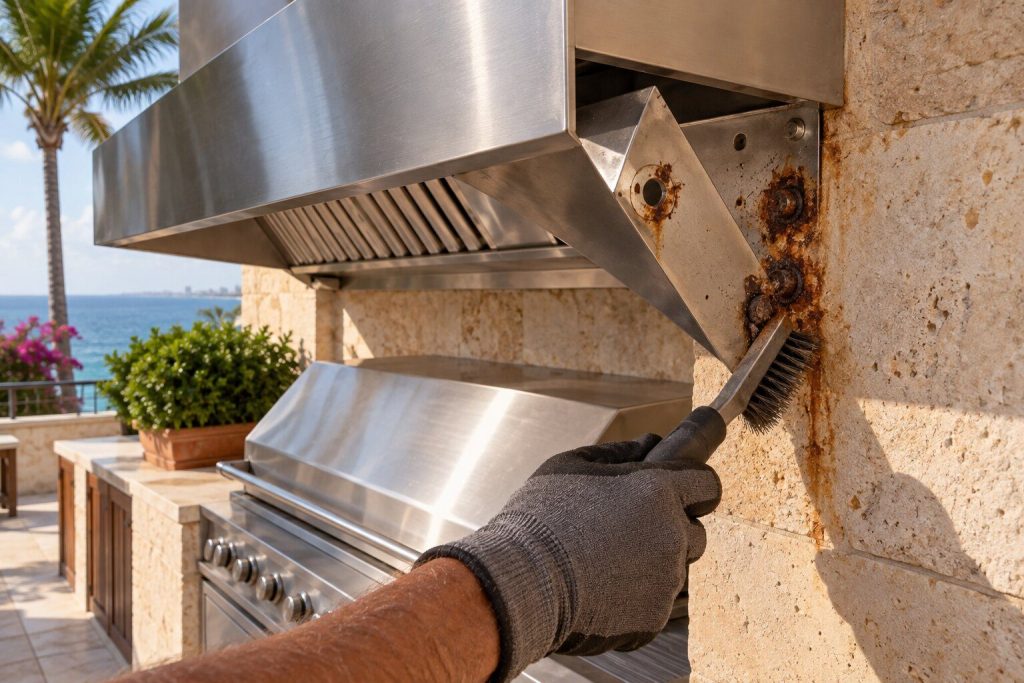
from $185 Outdoor hood corrosion service
A hood over an outdoor grill is a structure as much as an appliance, and in this market the structure is what fails. Mounts, fixings, the underside of the canopy and the housing that carries the electrics all corrode on a schedule set by how close the kitchen is to the water. The work is honest and unglamorous: get to sound material, treat what can be treated, replace what cannot, and route the electrics so water leaves instead of collecting. Done at the right time it adds years. Left too long it becomes a canopy that is not safely holding its own weight, and we will tell you when that line has been crossed.
- It is a structure first — the fixings matter more than the fan
- Proximity to the water is the real service interval on this item
- There is a point where replacement is the honest answer, and we say so
-
from $195 Salt air protection service
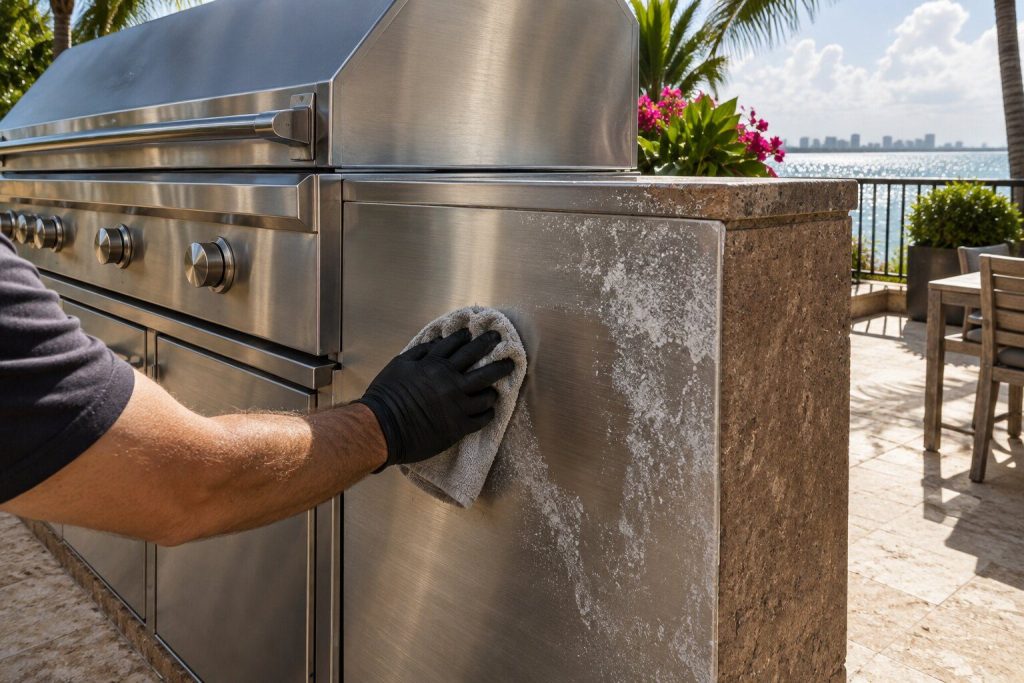
A visit that exists because of where this equipment lives. Four of the seven machines on this site stand outdoors in air that carries salt, and the difference between a kitchen four blocks from the water and one four miles inland is measured in years of service life. This is the planned, unglamorous work that changes that number: stainless cleaned and protected in the right direction, fixings inspected and replaced with the right grade before they seize, ignition components and electrical housings treated and re-sealed, hardware caught while it is stiff rather than after it is stuck. It is not a cosmetic service, although the kitchen does look better afterwards.
- Distance from the water is the real service interval on this coast
- Fixings replaced with the right grade before they seize, not after
- Not a polish — the point is the fixings, the housings and the hardware
In more detail
About DCS outdoor kitchens
An outdoor kitchen is not one appliance
It is a set of them sharing a gas manifold, a power supply and a surround. That matters on the telephone: a problem on every machine at once is a supply question, a problem on one is that machine's own, and which of those two we are dealing with is something the caller can usually tell us in a sentence. It is the fastest triage we have on this site.
The hardware fails before the gas does
Owners expect burners and ignitors to be the weak point. In South Florida the drawers, hinges, latches and fixings are what go first, because they are what salt and rain reach and nothing about them is sealed. Budgeting for hardware is the difference between an island that stays usable for a decade and one that quietly becomes a cabinet nobody opens.
Who built the island is part of the service history
Cutout sizes, clearances, drainage and the gas routing were decided by whoever assembled the run, not by the manufacturer, and a well-built island is a visibly cheaper machine to maintain. We do not say this to assign blame. We say it because the first thing we look at is the install, and on this type it is frequently the answer.
This article is based on:
- Official manufacturer documentation
- Internal repair procedures
- Technician repair history
- Company quality standards
Before you book
Questions about DCS outdoor kitchens
The side burner will not light but the grill does.
That is good news for the diagnosis, because it takes the supply out of the picture. One machine dead on a shared manifold points at that machine — its own valve, its own ignitor and electrode, its own burner ports. Side and power burners sit lower and closer to the splash than the grill does, so they collect water and debris the grill never sees. If both go at once, or if everything runs weakly, we look at the manifold and the regulator instead.
The drawers have stopped sliding.
Almost always the runners rather than the drawer. Outdoor stainless hardware carries salt in a film that dries into the mechanism, and once a runner has pitted, cleaning does not bring it back. It is also the cheapest thing on the island to put right and the easiest to neglect until the drawer has to be forced, at which point the front or the frame is what bends. If a drawer is stiff rather than stuck, say so when you call — there is a real difference in what the visit involves.
Water gets in and sits in the cabinet.
An outdoor island is designed to shed water, not to exclude it, and where it collects tells us whether that is working. Water in the base of a cabinet after rain is usually a blocked or missing drain path, a seal that has hardened, or a door that no longer closes square because a hinge has dropped. Water in there constantly is a different problem and usually a plumbing or an irrigation one. Neither is cosmetic in this market: standing water inside a gas island is how fittings and electrics get ruined.
Can any of it be moved for the repair?
Sometimes, and it is the question that decides the length of the visit. Components dropped into a stone island are held by the surround as much as by their own fixings, and a mason who tiled up to the flange did not expect anybody to take it out again. We would rather know before arriving, which is why we ask for a photograph of the run and the cutouts. Where something genuinely cannot come out, the work is done in place and takes longer — but it is planned that way rather than discovered.
Where we do it
Across Miami-Dade, Broward, and Palm Beach
Same terms everywhere we go: an on-site diagnostic first, the price agreed in writing, and the exact figure confirmed once we have seen the unit.
Neighborhoods people ask for by name