DCSRepair Miami

35 jobs · 7 machines

What we actually do to a DCS, most of it outdoors.

Each page says what the work involves, what moves the figure and what the visit looks like on equipment set into stone rather than pushed into a gap. Starting figures are on the page for the job, not behind a form.

  • 35 jobs written up
  • 7 machines we take on
  • from $95 diagnostic, credited to the repair
  • Every one is a from, never a final price

Every job we list

All 35 of them

Sorted by the machine they belong to. Each page carries its own starting figure.

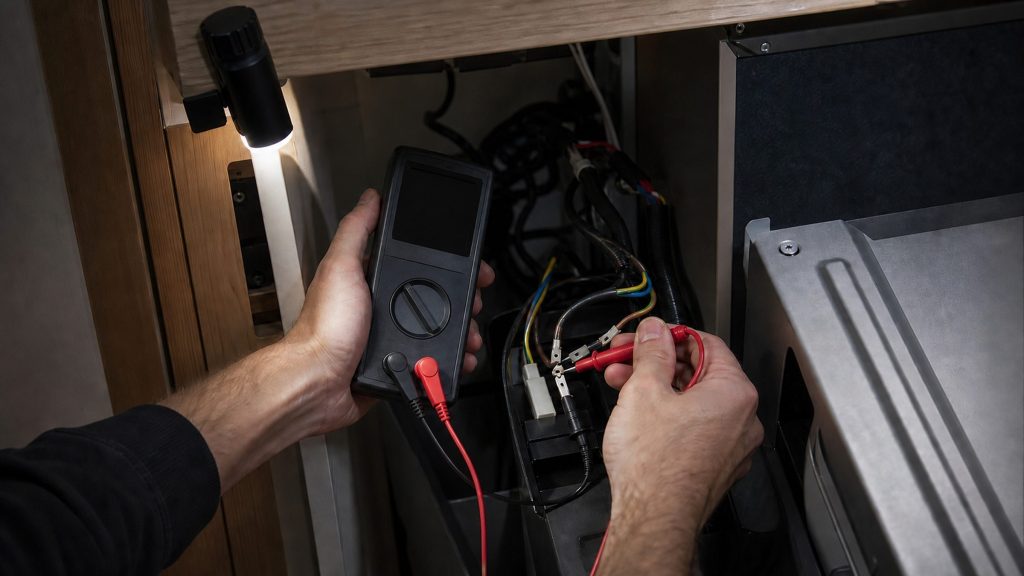
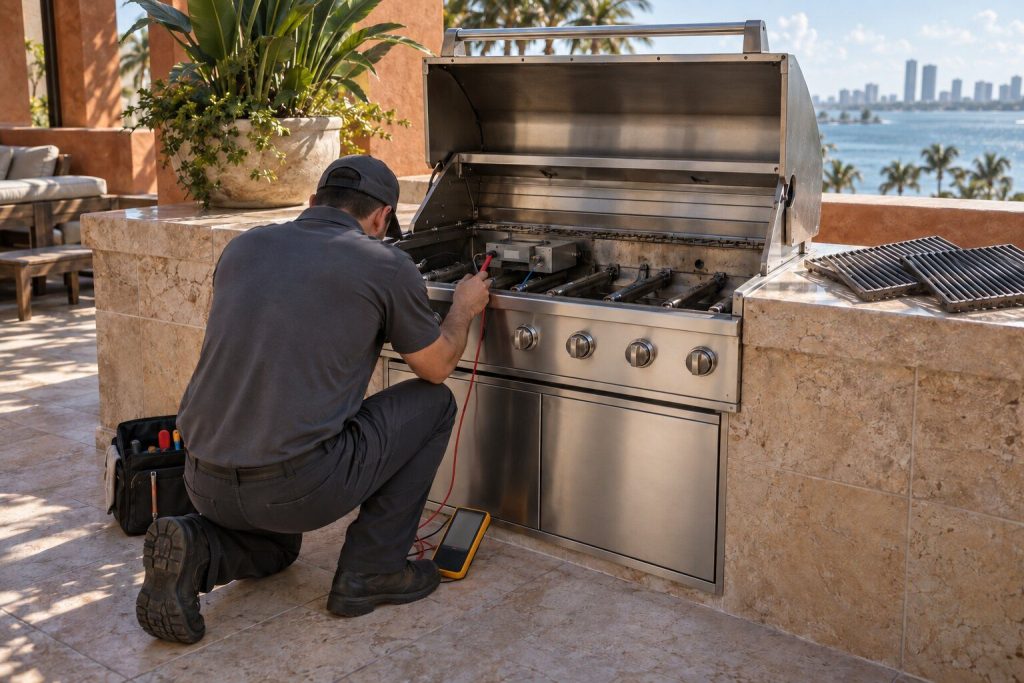
  • A technician kneeling behind a built-in appliance with a multimeter in one hand and its probes on a terminal, a work lamp clipped above
    from $95

    Diagnostic visit

    Establishing the problem itself, with nothing quoted until it is established. Two questions come before the symptom on this badge. Is the machine indoors or outdoors — because the indoor line answers in a decoded code and the outdoor line has no codes whatsoever, so the whole method changes. And what is it sitting in — masonry, joinery or a cart — because that, not the problem, sets the length of the visit. Whatever we find is written down with a figure beside it before a spanner is picked up. The charge comes off the repair when you go ahead; when our recommendation is to stop spending money on the machine, you get that recommendation and pay the same.

    • Indoors or outdoors decides the method: a code to decode, or flame and smell to read
    • Nothing quoted until the problem is established, and the charge comes off the repair
    • Told plainly when the machine has stopped being worth the money
    What this involves
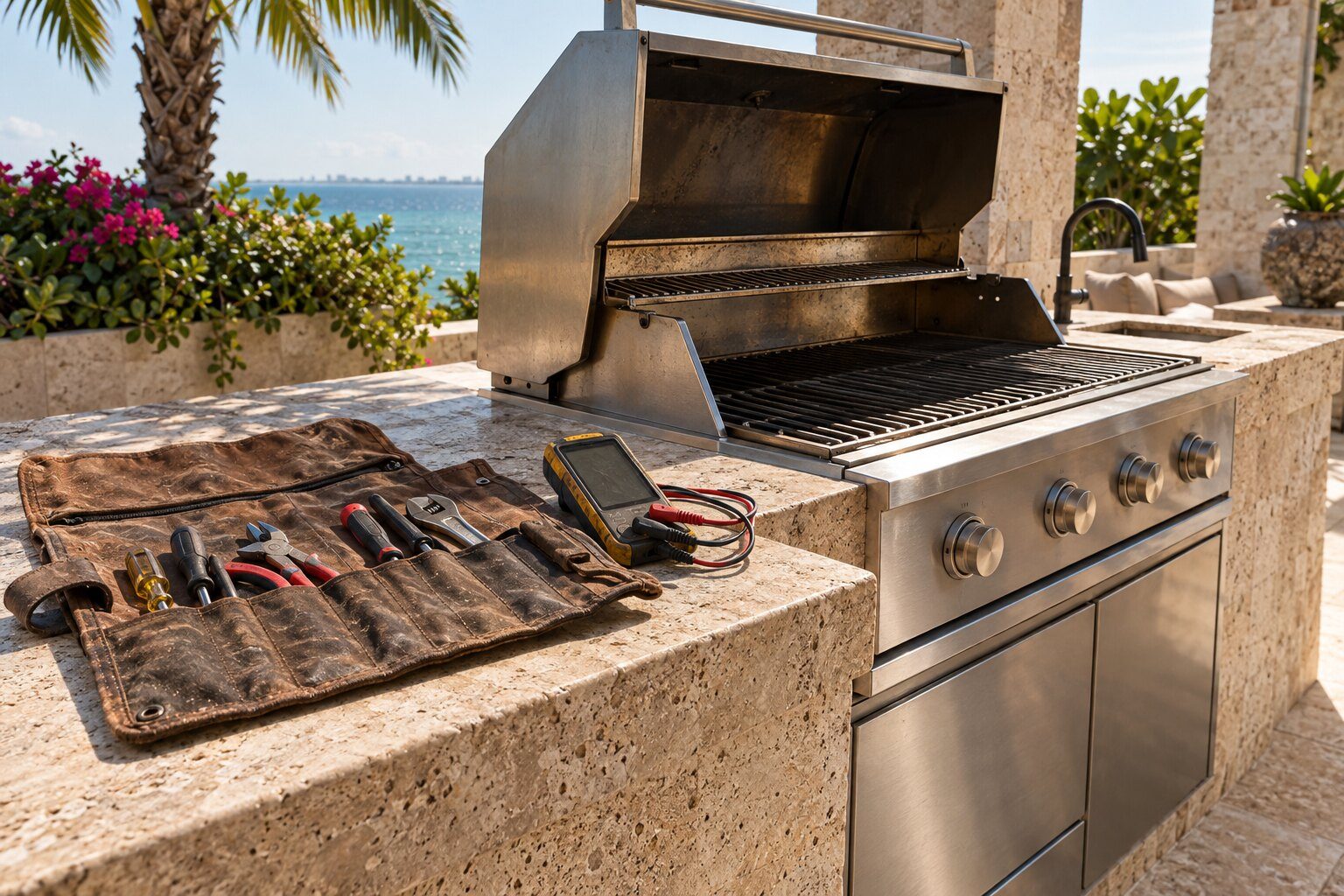
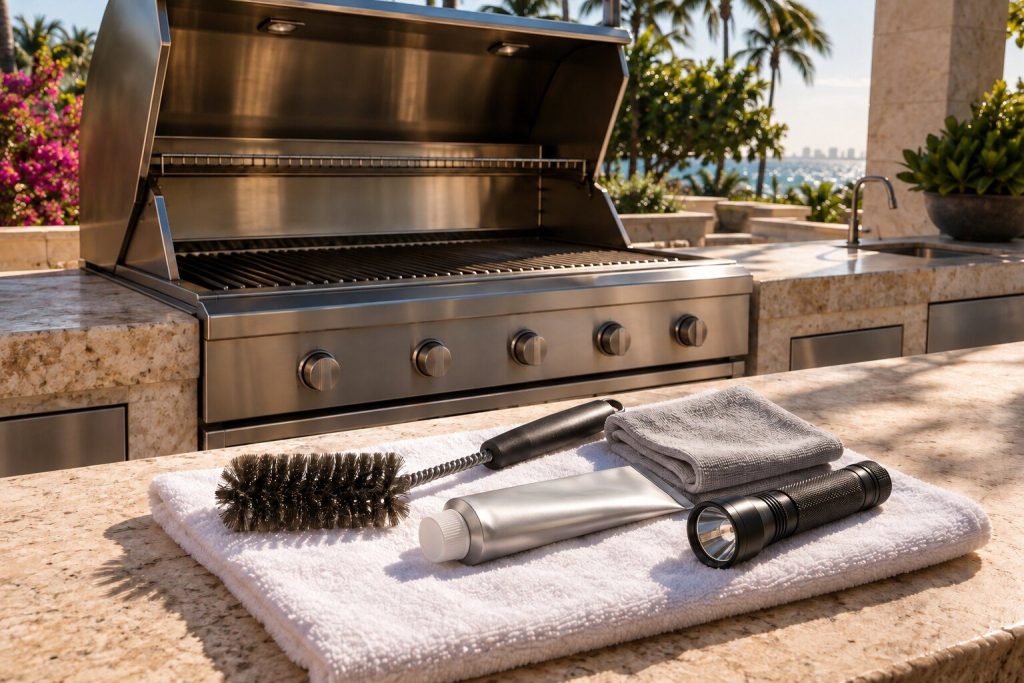
  • A coil brush, a tube of stainless polish, a folded cloth and a flashlight laid out together on a folded white towel on the coral stone counter of a terrace kitchen, the grill hood open behind them.
    from $175

    Appliance maintenance

    The visit that is booked rather than called in. Outdoor cooking equipment in this market does not fail on a schedule set by hours of use — it fails on one set by salt, rain and the months it spends under a cover with humidity trapped underneath. A maintenance visit is where burners come out and get looked at before they are the reason dinner stopped, where the grease path is cleared before it is a fire, where drawer runners are treated before they pit, and where an undercounter refrigerator's condenser is cleaned before August asks it for everything. Indoors it is the ordinary and useful work: seals, hinges, sensor accuracy, filters, and the parts of a high-output range that quietly drift.

    • Built around salt and season rather than around hours of use
    • The grease path is treated as a fire question, because that is what it is
    • Findings written down, so next year's visit starts from evidence
    What this involves
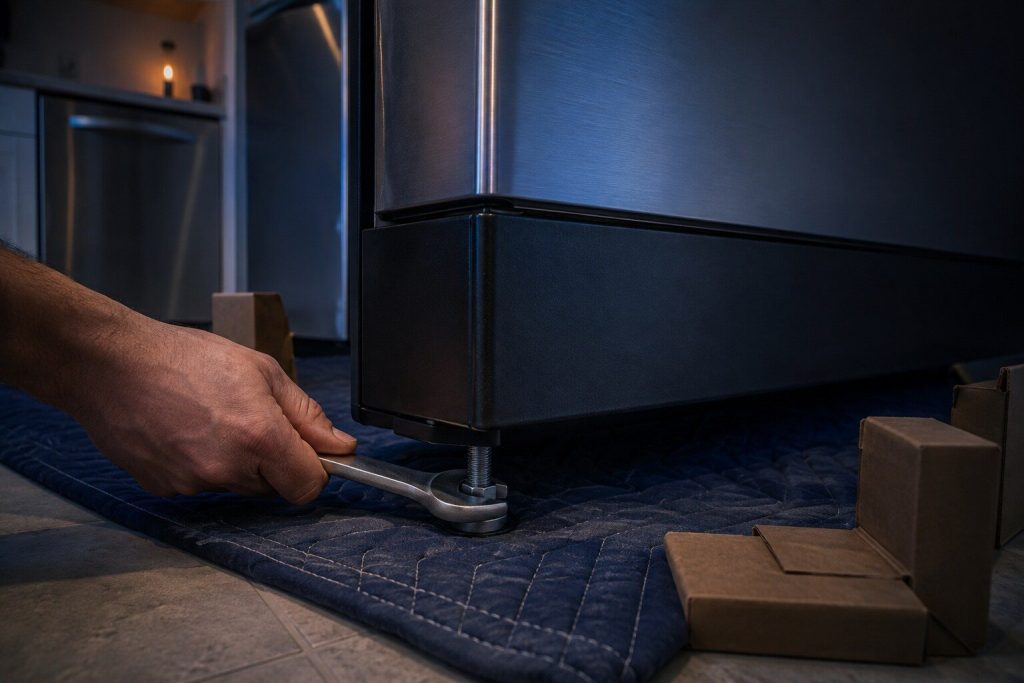
  • A wrench turning the threaded leveling foot of a newly placed range standing on a moving blanket in a kitchen opening, the toe kick above it and cardboard corner guards on the floor.
    from $245

    Appliance installation

    Putting a machine into a space somebody else built. On this brand that is rarely a delivery and usually a fit: a grill head into a masonry cutout, a beverage center into an island with a ventilation path that has to actually work, a wall oven into a tall run, a cooktop into stone that does not forgive a second attempt. The measuring happens before anything is ordered, not after it arrives. Where an existing cutout is wrong for the machine that is meant to go into it, we say so while it is still a drawing — that conversation is cheap and the alternative is a slab with a hole in the wrong place.

    • Measured against the cutout that exists, not the one in the brochure
    • Ventilation and clearance treated as part of the install, because they decide whether it works
    • Gas connection and leak check done properly and documented
    What this involves
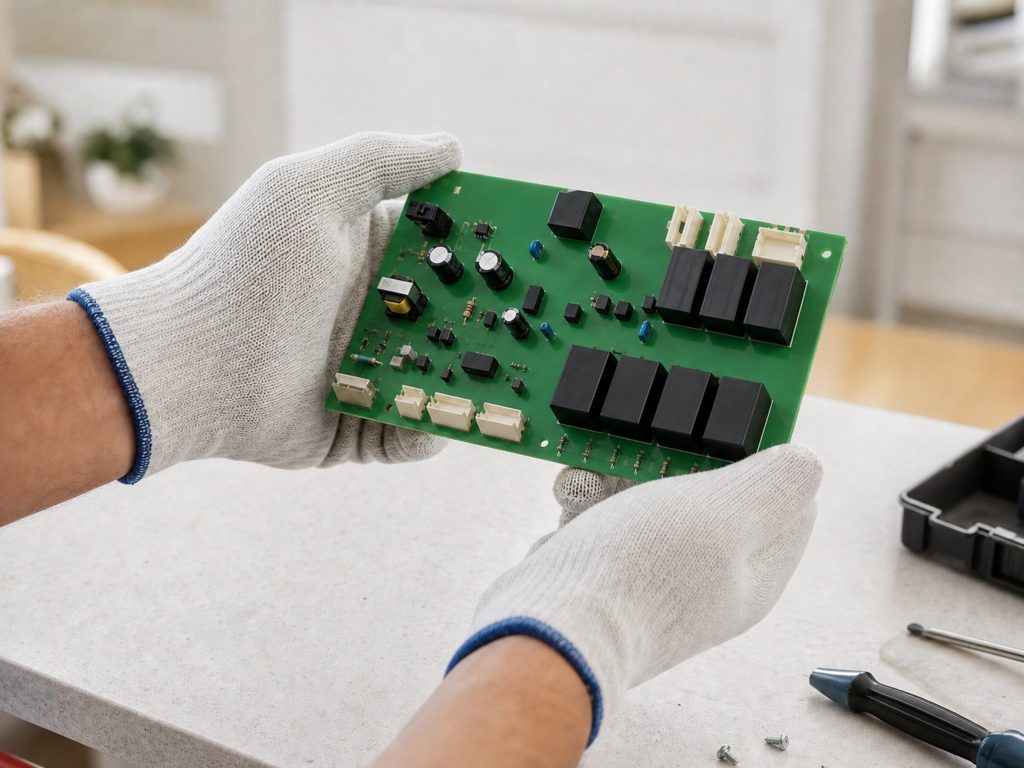
  • An appliance control board held in two gloved hands over a workbench, its plain green surface and relays visible, no markings legible
    from $295

    Control board repair

    When the electronics rather than the mechanics are the problem. Indoors this brand publishes an error table that names board errors directly — a missing master or slave power board, a software error, a communication failure between boards, and one code that fires when the control does not recognize which model it is fitted to. That last one is the interesting one: it usually appears after a part has been replaced with the wrong variant, and no amount of further replacing will settle it until the model identity matches. We diagnose before we order, because a board is the most expensive thing on most of these machines and the second most commonly replaced without need.

    • The published sub-error separates board, software and communication errors
    • A code that means the control does not recognize the model is a fitting problem, not a dead board
    • We prove the board is the problem before one is ordered
    What this involves
  • A technician kneeling at an open built-in grill on a stone island with the grates out and a meter lead clipped to the ignition module, the hood standing open above him.
    from $145

    Grill will not light

    The call we take most often here, and the one whose answer most often lies upstream of the grill. Before anything is opened we work backwards from the flame: is it one burner or all of them, does it light from a match, has the cylinder been changed recently, is there a smell of gas. Those four answers separate a supply problem from an ignition problem from a burner problem, and they cost nothing to establish. In this market the ignition side is a consumable — electrodes crack, ceramics absorb salt, earths corrode — and the supply side is where a surprising number of calls actually end.

    • One burner dead, or the whole set — that single answer splits the diagnosis in half
    • Lights from a match but not from the ignitor: that sentence halves the diagnosis
    • A tripped limiting device on a cylinder imitates a dead grill
    What this involves
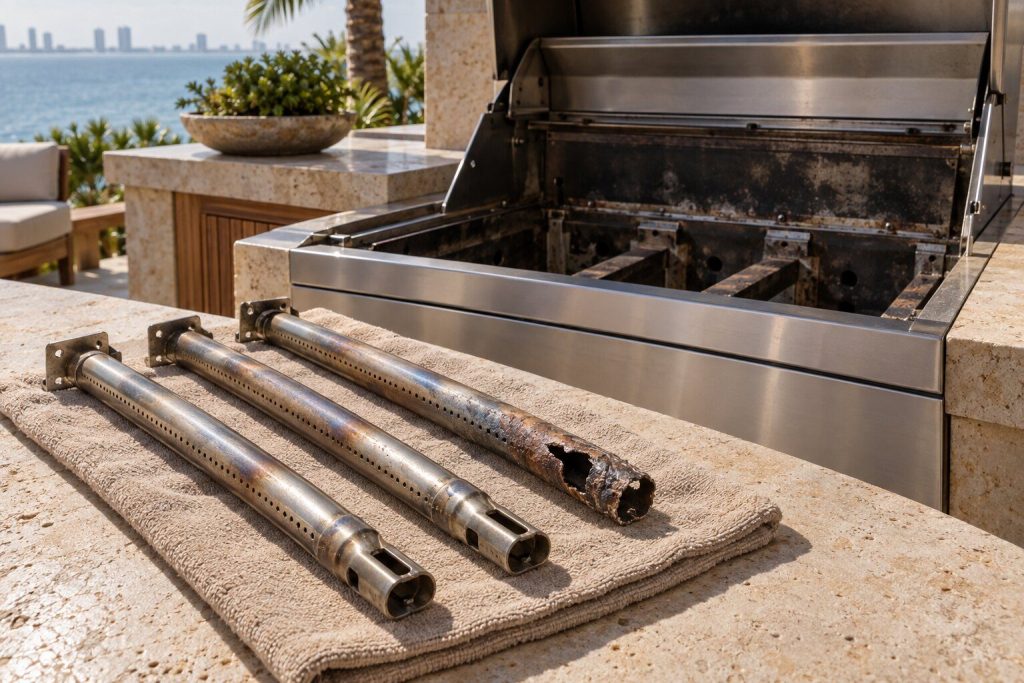
  • Three tubular grill burners lying side by side on a folded cloth on a stone counter beside the open firebox they came out of, one of them burned through at the end.
    from $185

    Grill burner replacement

    Burners are consumables on an outdoor grill in South Florida, and the question is rarely whether one has gone but whether it has gone far enough to matter. A burner that has burned through at the ends puts flame where the design did not intend it, cooks unevenly down its length, and eventually damages the radiants and the firebox around it. We would rather replace a set at the point where the first one has failed than come back three times, and we will say when a burner still has a season in it rather than selling a set on principle.

    • Burn-through at the ends is the failure to look for, not the obvious hole
    • Replaced as a set when the set is the same age, one at a time when it is not
    • The radiants above them are checked at the same time, because they fail together
    What this involves
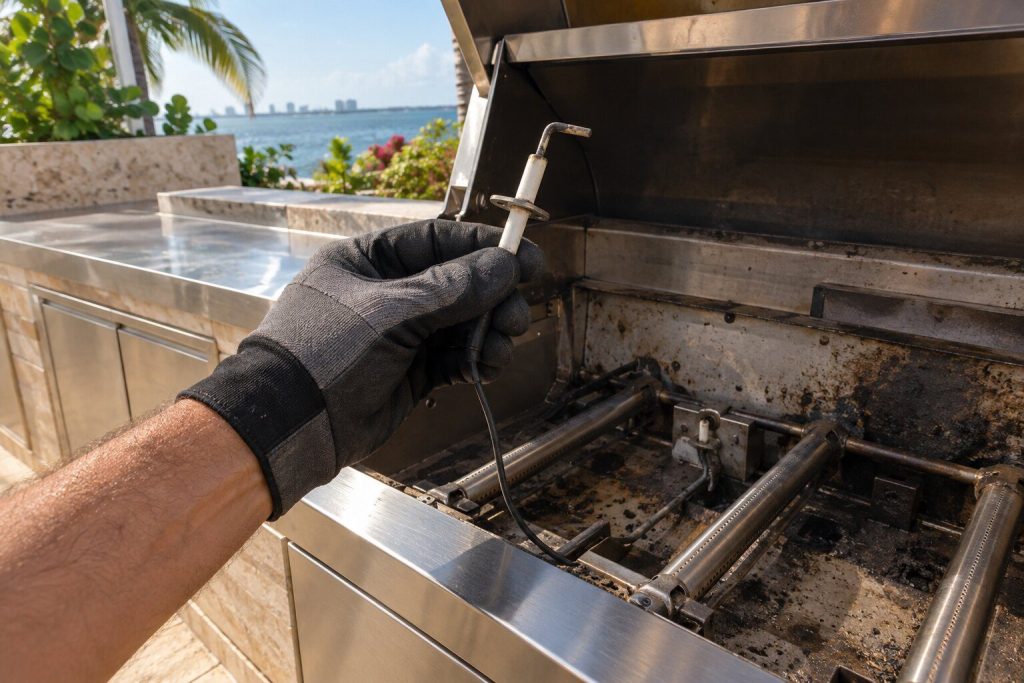
  • An ignition electrode and its white ceramic insulator held up in a gloved hand over an open grill firebox, the lead still attached and trailing down into the cabinet.
    from $135

    Ignition and electrode service

    Everything between the button and the flame. On the coast this is the fastest-ageing system on an outdoor kitchen: ceramic insulators absorb salt and crack, electrode gaps move, earth paths corrode where they are bolted to a firebox, and battery modules sit in a damp compartment for years. The symptom is almost always the same — clicking with no light, or lighting on the fourth press instead of the first — and the cause is almost never the same twice. We service the path rather than swapping the part that is easiest to reach.

    • Ceramic, electrode, wire, earth and module — a path, not a part
    • Lighting on the fourth press is a problem, not a personality
    • The same service covers the island's side and power burners
    What this involves
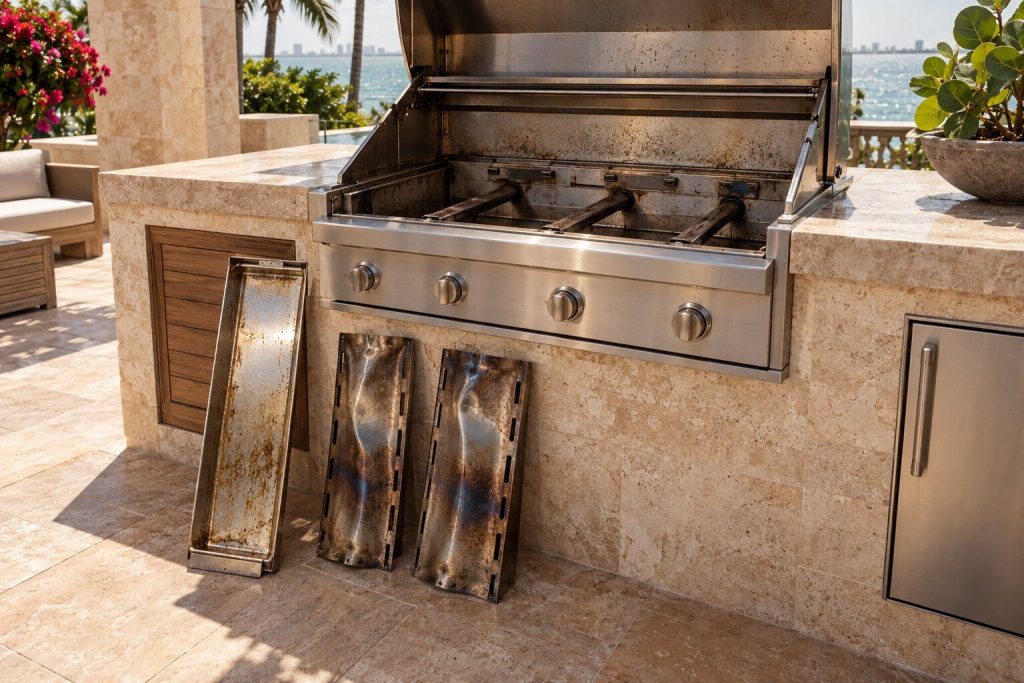
  • A grill drip tray and two warped radiant trays drawn out and standing on the terrace tile beside the open grill, the empty burner box visible above them.
    from $165

    Grease management service

    The service that is sold as cleaning and is really fire safety. A grill is designed to take rendered fat away from the flame — radiants spread the heat and shed the drippings, a tray collects what comes through, a channel takes it somewhere it can be emptied. When any part of that path is loaded, missing or refitted wrong, fat arrives on the burners instead, and the result is the flare-ups people describe as the grill 'getting angry'. In this market we see this most on grills that are spotless on the grates and untouched underneath. It is the cheapest work on an outdoor kitchen and the one with the highest consequence.

    • Flare-ups at every cook are a grease path problem, not a cooking technique problem
    • Radiants refitted the wrong way round defeat the whole design
    • The single highest-consequence, lowest-cost job on this site
    What this involves
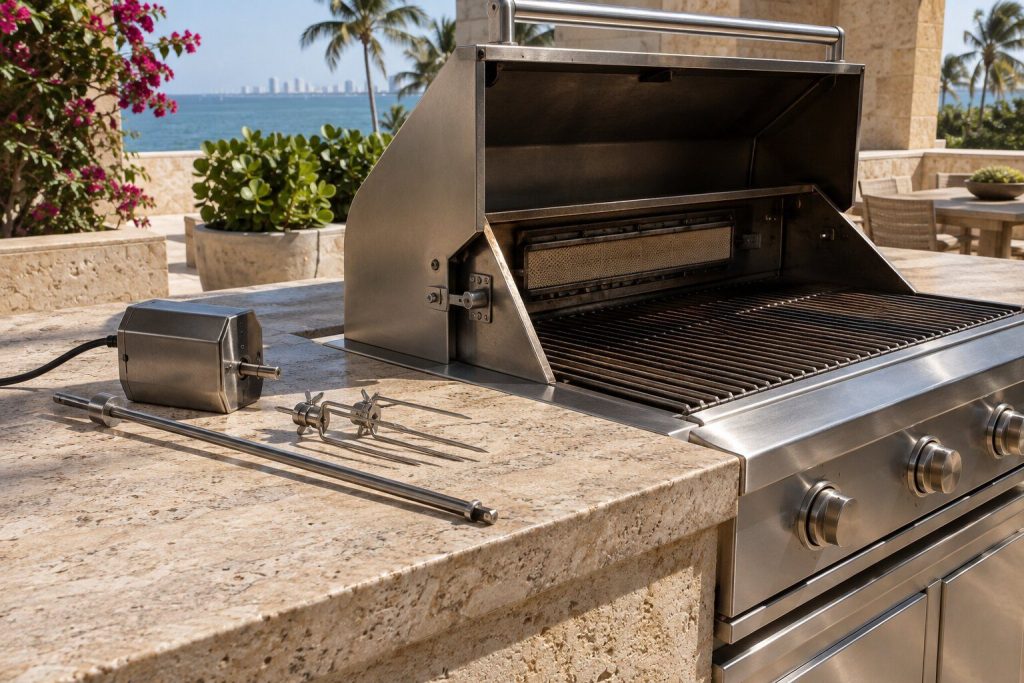
  • A rotisserie motor unbolted from the side of a built-in grill and resting on the stone counter beside its spit rod and forks, the rear infrared burner visible in the open firebox.
    from $145

    Rotisserie repair

    Two separate things are called the rotisserie and they fail separately. There is the motor and spit that turn, and there is the rear burner that does the cooking, and a complaint of 'the rotisserie does not work' is worth splitting on the phone. A motor that hums and does not turn, a spit that binds in its bracket, a burner that will not stay lit when the safety valve button is released — these are three different visits. The last one is the one people live with longest and is usually the flame-supervision device rather than the burner.

    • Motor and rear burner are two machines with one name
    • Will not stay lit once the button is released points at flame supervision
    • A binding spit ruins a motor that was fine until it did
    What this involves
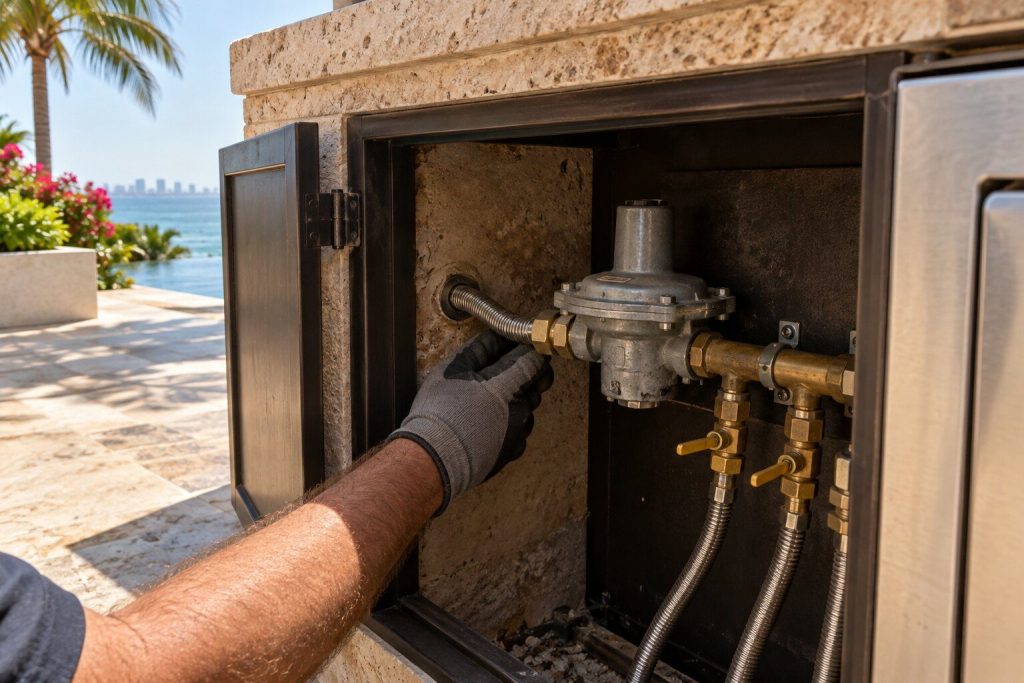
  • A gas regulator and the manifold behind it inside the open cabinet under an outdoor island, a gloved hand steadying a flex connector where it enters the masonry.
    from $155

    Gas supply and regulator service

    Everything upstream of the burner, which is where a large share of outdoor problems actually live. Weak flame on every burner at once, a grill that will not reach temperature, a cylinder that empties faster than it should, a limiting device that trips every time the valve is opened quickly — none of those are the grill. Under an island the fittings, the flexible connector and the manifold live in a space nobody has looked at since the mason closed it, in air that corrodes. We test rather than guess, and where the answer belongs to a gas contractor rather than to us, we say that.

    • All burners weak at once is a supply question, not a burner question
    • The fittings under an island are the ones nobody has ever seen
    • Where it belongs to a gas contractor, we say so instead of improvising
    What this involves
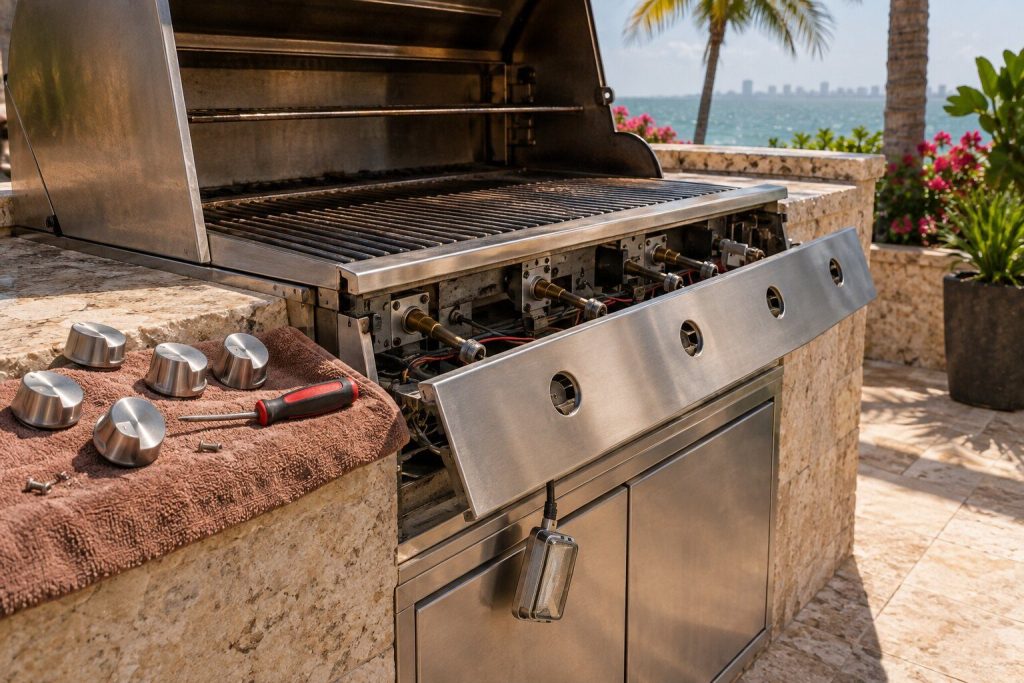
  • The control panel of a built-in grill with the fascia trim lifted away and the hood lamp housing hanging on its lead below it, dials removed and lying on a cloth.
    from $125

    Hood light and control repair

    The electrical half of an outdoor grill: hood lights, dial lighting, the switch panel and the wiring that runs through a cabinet exposed to weather. These are the problems people put up with rather than call about, which is a pity, because water in a switch housing on a terrace does not stay a lighting problem. Corroded connectors, a transformer that has taken rain, a switch that has swollen — they all read as a failed light until somebody opens the housing, and by then the corrosion has usually traveled.

    • A dead light on an outdoor grill is usually water, not a bulb
    • Corrosion travels along a loom — the problem is rarely where the symptom is
    • Left alone it stops being an electrical problem and becomes a housing one
    What this involves
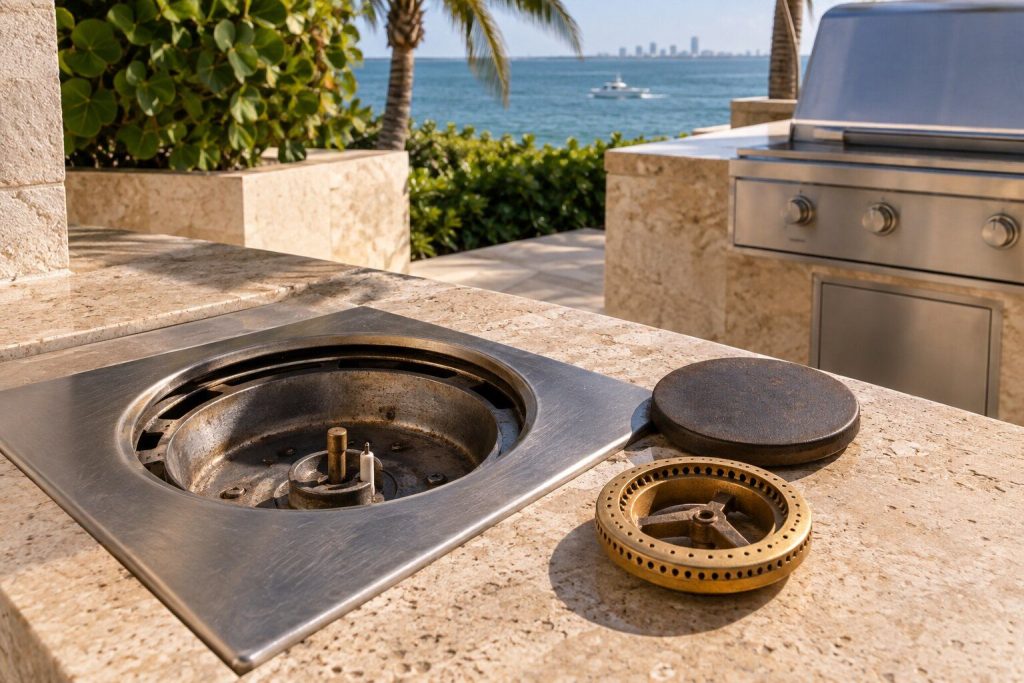
  • A side burner taken apart on an outdoor counter with its cast cap and brass head set beside the empty burner well and its orifice exposed.
    from $145

    Side and power burner repair

    The burners in the island that are not the grill. They sit lower, closer to the splash and the rain, and they are used less often — which sounds like an advantage and is not, because a burner that stands unused for four months in this climate collects everything. Insects nest in the venturi, the ports carbon up from one boil-over and are never cleared, and the ignition takes the same salt as the grill's does with none of the use to keep it dry. When one of these is dead and the grill beside it is perfect, the diagnosis is already half done.

    • Dead on its own with the grill fine: the supply is not the problem
    • Low and close to the splash — they collect what the grill never sees
    • Little use is a risk factor here, not a protection
    What this involves
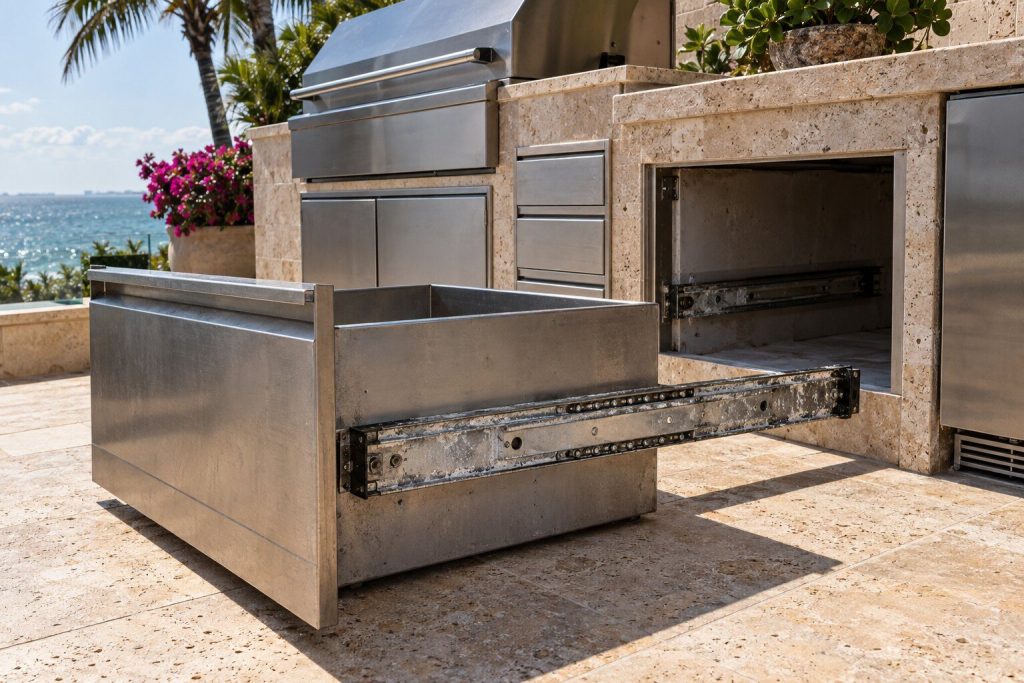
  • A stainless outdoor drawer pulled fully out of an island cabinet and standing on the terrace tile, its ball-bearing runner extended and crusted white with salt.
    from $135

    Drawer and door hardware service

    The part of an outdoor kitchen that fails first and is budgeted for last. Runners, hinges, latches and fixings are the hardware salt reaches, and once a runner has pitted, cleaning does not bring it back. The progression is predictable: stiff, then sticky, then forced, then a bent drawer front or a frame pulled out of square. Catching it at stiff is inexpensive. Catching it after somebody has put their weight behind a stuck drawer is not, and it is why we ask on the phone whether it is stiff or stuck.

    • Stiff and stuck are different jobs and different prices
    • A pitted runner is replaced, not cleaned — cleaning buys weeks
    • Forcing a stuck drawer is what turns hardware into cabinet work
    What this involves
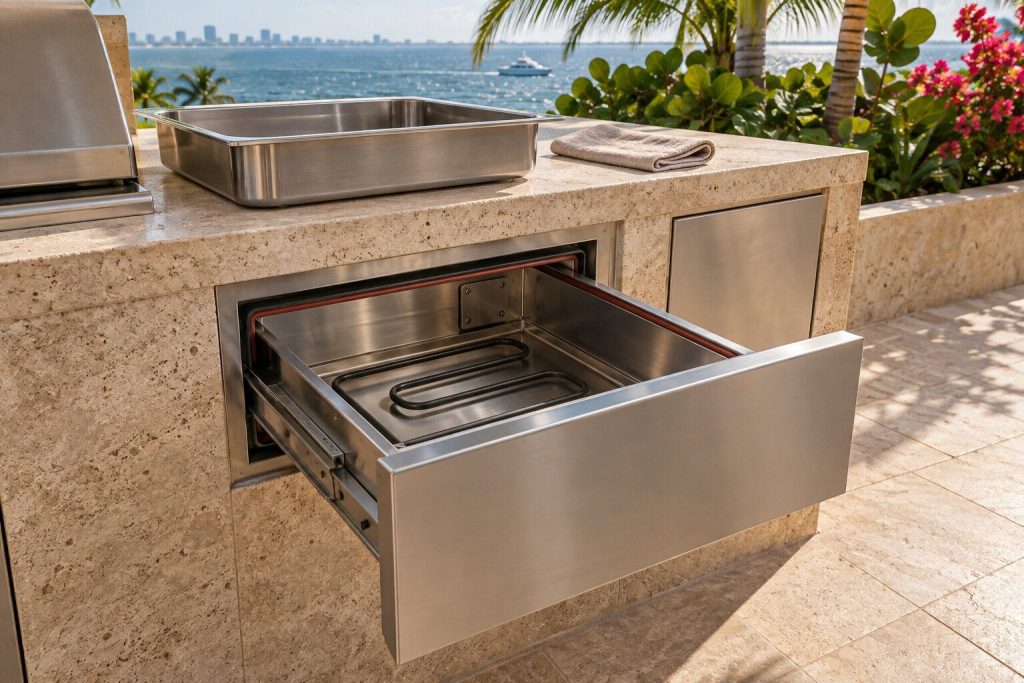
  • An outdoor warming drawer open in a stone island with its liner pan lifted out and its element and seal visible, a cloth folded on the counter above.
    from $165

    Outdoor warming drawer repair

    A heated compartment in an island that gets rained on. The two things it must do — hold a low temperature accurately and keep weather out of its own electrics — are in tension outdoors, and the problems follow from that. A drawer that has stopped heating is usually the element, the thermostat or the connection to a drawer that moves every time it is used; a drawer that heats unevenly is usually the seal or the runner letting it sit crooked. Water inside is its own category and is worth acting on quickly, because it does not stay a warming drawer problem for long.

    • The supply flexes every time the drawer opens — that is where breaks happen
    • Uneven heat is usually geometry rather than the element
    • Water inside is urgent on a heated outdoor compartment
    What this involves
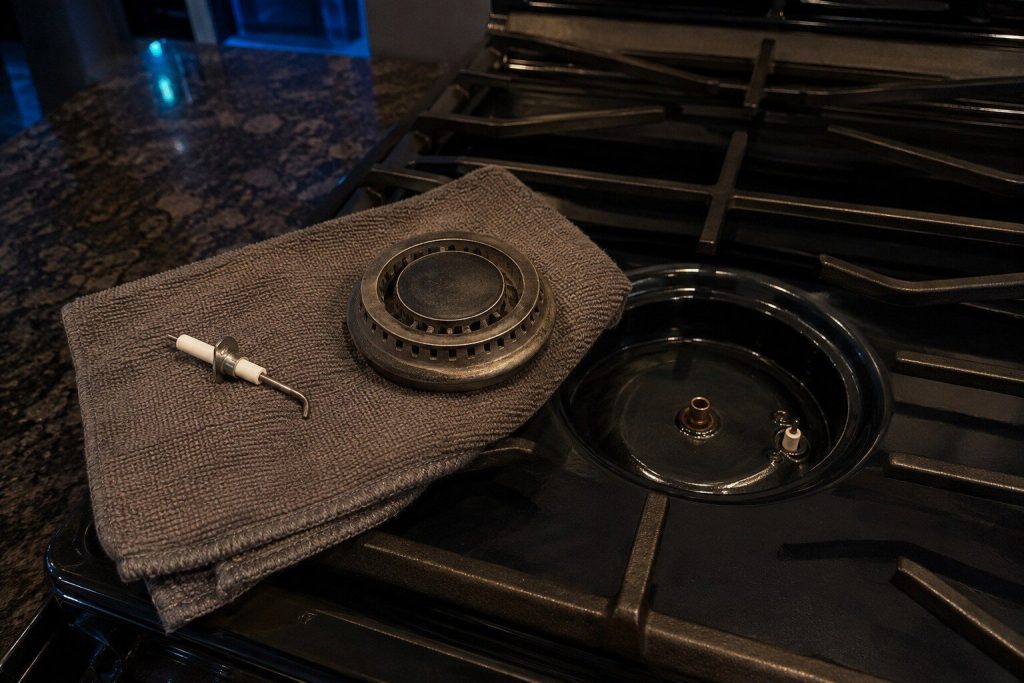
  • A burner head and cap apart on the hob with the igniter electrode exposed beside them
    from $145

    Range burner ignition repair

    Clicking without lighting, lighting on the second attempt, or one burner that has given up while the others are perfect. On a sealed burner the causes sit in a short list and one of them is free: a cap set down rotated or on a crumb will spark all day and never light. After that it is a wet or cracked electrode, a port blocked by a boil-over, or the switch behind the dial. Clicking that continues after the burner has lit is a different problem from clicking that never lights, and telling us which one you have saves a step.

    • Lift and re-seat the cap first: it costs nothing and settles a good share of these
    • Clicking after lighting is a switch; clicking without lighting is the path
    • Started after a clean or a boil-over? That is usually the whole diagnosis
    What this involves
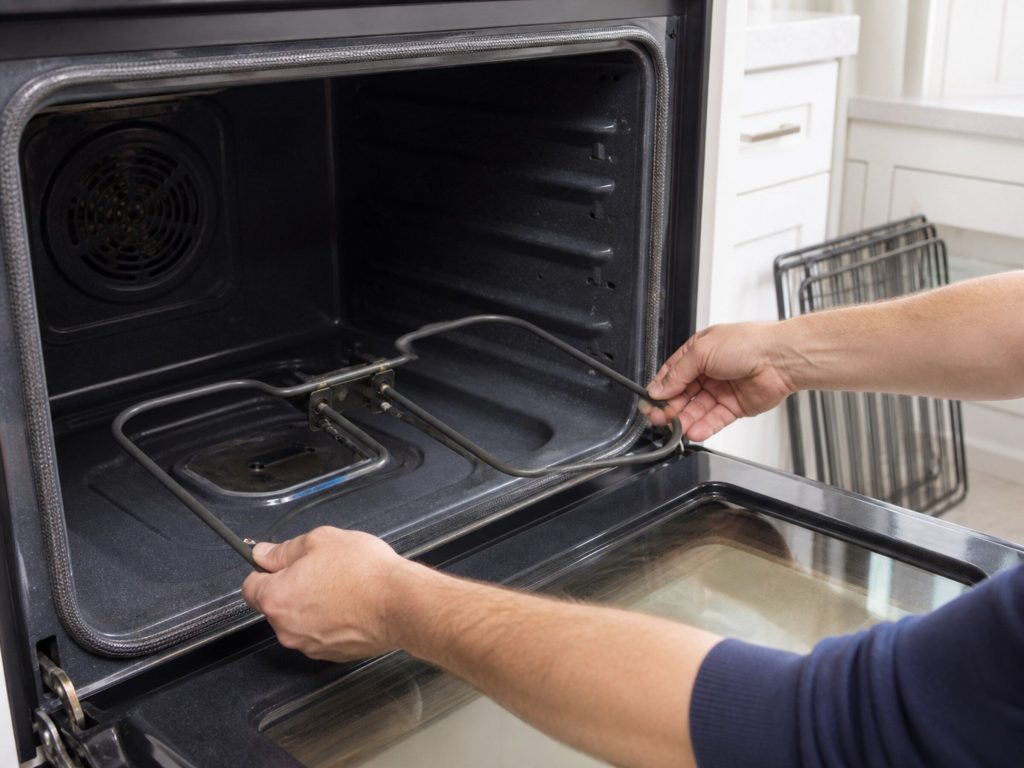
  • Two hands drawing a bake element out of the floor of an oven cavity, the door open, racks removed and leaning nearby, bright kitchen.
    from $185

    Range oven not heating

    The oven under a commercial-style range, which is heavier, deeper and better insulated than the average, and therefore hides a developing failure for longer. Not heating at all and not heating properly are different calls: nothing at all usually points at an element, an ignitor, a safety valve or a thermal fuse; not properly points at the sensor, the door or the fan. Whether the range is dual fuel or all gas decides which list applies, and it is the detail owners most often do not know — we will work it out, but knowing it on the phone means the right part is on the van.

    • Dual fuel and all gas fail in different places — we establish which first
    • Nothing at all and not quite right are two different diagnoses
    • A code with its sub-error narrows this before we arrive
    What this involves
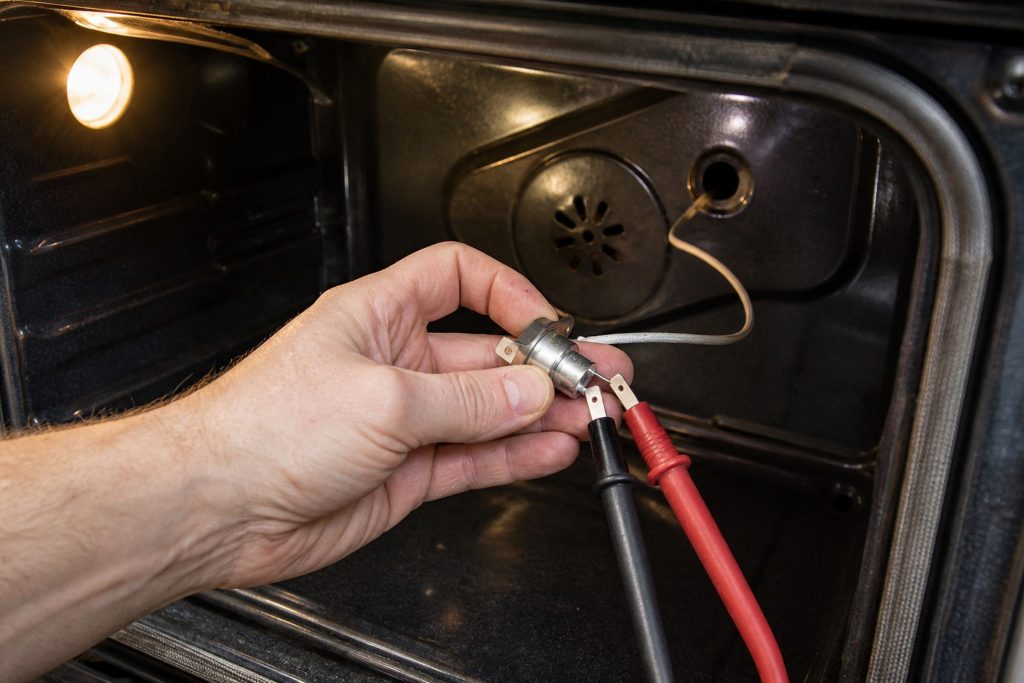
  • The oven temperature sensor unscrewed from the rear wall of an empty oven cavity and pulled forward into the cavity on its lead, held steady by one hand while two meter probes rest on its terminals.
    from $135

    Oven temperature calibration

    For the oven that works but lies. A cavity that runs twenty degrees hot bakes acceptably until it does not, and on a heavy range the mass hides the drift until something that used to be reliable comes out wrong. Calibration is measurement first: we log what the cavity actually does across a cycle at temperature rather than taking one reading at the peak, because the shape of the curve separates a drifted sensor from a door problem from a control that is cycling badly. Then we correct it, and re-measure rather than trusting the adjustment.

    • Measured across a cycle, not once at the top
    • The shape of the curve separates sensor drift from a leaking door
    • Re-measured after adjustment, because an adjustment is not a result
    What this involves
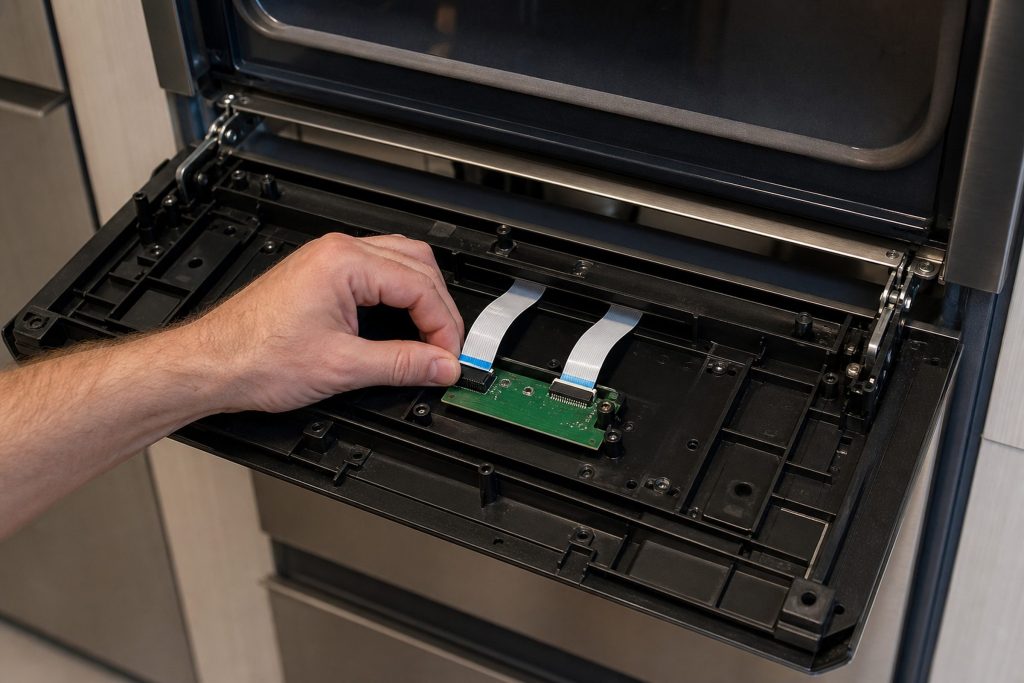
  • The control panel of a wall oven swung down and forward on its hinge at the top of the appliance, the back of it toward the camera with two ribbon connectors and a small board visible, a hand releasing one connector.
    from $155

    Range door and hinge service

    A heavy door that has stopped closing square costs heat, costs even baking, and eventually costs the seal and the hinges themselves. On this class of range the door is genuinely heavy, which is why it is worth doing properly rather than adjusting by eye: springs and hinges under tension are the part of an oven most likely to hurt somebody who is improvising. The symptoms people describe — a cool corner, a door that stands a few millimeters proud, a hinge that thuds on the last inch — are all one conversation.

    • A cool corner is usually the door, not the element
    • Hinges under tension are not an improvise-with-a-screwdriver job
    • Seal and hinges are checked together, because they fail together
    What this involves
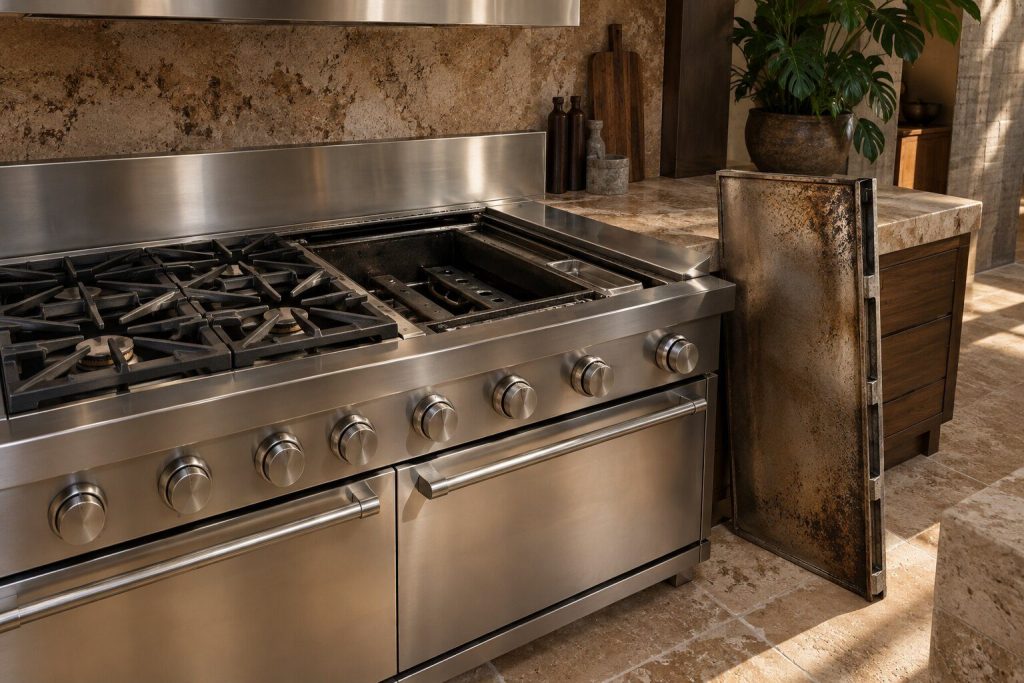
  • A steel griddle plate lifted off the top of a professional range and standing on edge against the counter beside it, the empty burner bay and its grease trough exposed.
    from $165

    Griddle and grill section service

    The part of the range top that is not burners. A griddle or an indoor grill section is asked to hold an even temperature across a plate rather than to put heat into a pot, and it fails in ways burners do not: a plate that has warped so that fat pools at one end, a thermostat that no longer reads the plate it is bolted to, a grease path under the section that has filled because nobody knew it was there. Owners usually describe this as 'it does not cook evenly any more', which is accurate and covers three different causes.

    • Uneven cooking on a plate is warp, sensor or grease — and they feel identical
    • The drain path under the section is the part nobody is told about
    • A warped plate is sometimes worth living with and we will say when
    What this involves
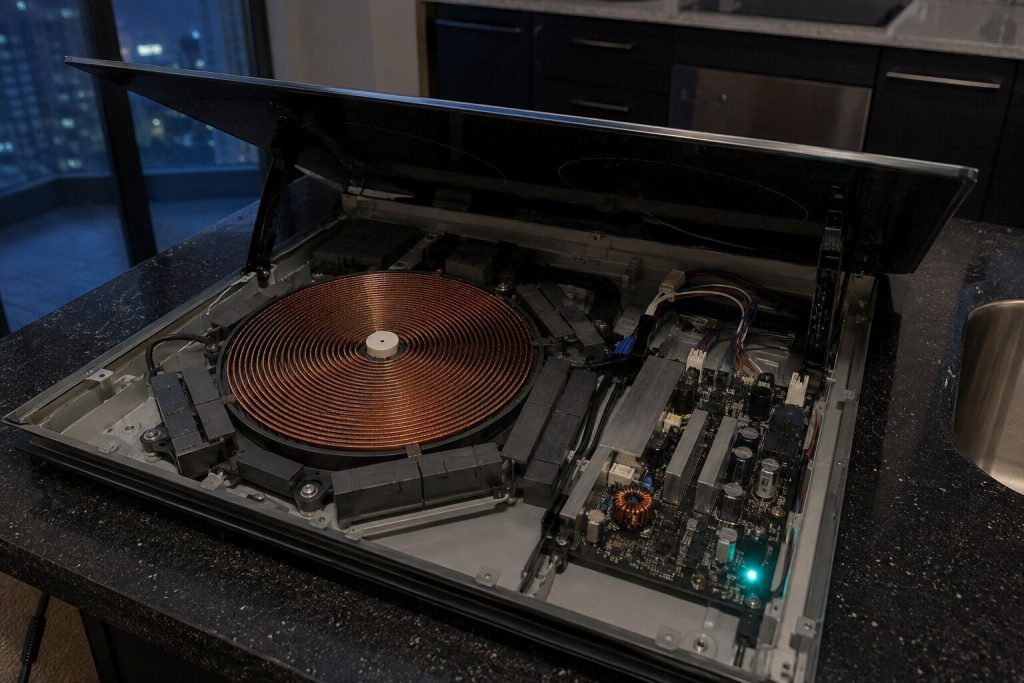
  • The flat spiral of an induction coil under the lifted glass top of a cooktop, its ferrite bars and the board beside it, the glass propped clear.
    from $195

    Induction cooktop repair

    A power-electronics machine wearing a glass lid, and the only part of this brand that announces its problems in a short, published, decoded list. That list is worth knowing because one entry on it is not about the cooktop at all: a voltage complaint means the machine is reporting the supply it is being given. In older buildings, and particularly where a kitchen was rewired around a new island, that appears for a real reason and the right next call may be an electrician's rather than ours. The rest of the list separates a key stuck under a spill from a short in the key evaluation from a communication error inside the machine from a temperature condition.

    • One published code is about the building's supply, not the cooktop
    • Continual key activation is often a cloth or a boil-over and costs nothing
    • Take the code down before it clears — it is the difference between two visits
    What this involves
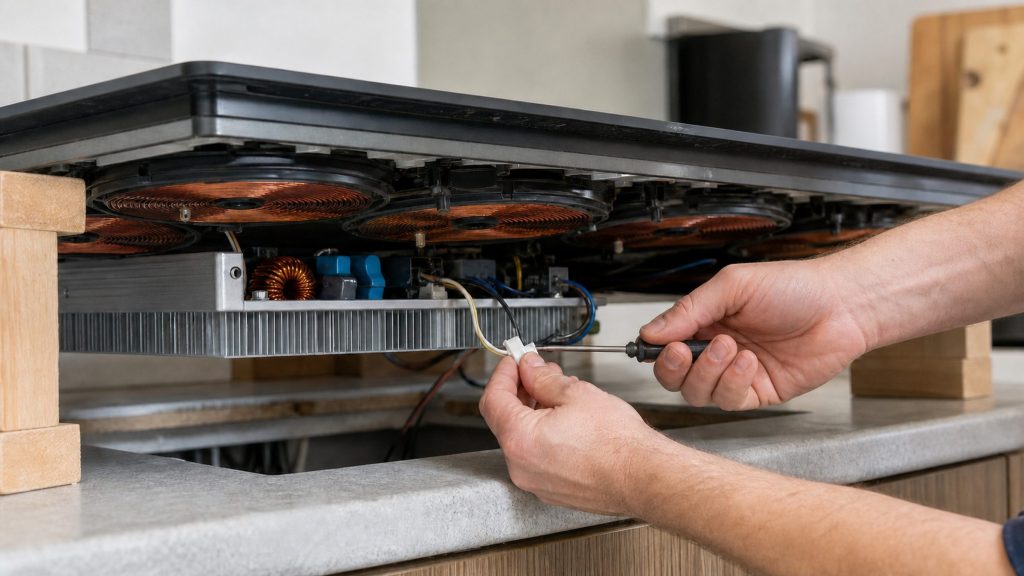
  • The cooktop lifted on timber blocks clear of the cut-out, four copper induction coils, the heatsink and power board, a connector being released with a screwdriver.
    from $215

    Induction zone and coil repair

    One zone dead while the others work perfectly. That is the useful version of an induction problem, because it takes the supply and the main board mostly out of the picture and puts the zone's own coil, its power stage and its cooling in front of us. Before any of that is opened there is a free check worth doing: a pan whose base is not magnetic, or has warped so it no longer sits flat, will fail on any zone and fail most obviously on the smallest. If every pan fails on one zone and all of them work on the others, that is the zone, and that is this page.

    • One zone dead, the rest fine — the problem is in that zone's own chain
    • Test with a pan you know works before an appointment is booked
    • Cooling failures present as zone failures and are cheaper to fix
    What this involves
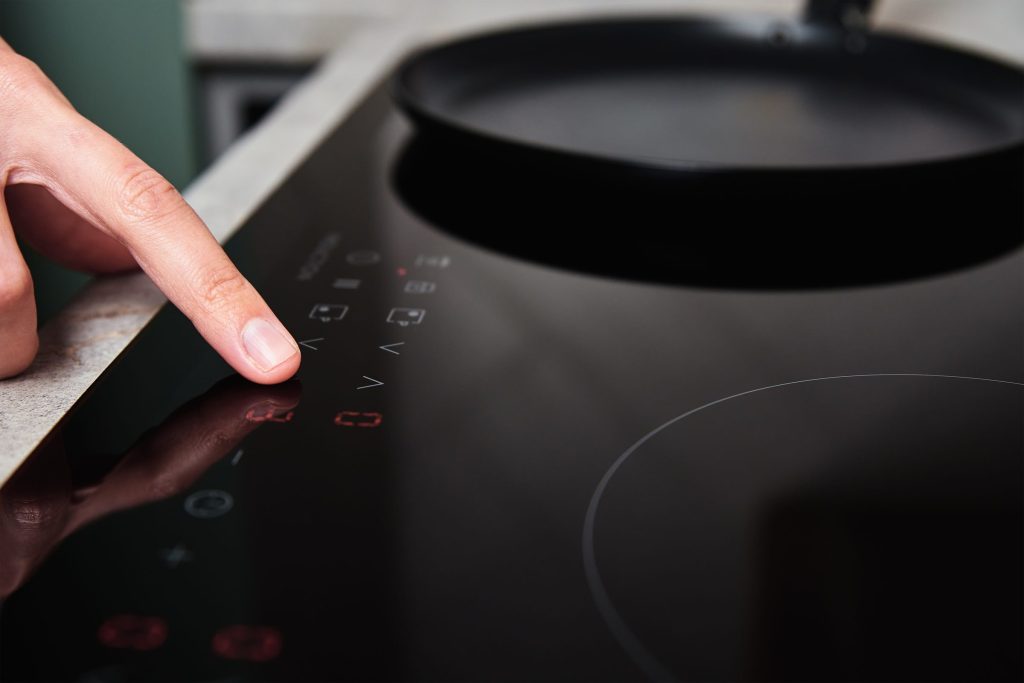
  • A finger resting on the touch control strip of a dark induction cooktop
    from $175

    Cooktop touch control repair

    For the top that lights up and will not listen, or listens when nobody has touched it. On a glass top the control surface is also the cooking surface, and everything that gets spilled, wiped or rested on it is part of the story: the published code list includes continual key activation precisely because a cloth left over the controls is a routine cause. Where it is not that, it is usually moisture that has got under the glass at an edge, a connection to the control board, or the board itself. The order matters, because the last of those is the expensive one and the first two are not.

    • A cloth over the controls is a published code, not a joke
    • Moisture under the glass edge imitates a failed panel exactly
    • The board is the last suspect, not the first
    What this involves
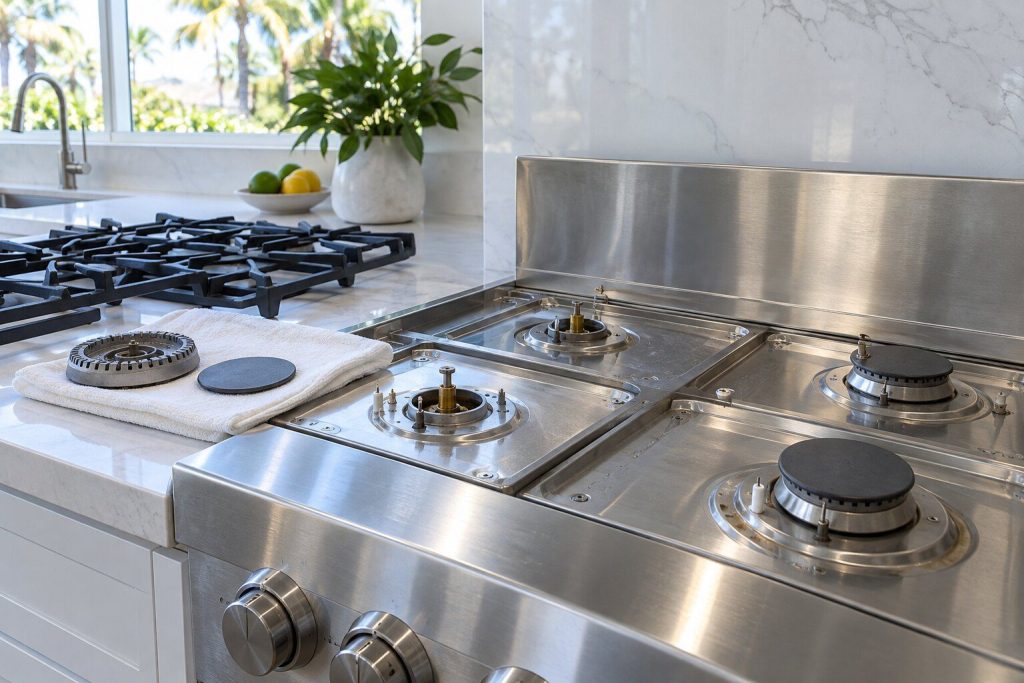
  • A stainless gas rangetop with a raised back panel, its cast grates lifted off and set aside, one burner head and cap apart on a folded cloth
    from $135

    Gas cooktop burner service

    For flames that are uneven, lazy, or wrong on one burner out of five. On a drop-in gas top the diagnosis is the same as on the range top and the access is easier, which makes this one of the few genuinely quick visits on this site. Uneven around a single ring is nearly always the cap or the ports; uneven on every burner at once is the supply or the regulator and belongs to a different page. Burners that have been through a dishwasher — which is common and rarely helpful — get their own look, because a cap that has been stripped of its coating never behaves the same again.

    • One ring wrong is the burner; every ring wrong is the supply
    • Caps through a dishwasher are a recognisable and permanent change
    • The quickest visit on this site when it is what it looks like
    What this involves
  • A bake element unbolted in an oven cavity.
    from $185

    Wall oven not heating

    A built-in cavity that has stopped making heat, or has stopped making the heat it claims. The list of causes is ordinary — element, sensor, thermal fuse, board, door — and the access is not, because everything is at chest height in somebody's joinery. This make publishes a decoded error table for these ovens and the sub-error after the letter separates several quite different visits, including one that means the control does not recognize which model it is fitted to. Reading the whole string to us on the phone regularly saves an entire diagnostic visit.

    • Read the whole code — the digits after the letter are the message
    • A thermal fuse that has opened after a self-clean is a common and cheap finding
    • The cabinet decides whether this is an hour or an afternoon
    What this involves
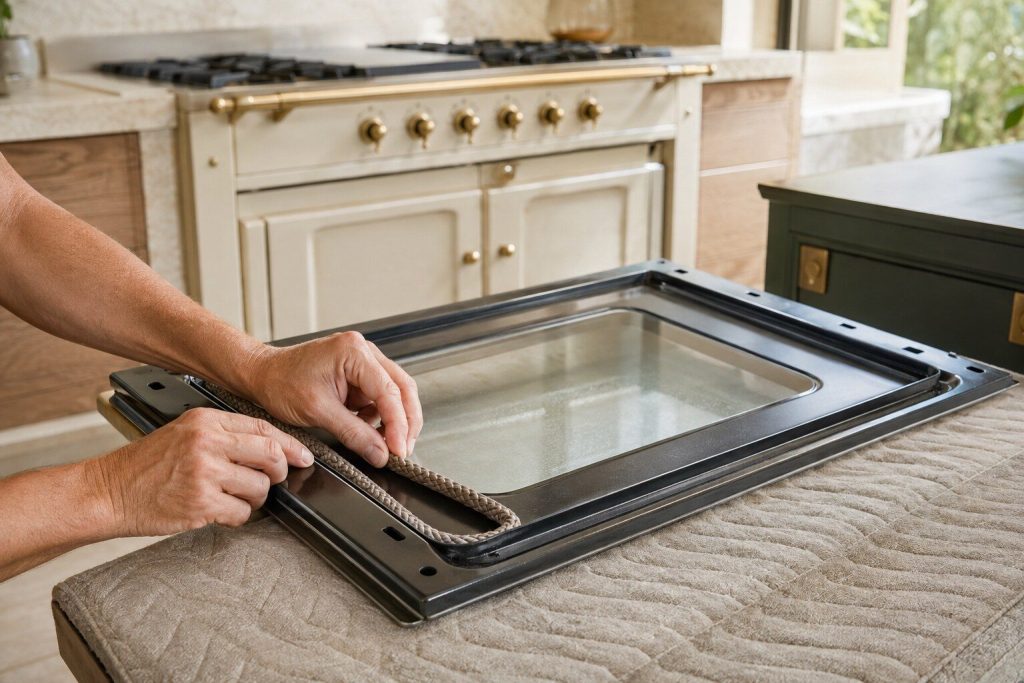
  • Two hands pressing a new braided rope gasket into the channel around the frame of an oven door that has been laid flat on a padded bench, half the run new and half still empty.
    from $145

    Wall oven door seal replacement

    A seal that has hardened, shrunk or come away at a corner costs more than heat — it changes how the whole cavity behaves and it hides behind other symptoms. Owners describe uneven baking, a long preheat, a cool corner, or a kitchen that gets warm when the oven is on, and any of those can be a seal. It is also the classic casualty of the self-clean cycle: the hottest hours the seal will ever see, taken once a year, and it is the year after one of them that it fails. We check the hinges at the same time, because a door that no longer pulls square will destroy a new seal as quickly as it did the last one.

    • Long preheats and a warm kitchen are seal symptoms people rarely connect
    • Self-clean is the cycle that finishes a tired seal
    • Fitted without checking the hinges, a new seal fails the same way
    What this involves
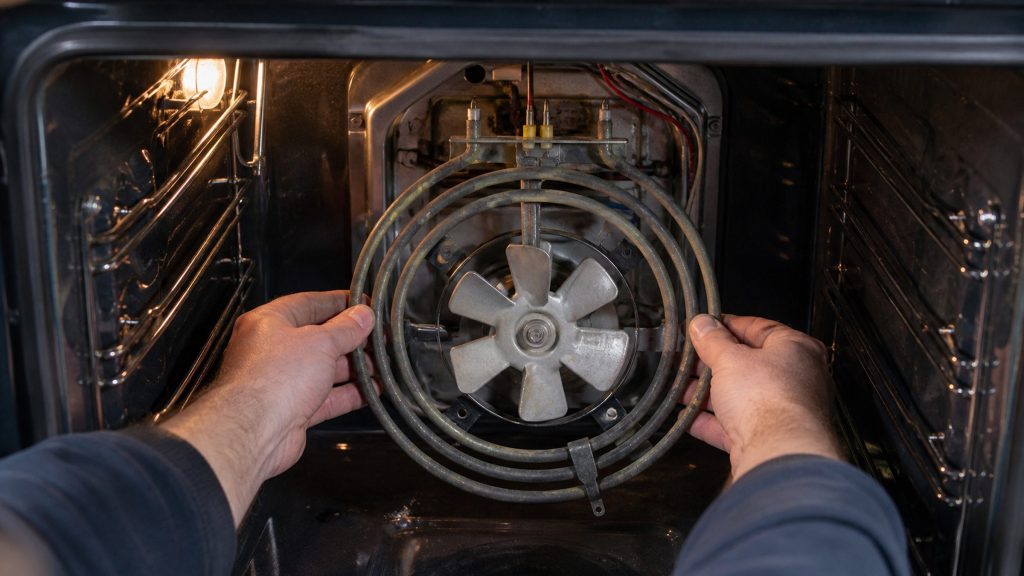
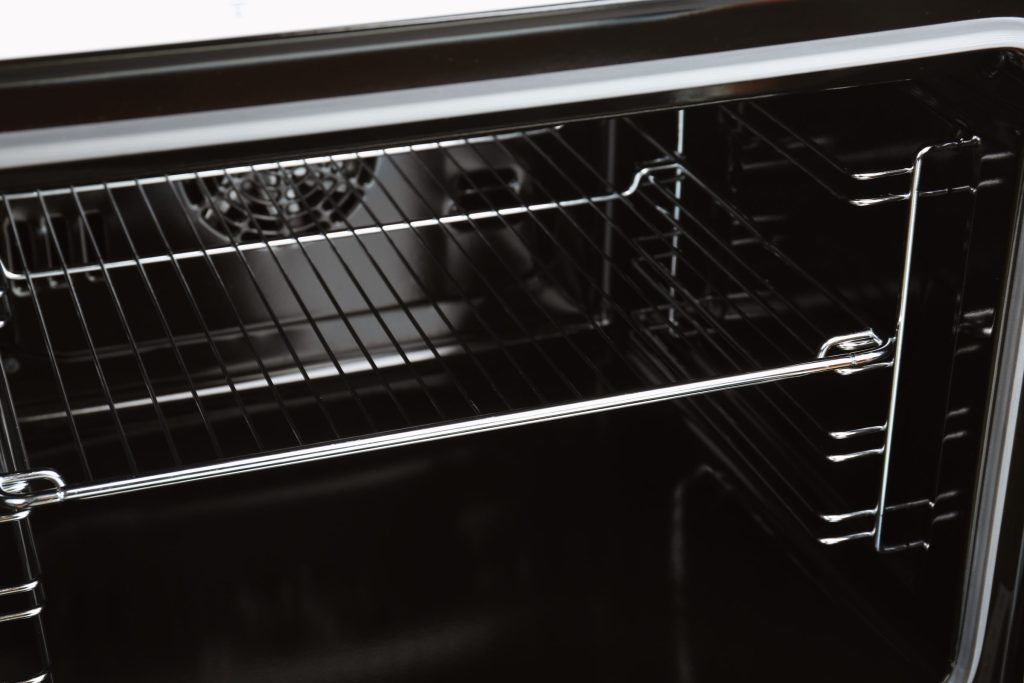
  • The inside of a cold oven with the circular convection fan cover on the rear wall behind empty racks
    from $165

    Convection fan repair

    The sound arrives long before the symptom. A convection fan that has grown loud is generally a bearing going, or a blade catching its housing, and the window between noise and damage is the cheap part of this repair — an unbalanced wheel machines away the housing it spins in, and housings cost several times what motors do. The performance half of this is subtler: a fan that has stopped moving air properly turns a convection oven into an ordinary one, and the owner usually adapts to it over months without ever describing it as a problem. If your convection results changed and nothing else did, this is the page.

    • The noise is a warning with months of notice in it
    • A fan can fail into 'ordinary oven' without ever announcing itself
    • An unbalanced fan damages the housing, which is the expensive part
    What this involves
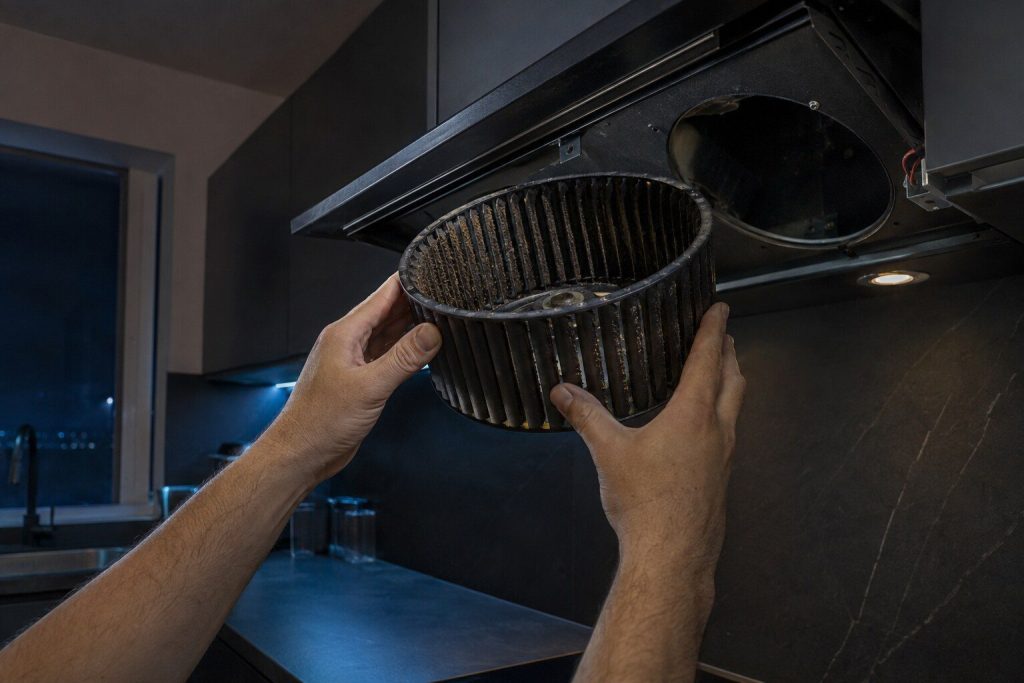
  • A squirrel-cage blower wheel drawn out of the top of a wall-mounted hood canopy and held in both hands, greasy at the vanes, the empty housing above.
    from $175

    Range hood blower repair

    For a hood that has become loud, slow or silent. Gradual noise is bearings or an impeller loaded unevenly with grease; sudden noise is something loose, something in the impeller, or a mount that has let go. Silence with the lights still working is usually the blower's own circuit rather than the supply. Outdoors, add corrosion to every one of those: a mount that has rusted changes the sound long before it changes anything else, and a blower over a grill has a much harder life than one over a hob.

    • Gradual noise and sudden noise are different problems entirely
    • Lights alive with no fan points at the circuit, not the supply
    • Outdoor hoods fail at the mounts, and the sound tells you first
    What this involves
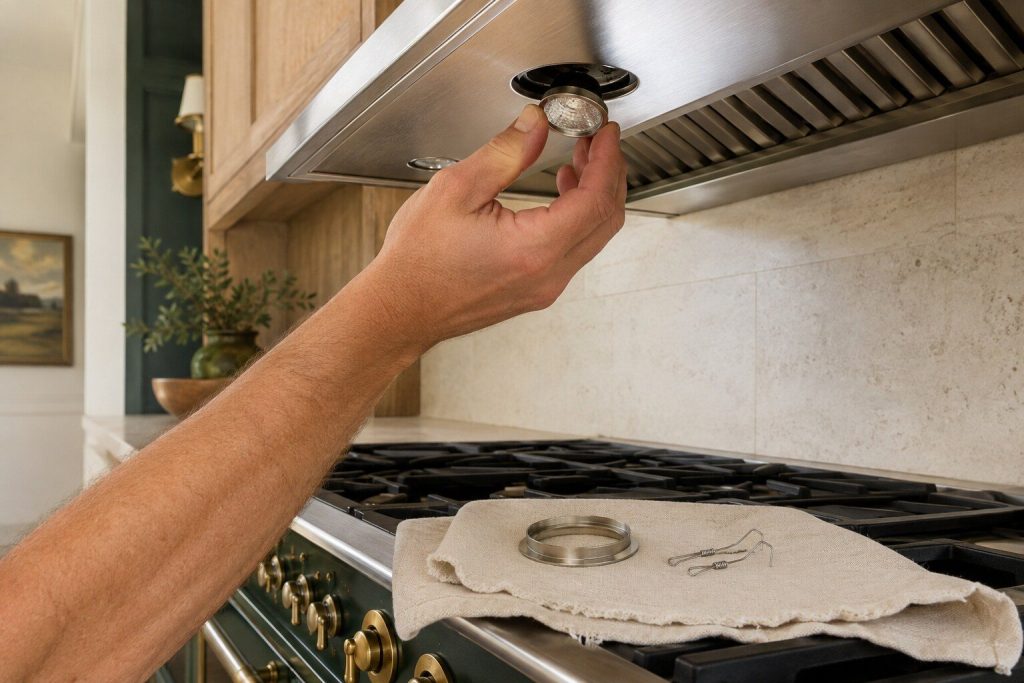
  • A hand fitting a small lamp into a recess in the stainless underside of a hood canopy, the lens ring and its retaining spring lying on a cloth on the range top below.
    from $125

    Hood light and switch repair

    Dead lamps, a speed control stuck on one setting, buttons that work when they feel like it. Indoors these are usually the switch, the control or a lamp holder cooked by years of heat directly above a high-output range. Outdoors they are usually water. The split is diagnostic: lights dead with the blower alive, or the reverse, points at a control or that circuit; everything dead points at the supply or the board. It is a cheap repair to make and an easy one to keep living with, which is why it is often years old by the time somebody calls.

    • One half dead and the other alive is the most useful symptom here
    • Heat cooks lamp holders above a high-output range — it is not the bulb
    • On an outdoor hood, start at water rather than at electronics
    What this involves
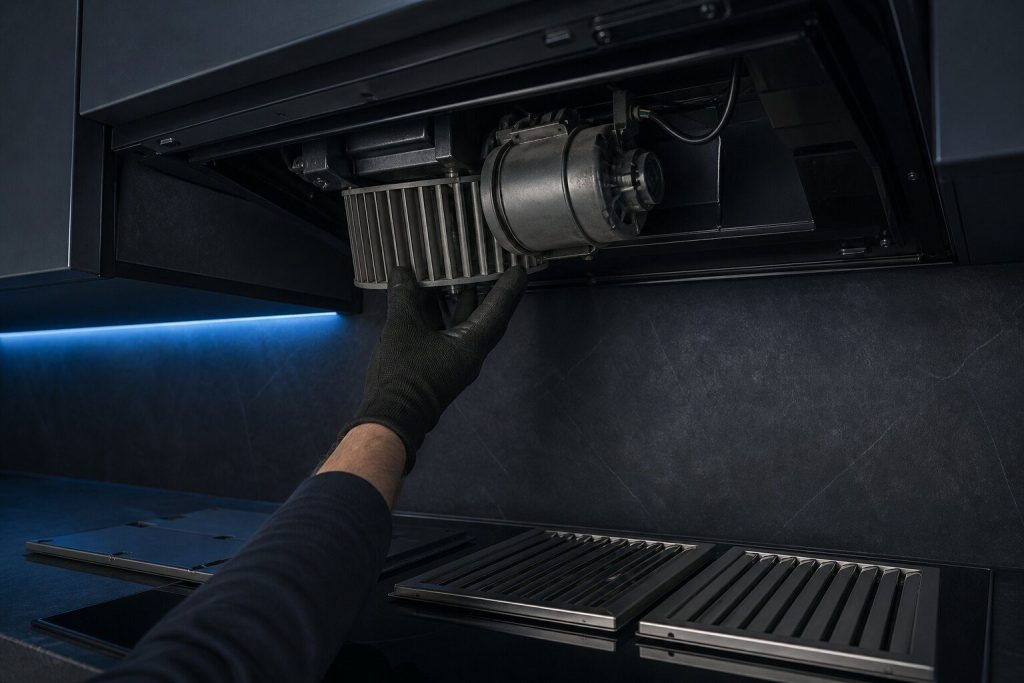
  • The underside of a wall-mounted hood with its cover and baffle filters taken out and laid on the cooktop below, the blower housing and its motor exposed inside the canopy, a gloved hand supporting the wheel.
    from $155

    Filter and duct service

    The maintenance nobody was told about, and the answer to a large share of 'the hood does not clear the kitchen' calls. Baffle filters above high-output burners or a griddle load quickly, and a loaded filter is both an airflow problem and fuel sitting over flame. Beyond the filters, the duct itself is worth looking at in this climate: a wall cap with a nest behind it, a damper that has stopped opening, or flexible ducting that has been crushed above a ceiling will defeat any blower. We check the whole route rather than the part that is easy to reach.

    • Loaded filters over a griddle are a fire question, not a housekeeping one
    • A wall cap with a nest in it is a routine finding here, not an exotic one
    • Any blower loses to a crushed or blocked duct
    What this involves
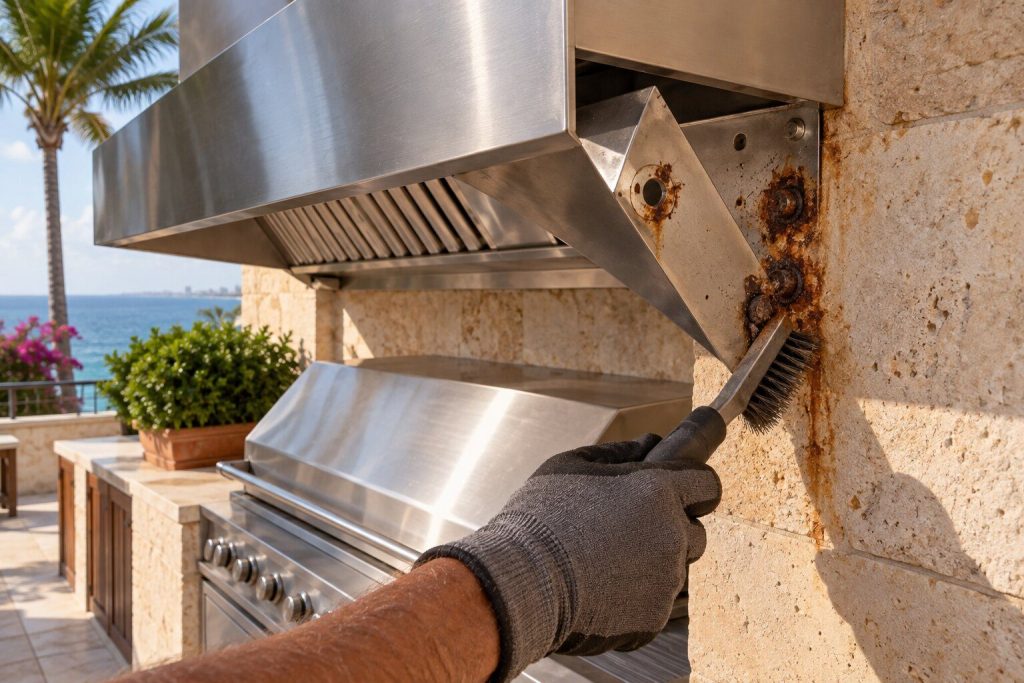
  • The mounts of a stainless outdoor vent hood over a terrace grill, one bracket lifted clear to show rust bleeding out of the fixings, a wire brush in a gloved hand.
    from $185

    Outdoor hood corrosion service

    A hood over an outdoor grill is a structure as much as an appliance, and in this market the structure is what fails. Mounts, fixings, the underside of the canopy and the housing that carries the electrics all corrode on a schedule set by how close the kitchen is to the water. The work is honest and unglamorous: get to sound material, treat what can be treated, replace what cannot, and route the electrics so water leaves instead of collecting. Done at the right time it adds years. Left too long it becomes a canopy that is not safely holding its own weight, and we will tell you when that line has been crossed.

    • It is a structure first — the fixings matter more than the fan
    • Proximity to the water is the real service interval on this item
    • There is a point where replacement is the honest answer, and we say so
    What this involves
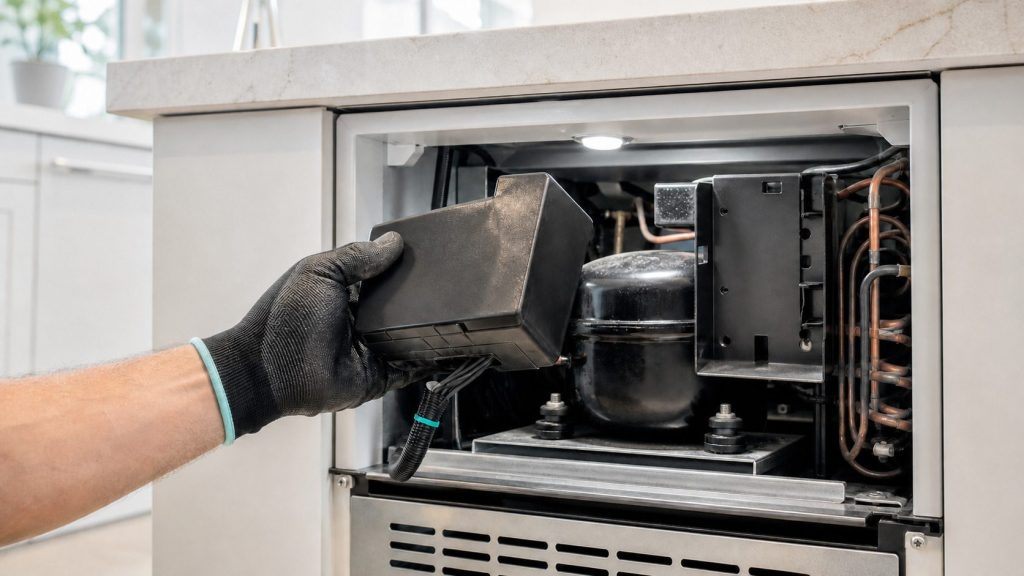
  • A small black inverter box unclipped from its bracket beside a compressor in the machine compartment of an undercounter cabinet, held in a gloved hand on its loom, the condenser tubing behind it, service light across the scene.
    from $185

    Beverage center not cooling

    An outdoor undercounter cabinet that will not reach or hold its temperature, most often reported in the hottest weeks of the year. The first question is not about the machine: an undercounter unit in a closed stone island, next to a grill, is being asked to reject heat into air that is already hot, and where the ventilation path was built tight or has been blocked, no part will fix it. Where the ventilation is genuinely adequate, the ordinary refrigeration list applies — door seal, evaporator or condenser fan, a condenser packed with salt and dust, then the sealed system. In that order, because that is the order of both likelihood and cost.

    • Ventilation first — in a sealed island no part will fix this
    • A condenser in an island loads with salt far faster than any indoor cabinet
    • Running constantly in August is not automatically a defect
    What this involves
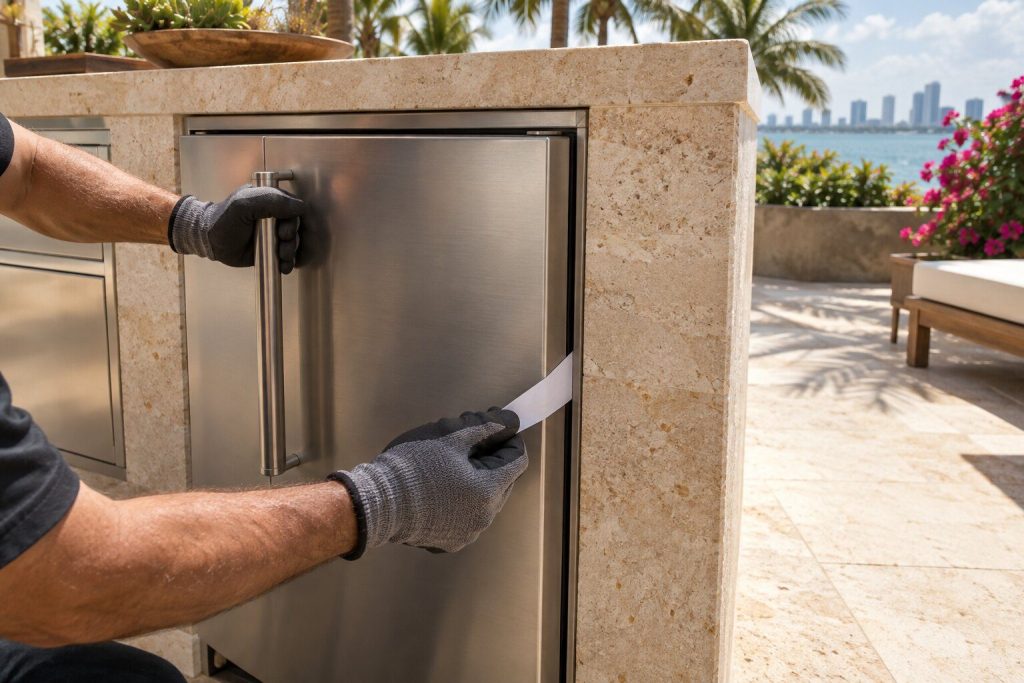
  • A strip of paper being pulled from between the closed door and the frame of an outdoor beverage center, a gloved hand on the handle, the island stone bright around it.
    from $145

    Beverage center door and seal service

    A door that no longer seals on an outdoor cabinet does something an indoor one never has to deal with: it lets humid Florida air onto cold surfaces, and the result is water in quantities that surprise people. The seal can look perfect and still have lost its set — the test is whether it grips, not whether it is intact. Hinges matter as much as the gasket, because a door that has dropped even slightly will hold at the top and stand open at the bottom, and on an undercounter unit that is exactly where nobody looks.

    • A gasket that looks new can still have lost its grip
    • Humid air on cold surfaces is where the water is coming from
    • Undercounter doors fail at the bottom, where nobody looks
    What this involves
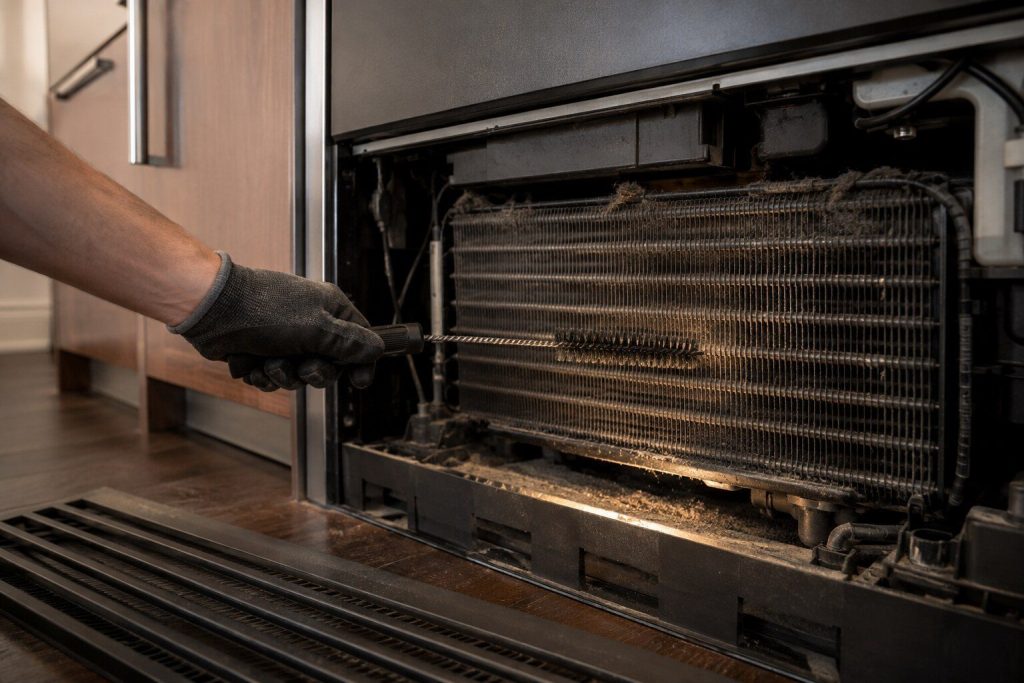
  • A gloved hand drawing a long narrow brush across a dusty condenser coil in the machinery compartment of a built-in refrigerator, the grille panel set aside, warm torchlight and visible dust.
    from $135

    Outdoor refrigeration condenser service

    The highest-yield maintenance on the one cold machine this brand builds. A condenser rejects heat by moving air across a coil, and in an outdoor island that air carries salt, dust, pollen and whatever the landscaping is doing. The coil loads, the temperature the cabinet can reach rises, the compressor runs longer, and the owner hears about it as 'it never turns off any more'. Cleaning it is inexpensive, takes an hour, and buys back performance that people assume is gone for good. On the coast this is a yearly job, not a five-yearly one.

    • 'It never turns off' is the symptom this service answers
    • Yearly on the coast, and the coil shows why
    • An hour of work that returns performance people had written off
    What this involves
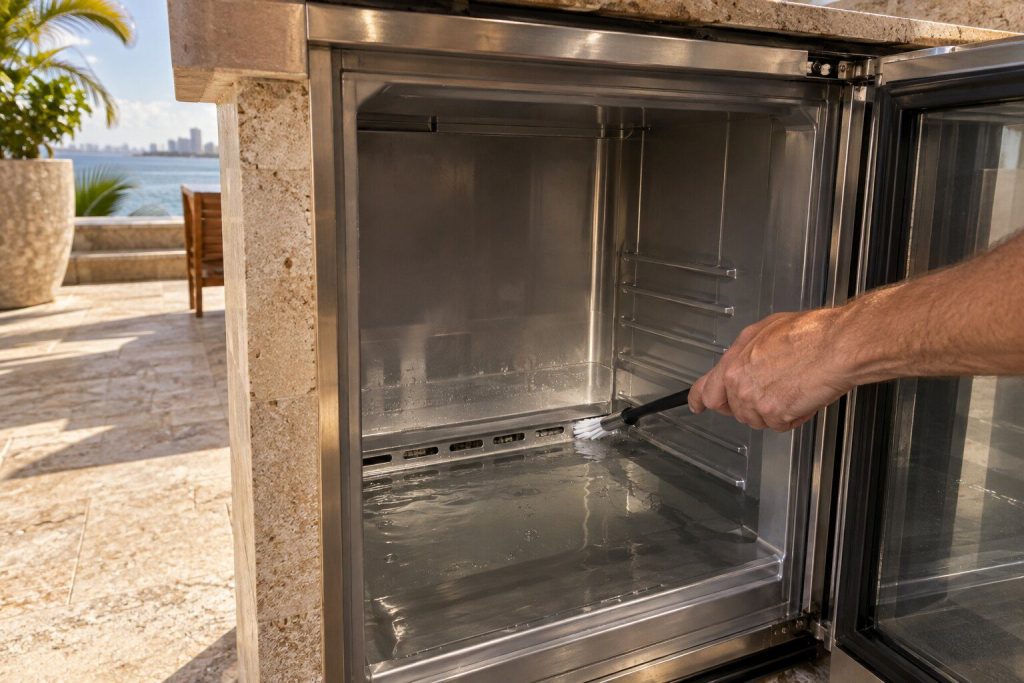
  • The drain channel at the back of the liner inside an emptied outdoor beverage center being cleared with a small brush, a shallow pool of water standing in the base.
    from $125

    Drain and condensation service

    Water inside a cold cabinet, or under it, and neither is usually a leak in the refrigeration. Every cold machine makes water and has a planned route for it; when the route blocks, the water finds its own, and outdoors there is a second source that indoor cabinets never have — humid air arriving past a tired seal and condensing on everything cold. The two causes look identical on the floor and are completely different to fix. We deal with the drain and the seal together, because fixing one and leaving the other means somebody sees the same puddle next month.

    • Water inside is almost never a refrigerant leak
    • Outdoors, a tired seal makes water the drain then has to deal with
    • Drain and seal are one job — treating either alone brings it back
    What this involves
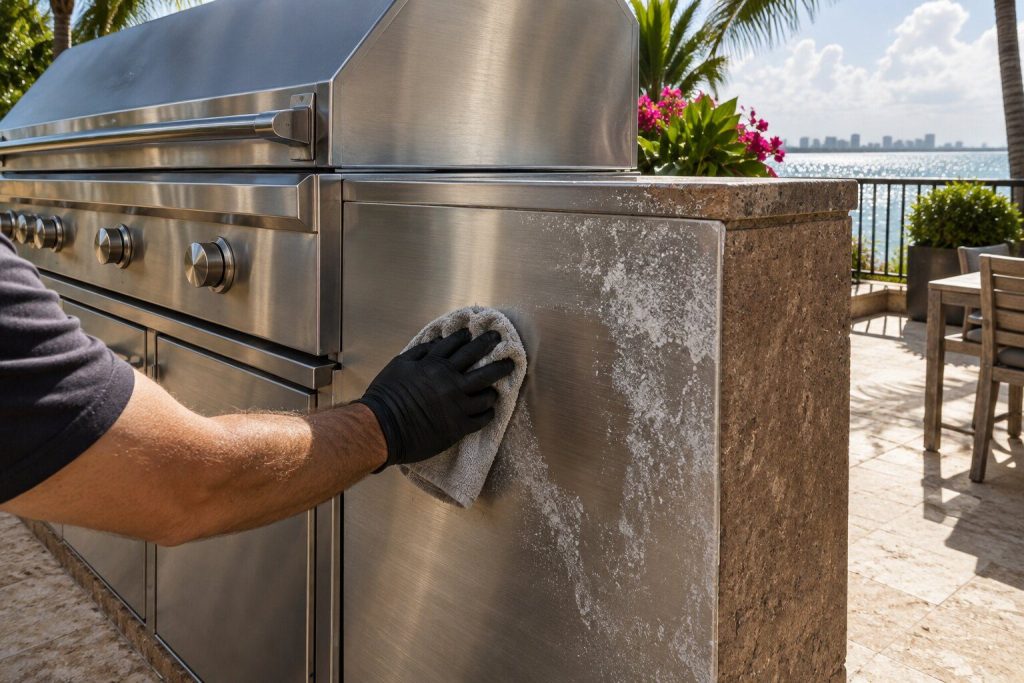
  • A gloved hand wiping white salt bloom off the stainless flank of a built-in grill on a waterfront terrace, the sea haze bright beyond the railing.
    from $195

    Salt air protection service

    A visit that exists because of where this equipment lives. Four of the seven machines on this site stand outdoors in air that carries salt, and the difference between a kitchen four blocks from the water and one four miles inland is measured in years of service life. This is the planned, unglamorous work that changes that number: stainless cleaned and protected in the right direction, fixings inspected and replaced with the right grade before they seize, ignition components and electrical housings treated and re-sealed, hardware caught while it is stiff rather than after it is stuck. It is not a cosmetic service, although the kitchen does look better afterwards.

    • Distance from the water is the real service interval on this coast
    • Fixings replaced with the right grade before they seize, not after
    • Not a polish — the point is the fixings, the housings and the hardware
    What this involves

Jobs that exist on no other site we run

Grease management, gas supply and salt

Three of the jobs on this list have no equivalent anywhere else on our work. Grease management is sold elsewhere as cleaning and is really fire safety: the radiants, the tray and the channel are a system for keeping rendered fat off open burners, and when it stops working the grill sets about the food.

Gas supply and regulator work exists because the run feeding an outdoor island was made, tested and then sealed inside masonry, and it has been ageing in salt air ever since where nobody can see it. And the salt air protection visit exists because four of these machines stand outside, where distance from the water is a better predictor of service life than the age on the plate.
See what a repair costs
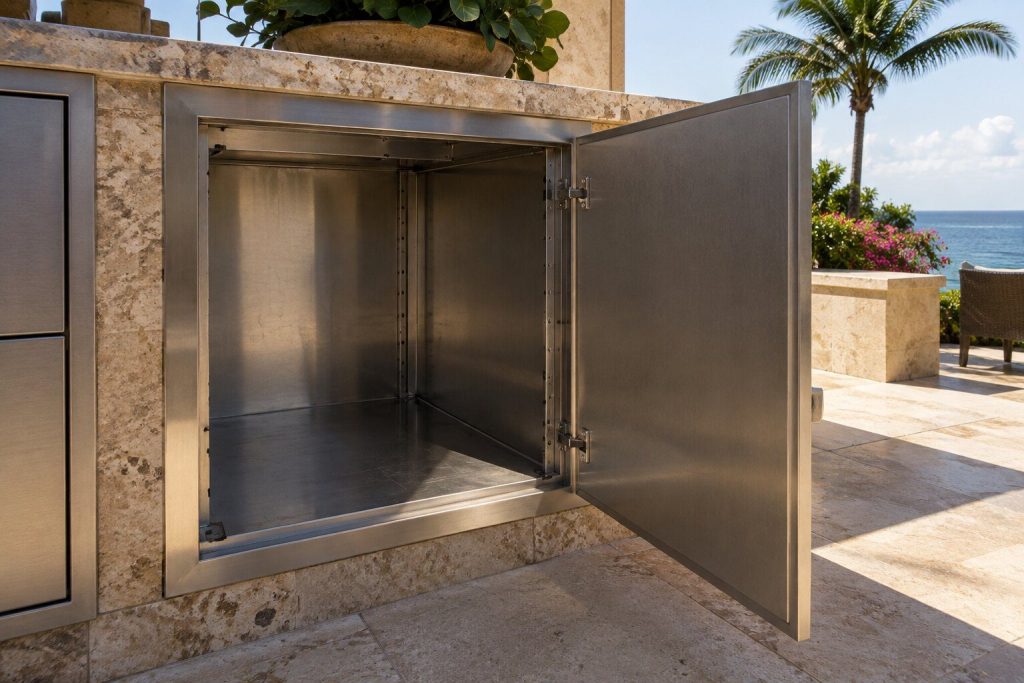
The underside of an outdoor island counter with a cabinet door swung open on an empty stainless carcass.

Indoors is a different trade

Commercial-style cooking that can describe itself

The range, the cooktops and the wall ovens are the other half of this badge and they behave nothing like the terrace. They are heavy, they are built into joinery, and — unlike anything outdoors — they publish decoded error tables. A code with its two digits read out in full will frequently tell us which board or which link failed before anybody is dispatched.

So the first question on any call here is simply which of the two halves we are talking about. It changes the method entirely.

See what a repair costs
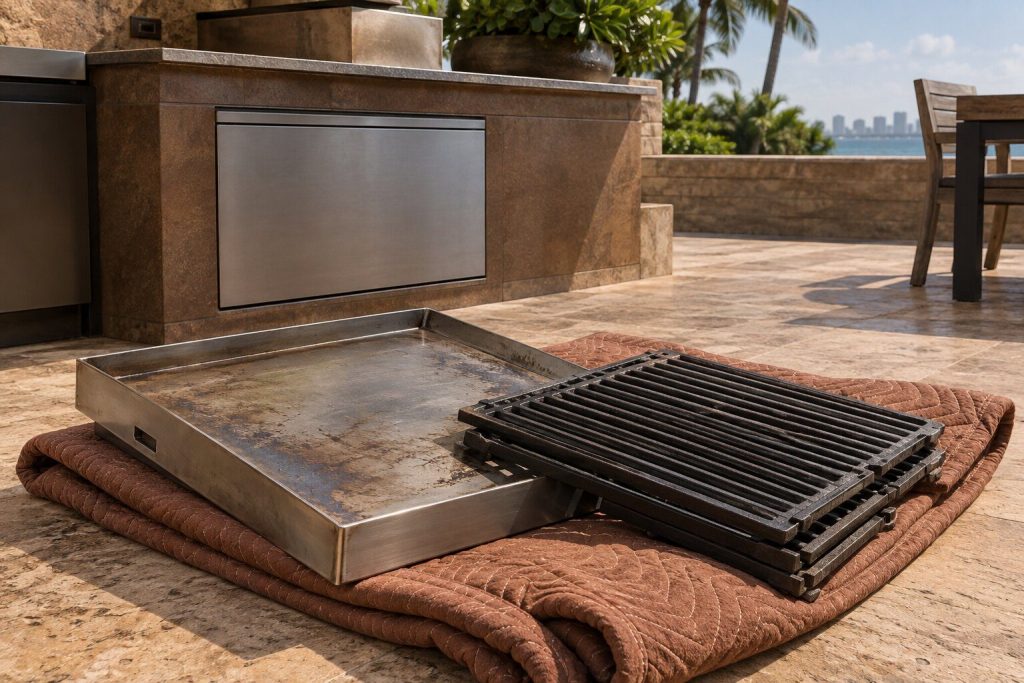
A stainless griddle plate and a set of cast grates stacked on a folded moving blanket on a terrace floor.

Before you book

Four things that shorten the visit

What we ask for

  • Whether the machine is indoors or outdoors, and what it is built into
  • Natural gas or LP, if you know — and we will check rather than assume
  • The full code if there is a display, digits included
  • A photograph of the island or the run, on anything built in

What happens next

  • We say what we think it is and what the visit will cost before you commit
  • You get a time slot we can keep, not the earliest one that sounds good
  • The diagnosis happens on site, and the scope and price go to you in writing before anything is opened
  • If the honest answer is that the repair is not worth it, we say so

Or start from the machine

By appliance instead

If you would rather begin from what it is than from what needs doing.

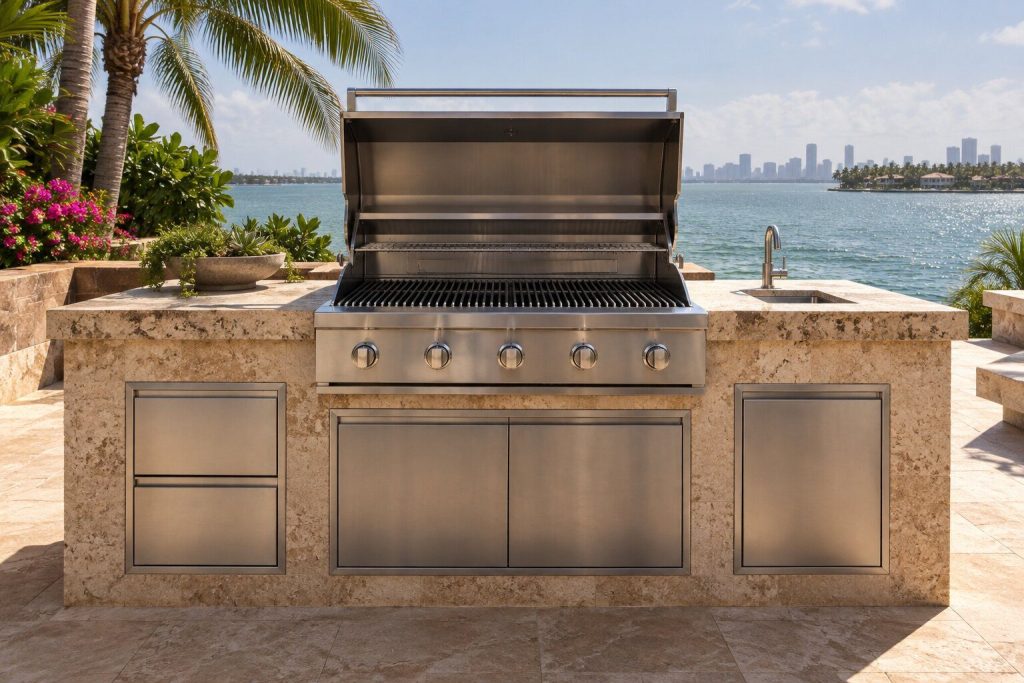
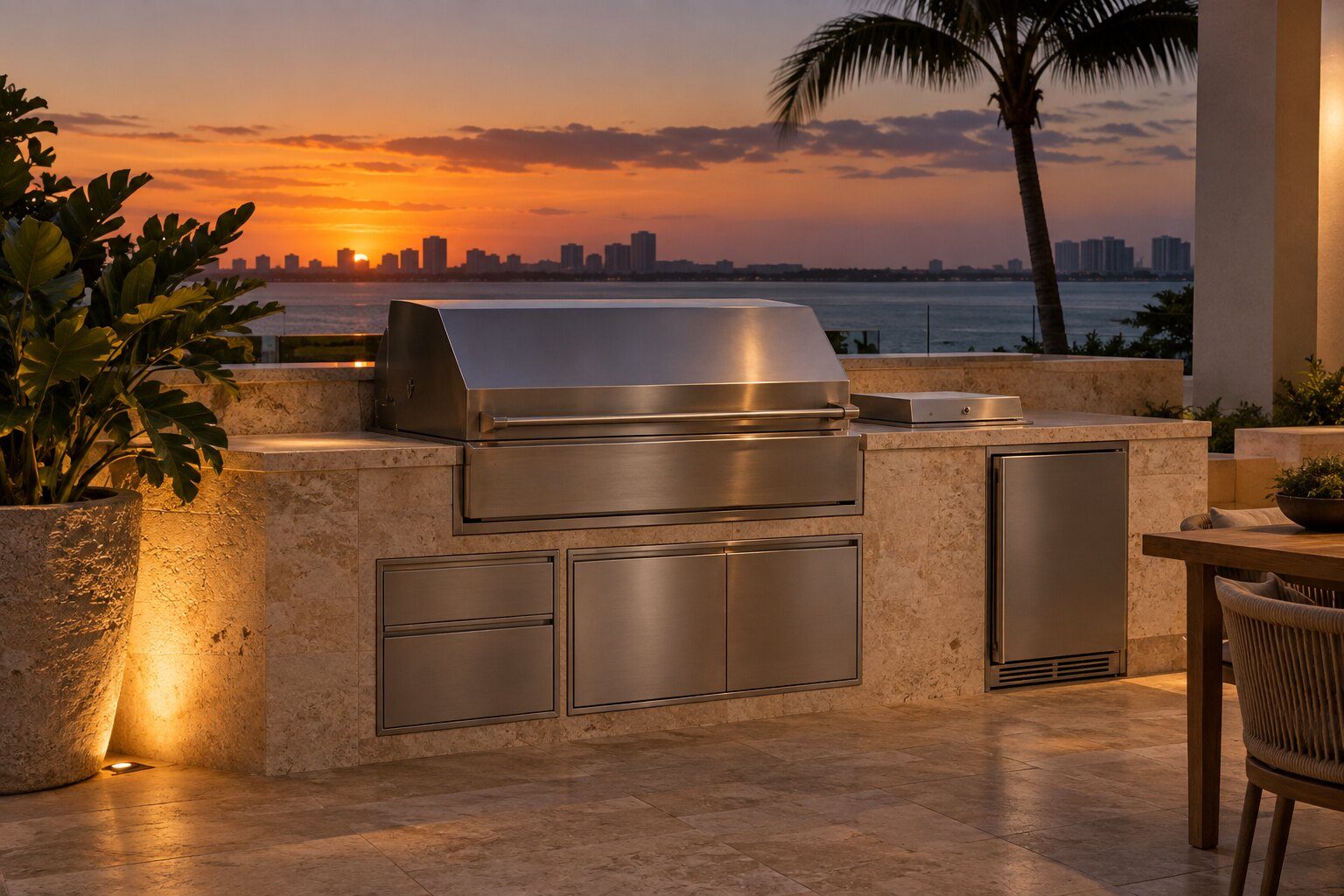
  • A wide stainless built-in grill set into a coral stone island on a terrace above the water, its hood open over empty cast grates.
    Built into the island, or on a cart · Series 7 and Series 9

    Grills

    This is the machine most people mean when they say DCS, and in South Florida it is the one that ages fastest. A grill dropped into a stone island is plumbed to gas, wired for its lights and rotisserie, and then left to face salt air for eleven months of the year with a cover on it. What fails is rarely the thing the owner expects: burners and ignitors are consumables here, the radiant trays and grease tray are part of the fire risk rather than part of the cleaning, and half the calls we take turn out to be a supply problem at the cylinder or the manifold rather than anything inside the hood. The ones built into an island are the slower visits — the surround decides what can come out and in which order.

    • Built-in and cart versions of the same cooking platform — the surround decides the visit
    • No error codes anywhere on this half of the brand: the grill tells you in flame, smell and sound
    • Salt air is the second owner of every outdoor stainless part in this market
    Grill repair
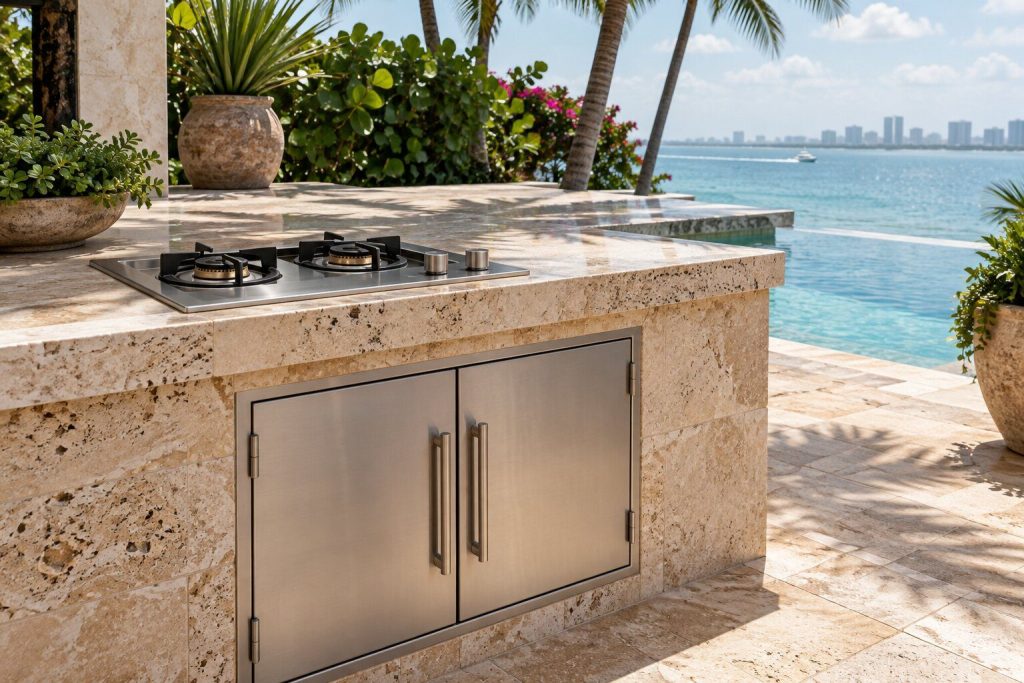
  • An outdoor kitchen run built into travertine with a double side burner at one end and two stainless access doors below the counter, the terrace opening to a pool beyond.
    Side and power burners, warming drawers, doors and drawers

    Outdoor kitchens

    The grill is the part people photograph; the rest of the island is the part that generates the calls. A DCS outdoor kitchen is a run of separate machines sharing one gas manifold and one stone surround — side burners and power burners for a pot, a warming drawer, access doors and drawer stacks, sometimes a vent hood over the whole thing. Each has its own failure and its own access, and they fail in an order the climate sets rather than one the catalog does. Doors and drawers seize long before anything gas-fired stops working, because the hardware is what the rain and the salt reach first.

    • Several machines, one manifold and one surround — a supply problem shows up on all of them at once
    • Drawer runners, hinges and latches are the first casualties of an outdoor install
    • The stone is the constraint: what can be removed was decided when the island was built
    Outdoor kitchen repair
  • A professional stainless range standing INSIDE a bright white indoor kitchen under open shelving, six sealed burners on the top and the oven door closed.
    Commercial-style, dual fuel and all gas

    Ranges

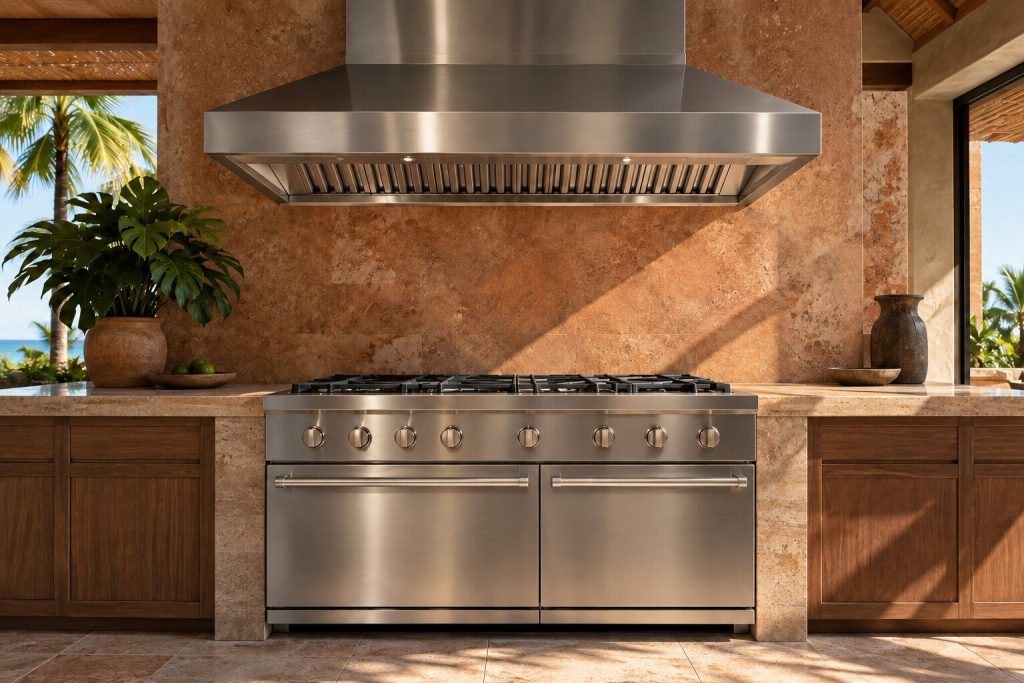
    Indoors the badge means a commercial-looking range: heavy grates, high-output sealed burners, a single deep oven or a pair, and often a griddle or a grill section in place of two burners. It is built to be cooked on hard, and the calls reflect that — ignition on one burner, an oven that will not hold the temperature it is set to, a door that has stopped sealing, a fan that has become loud. Dual fuel and all-gas versions fail in different places, so the first thing we establish is which one is in the kitchen. Unlike the outdoor half of this brand, a range can tell us what is wrong: the indoor line publishes decoded error tables, and an F-code with its sub-error narrows the visit before we arrive.

    • Dual fuel and all gas — the same cabinet, two different service stories
    • A griddle or grill section instead of burners changes what the top is asked to do
    • This half of the brand does publish codes, and they are decoded rather than numbered
    Range repair
  • A black glass induction cooktop set flush into a pale stone worktop INSIDE a bright indoor kitchen, with nothing standing on it and fitted cabinetry around it.
    Gas and induction · drop-in, with the range top's burners

    Cooktops

    Two quite separate machines share this page because they share a cutout. A gas cooktop is the range's top without the oven under it, and it fails the way that top fails — ignition, seating, a blocked port, a switch. An induction cooktop is an electronics problem wearing a glass lid, and it announces itself in code: this make publishes a short, decoded list, and one of those codes is a voltage complaint rather than a problem in the machine at all. What is in the stone decides the whole visit — down to whether the person who finally solves it works for us or for the power company.

    • Gas: ignition, caps, ports and switches — the same story as the range top
    • Induction: a decoded code list, and one entry is about the supply rather than the cooktop
    • The cutout and the worktop decide whether anything can come out at all
    Cooktop repair
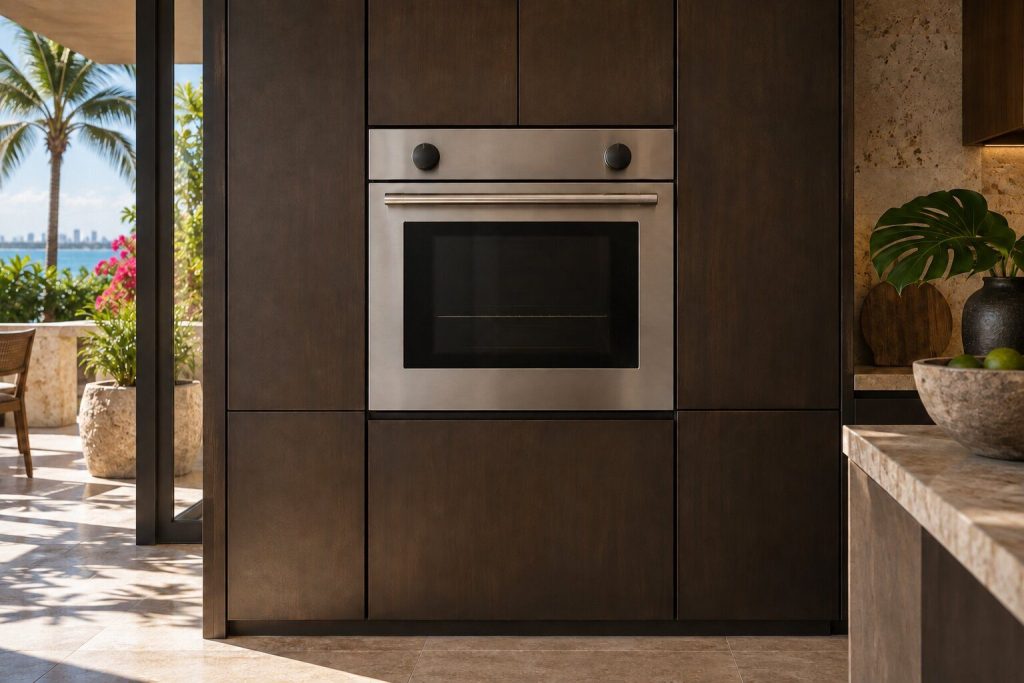
  • A stainless wall oven built into a tall dark cabinet run at chest height INSIDE a kitchen, its door closed and its frame flush with the joinery.
    Single and double, built into a tall run

    Wall ovens

    A wall oven is a cavity in a cabinet, and everything about the repair follows from that. It is heavy, it is screwed to the joinery, it sits above waist height, and behind it is a space somebody sized once and nobody has looked at since. The problems are the ordinary ones — heat that is not what the dial says, a door that has lost its seal or its hinge tension, a fan that has become loud, a control that has stopped responding — but the access is not ordinary, which is why we ask about the cabinet before the symptom. This make's wall ovens publish a decoded error table, and the sub-error after the F is where the real information is.

    • Built in above waist height — the cabinet decides the visit before the problem does
    • The published table decodes F1 into separate board, software and communication errors
    • A double oven is two cavities and frequently one control — which one is wrong matters
    Wall oven repair
  • A wide stainless professional hood canopy over an empty stainless range INSIDE a bright indoor kitchen, its underside and baffle filters visible from below.
    Over the range indoors, over the grill outside

    Range hoods

    A hood is the machine nobody thinks about until the kitchen stops clearing, and on this badge there are two of them living quite different lives. Indoors it sits over a high-output range and is asked to move a great deal of air quietly; outdoors it sits over a grill in the weather and is asked to survive. The problems divide the same way — indoor hoods bring blowers, speed controls, lights and baffle filters that nobody has washed; outdoor hoods bring corrosion, water where the electrics are, and a duct that has become a home for something. Whether the hood actually vents outside or recirculates through a filter is the first thing we establish, because half the complaints we hear about smoke are a hood doing exactly what it was installed to do.

    • Indoor and outdoor hoods on one badge, and they fail for opposite reasons
    • Vented or recirculating decides whether the complaint is a problem at all
    • Baffle filters are the maintenance nobody was told about
    Range hood repair
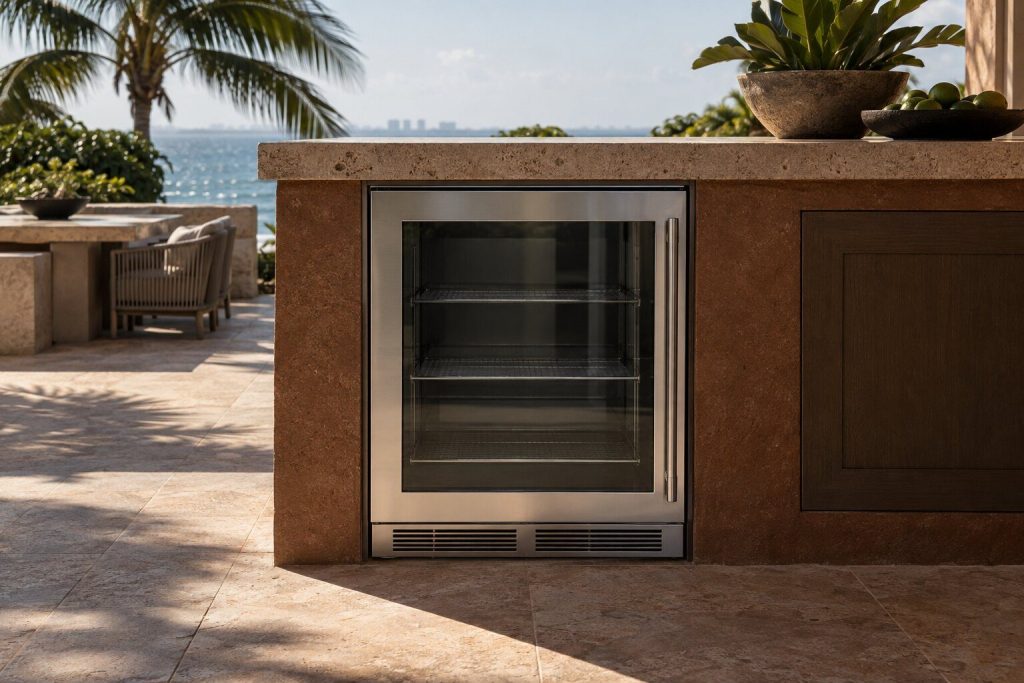
  • A stainless outdoor beverage center set under a coral stone counter in a terrace island, its glass door closed and the shelves inside empty.
    Outdoor-rated, under the counter of the island

    Beverage centers

    The one cold machine on a hot brand, and it earns its place by living outside. An outdoor-rated beverage center sits under the counter of the island, a meter from a grill, in ambient temperatures the indoor version of the same cabinet is not built for. That changes what fails and how it presents: a unit running constantly and never reaching temperature in August is often doing everything right in conditions it cannot win, and the fix is ventilation or shade rather than a compressor. The genuine problems are the ordinary refrigeration ones — a seal, a fan, a drain, a condenser packed with dust and salt — plus one this climate adds, which is condensation where an indoor machine would have had none.

    • Outdoor-rated, and the rating is the whole story in a Miami August
    • A condenser in an island collects salt and dust faster than any indoor cabinet
    • Running constantly is not automatically a problem — the ambient may be the answer
    Beverage center repair

Worth saying

Several of these end with us telling you not to book

An undercounter refrigerator that cannot hold temperature in a sealed stone island is not going to be fixed by a part, and we would rather say that than fit one. A cooktop reporting a supply problem needs an electrician. A grill that has not been given a full preheat is not underperforming. All three are conversations that cost us the job, and all three are the reason somebody calls us again.

Before you book

The questions this page is asked

Do you work on DCS equipment that is no longer sold here?

Yes, and it is a good deal of what we open. The ranges, the wall ovens, the cooktops and the indoor hoods are in South Florida kitchens and are not in the current US catalog, which changes the parts conversation rather than ending it. We say plainly when a part is genuinely no longer available.

Is outdoor work more expensive?

Usually, and for two reasons we quote separately rather than burying. What the machine is set into decides how long it takes to reach, and how long the salt has been working on it decides whether a fixing comes out in twenty seconds or twenty minutes.

Can you work on the gas run itself?

We test it, we find where it is failing, and we do the work that belongs to the appliance and its connections. Where the answer lies further upstream than that, we say so and tell you who to call rather than improvising on somebody's gas supply.

In more detail

How this list was decided, and what is not on it

Weighted like the equipment, not like a template

35 jobs, and they lean the way this make leans in this market: 4 of the 7 machines stand outdoors, so the grill and the island carry the list. There is no laundry here, no dishwasher and no microwave, because the make builds none for this market — and nothing was invented to fill the space where a sister site’s laundry jobs would be.

What a starting figure is

Every number on these pages is a from. The diagnostic is from $95, credited toward the repair, and no final price is published anywhere on this site — the cost is measured at your equipment and agreed in writing before anything is opened.

Not sure which of these it is?

Tell us what the machine is doing, whether it is indoors or out, and what it is built into. That is usually enough for us to say which page you are on. Where a diagnostic is the right next step it is from $95, credited toward the repair.

This article is based on:

  • Official manufacturer documentation
  • Internal repair procedures
  • Technician repair history
  • Company quality standards
Call (305) 526-4714