Service
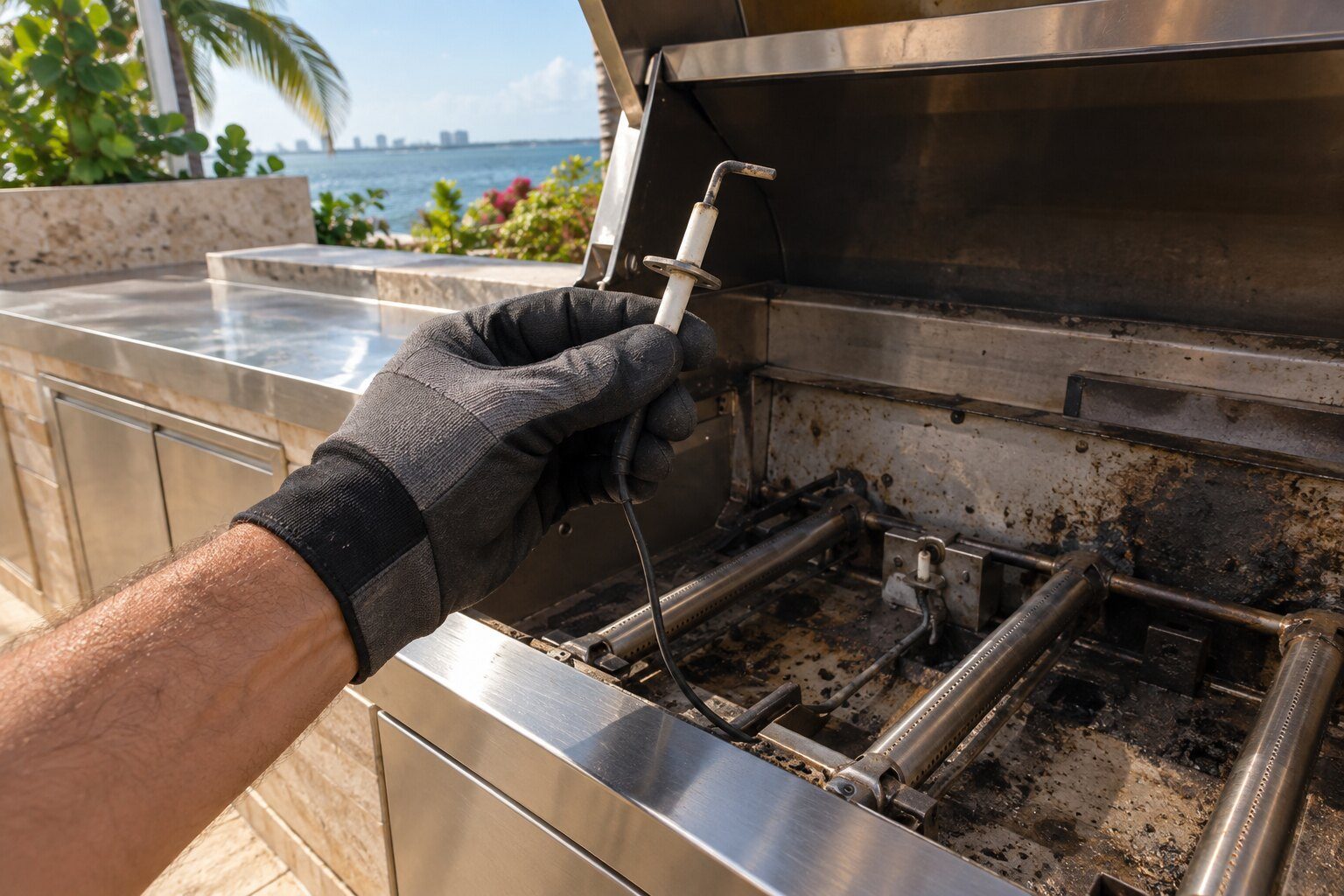
DCS ignition and electrode service
Everything between the button and the flame. On the coast this is the fastest-ageing system on an outdoor kitchen: ceramic insulators absorb salt and crack, electrode gaps move, earth paths corrode where they are bolted to a firebox, and battery modules sit in a damp compartment for years. The symptom is almost always the same — clicking with no light, or lighting on the fourth press instead of the first — and the cause is almost never the same twice. We service the path rather than swapping the part that is easiest to reach.
- From $95 diagnostic, credited to the repair
- 59 cities and neighborhoods covered
- OEM parts available on order
- In writing the price, before anything is opened
Before you read on
What this job costs and how it is agreed
A starting figure, not a quote. What moves it is the model, how the unit is built in and which part it needs — settled after the on-site diagnostic.
Starts at
from $135
After a diagnostic from $95, which comes off the bill when you go ahead.
or call (305) 526-4714
Diagnostic
From $95, credited to the repair
The price
In writing, before anything is opened
Warranty
On the labor we performed
On the visit
How this visit actually goes
The same order every time, so nothing is opened and nothing is charged before you have seen the figure and said yes.
-
01
Find where the spark is actually going
A spark that jumps to the firebox instead of across the gap looks and sounds identical from the control panel. We watch each electrode in shadow before deciding anything.
-
02
Treat the earth path
Corrosion where the earth is bolted down is the local failure, and it is invisible until the joint is opened. Cleaned and remade properly, it frequently fixes an ignition that has been intermittent for a year.
-
03
Set the gaps and prove every position
Gaps set to the design, insulators replaced where they have crazed, and then every burner lit from cold, in order, in front of you. Intermittent problems are only proved by repetition.
Applies to
The DCS units we carry this work out on
-
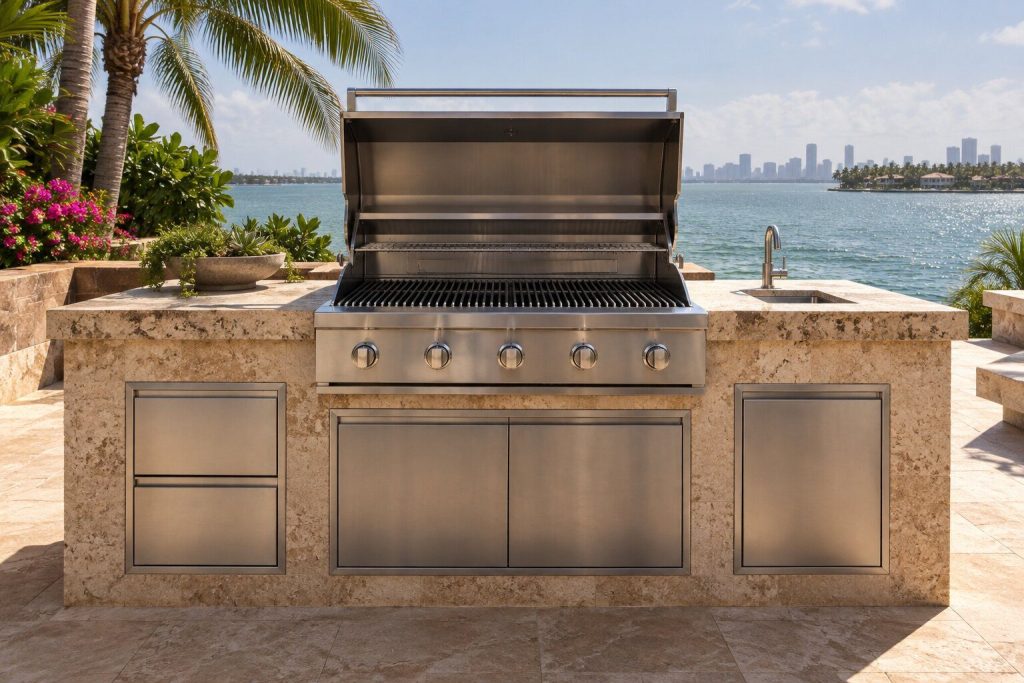
Built into the island, or on a cart · Series 7 and Series 9 DCS grill repair in Miami
This is the machine most people mean when they say DCS, and in South Florida it is the one that ages fastest. A grill dropped into a stone island is plumbed to gas, wired for its lights and rotisserie, and then left to face salt air for eleven months of the year with a cover on it. What fails is rarely the thing the owner expects: burners and ignitors are consumables here, the radiant trays and grease tray are part of the fire risk rather than part of the cleaning, and half the calls we take turn out to be a supply problem at the cylinder or the manifold rather than anything inside the hood. The ones built into an island are the slower visits — the surround decides what can come out and in which order.
- Built-in and cart versions of the same cooking platform — the surround decides the visit
- No error codes anywhere on this half of the brand: the grill tells you in flame, smell and sound
- Salt air is the second owner of every outdoor stainless part in this market
-
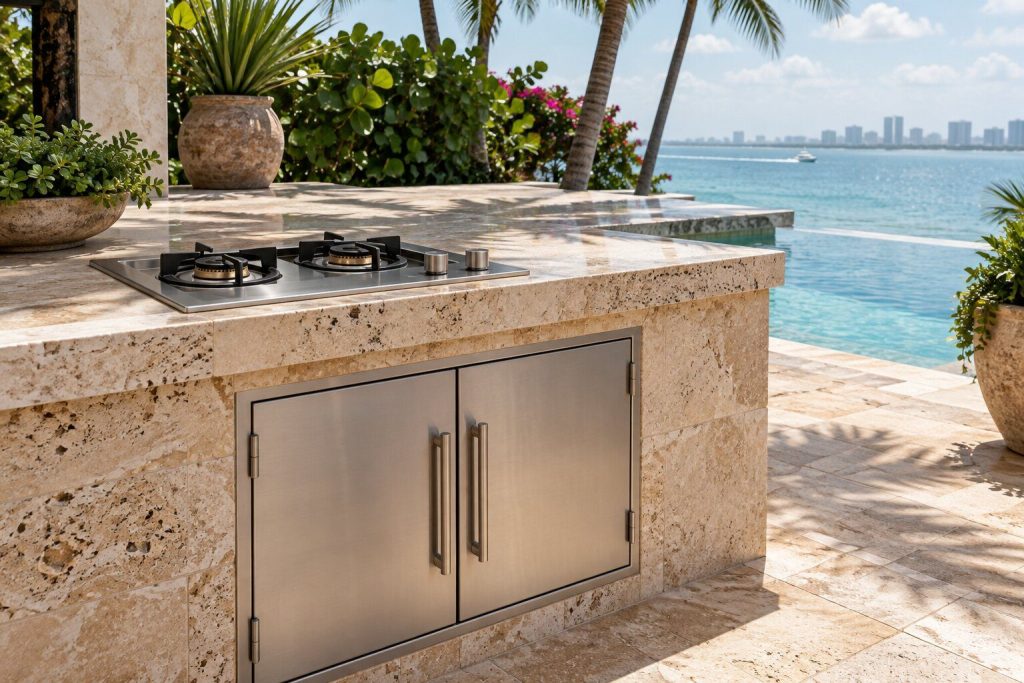
Side and power burners, warming drawers, doors and drawers DCS outdoor kitchen appliance repair in Miami
The grill is the part people photograph; the rest of the island is the part that generates the calls. A DCS outdoor kitchen is a run of separate machines sharing one gas manifold and one stone surround — side burners and power burners for a pot, a warming drawer, access doors and drawer stacks, sometimes a vent hood over the whole thing. Each has its own failure and its own access, and they fail in an order the climate sets rather than one the catalog does. Doors and drawers seize long before anything gas-fired stops working, because the hardware is what the rain and the salt reach first.
- Several machines, one manifold and one surround — a supply problem shows up on all of them at once
- Drawer runners, hinges and latches are the first casualties of an outdoor install
- The stone is the constraint: what can be removed was decided when the island was built
In more detail
About DCS ignition and electrode service
A path from the button to the flame, not a part
Everything between the press and the light: module or battery, lead, electrode, ceramic insulator, and the earth it all bolts back to. On this coast that whole path is a consumable, and the component that fails most is the one nobody suspects — a ceramic with a hairline craze in it lets the spark find a shorter route to the firebox, so it sparks visibly and audibly and never lights a burner. The other local failure is the earth bolt, where corrosion at a joint nobody has opened produces an ignition that has been unreliable for a year. Cleaned and remade properly, it frequently cures the whole thing.
This article is based on:
- Official manufacturer documentation
- Internal repair procedures
- Technician repair history
- Company quality standards
Before you book
Questions about DCS ignition and electrode service
Why does it light on the fourth press instead of the first?
That is a real problem rather than a personality, and it is usually a weak spark finding its way rather than a burner that is slow. The chain is tested as a chain, in shadow, so we can see where the spark is actually going rather than only hear it.
Does this cover the side burners as well?
Yes — the island's side and power burners have their own electrodes and their own leads, in wetter positions than the grill and with far less use to keep them dry. They are done at the same visit because the access is already open.
Where we do it
Across Miami-Dade, Broward, and Palm Beach
Same terms everywhere we go: an on-site diagnostic first, the price agreed in writing, and the exact figure confirmed once we have seen the unit.
Neighborhoods people ask for by name