
Miami-Dade · South Florida
DCS repair in Design District
Newer residences with designer kitchens, integrated panels and tight tolerances. Putting everything back so the line of the cabinetry is unbroken is part of the work here, not an extra.
Design District is a neighborhood of Miami, in Miami-Dade. We cover it on the same terms as the rest of the county: an on-site diagnostic first, the price agreed in writing, and the exact figure confirmed once we have seen the unit.
By unit
What we repair in Design District, by DCS unit
Start with whichever matches yours. How an appliance is installed shapes the visit as much as the repair does, which is why we ask about it when you book.
-
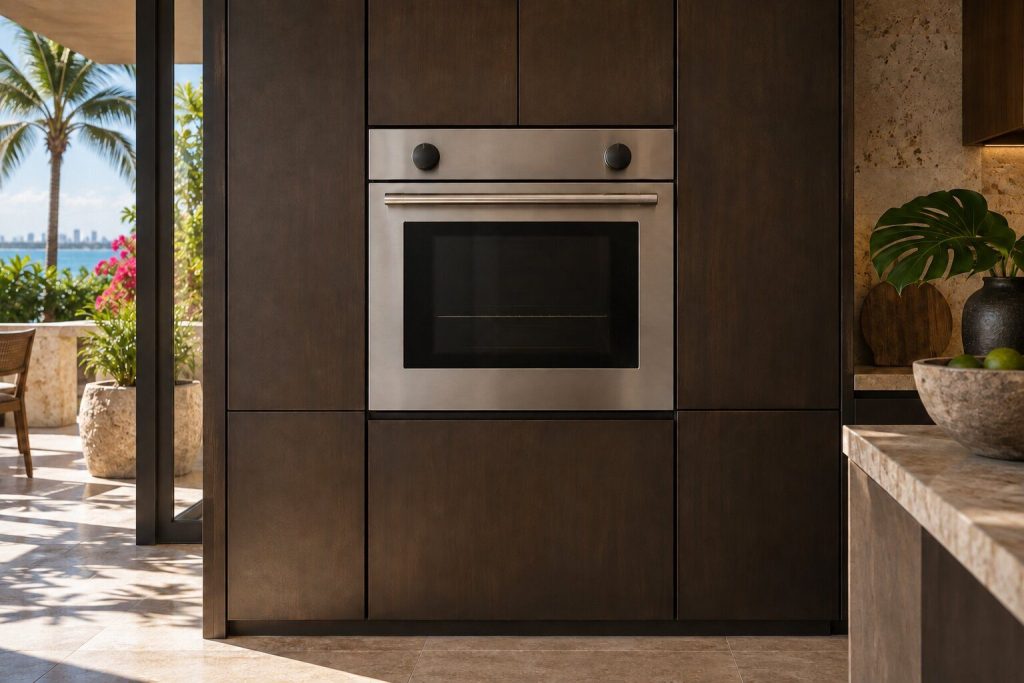
Single and double, built into a tall run DCS wall oven repair in Design District
A wall oven is a cavity in a cabinet, and everything about the repair follows from that. It is heavy, it is screwed to the joinery, it sits above waist height, and behind it is a space somebody sized once and nobody has looked at since. The problems are the ordinary ones — heat that is not what the dial says, a door that has lost its seal or its hinge tension, a fan that has become loud, a control that has stopped responding — but the access is not ordinary, which is why we ask about the cabinet before the symptom. This make's wall ovens publish a decoded error table, and the sub-error after the F is where the real information is.
- Built in above waist height — the cabinet decides the visit before the problem does
- The published table decodes F1 into separate board, software and communication errors
- A double oven is two cavities and frequently one control — which one is wrong matters
-

Commercial-style, dual fuel and all gas DCS range repair in Design District
Indoors the badge means a commercial-looking range: heavy grates, high-output sealed burners, a single deep oven or a pair, and often a griddle or a grill section in place of two burners. It is built to be cooked on hard, and the calls reflect that — ignition on one burner, an oven that will not hold the temperature it is set to, a door that has stopped sealing, a fan that has become loud. Dual fuel and all-gas versions fail in different places, so the first thing we establish is which one is in the kitchen. Unlike the outdoor half of this brand, a range can tell us what is wrong: the indoor line publishes decoded error tables, and an F-code with its sub-error narrows the visit before we arrive.
- Dual fuel and all gas — the same cabinet, two different service stories
- A griddle or grill section instead of burners changes what the top is asked to do
- This half of the brand does publish codes, and they are decoded rather than numbered
-
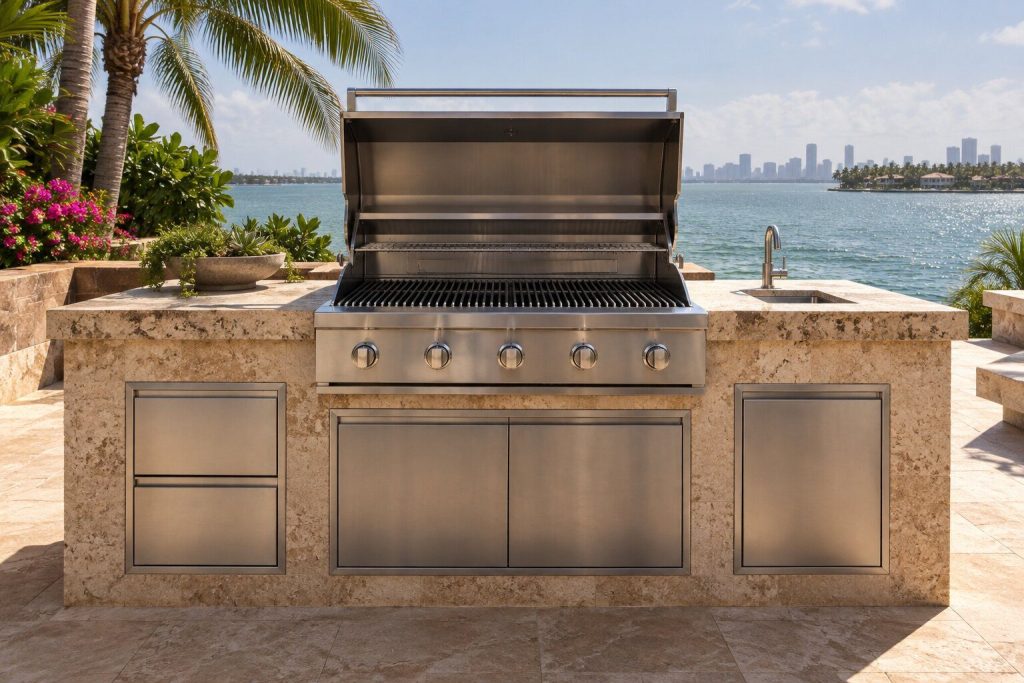
Built into the island, or on a cart · Series 7 and Series 9 DCS grill repair in Design District
This is the machine most people mean when they say DCS, and in South Florida it is the one that ages fastest. A grill dropped into a stone island is plumbed to gas, wired for its lights and rotisserie, and then left to face salt air for eleven months of the year with a cover on it. What fails is rarely the thing the owner expects: burners and ignitors are consumables here, the radiant trays and grease tray are part of the fire risk rather than part of the cleaning, and half the calls we take turn out to be a supply problem at the cylinder or the manifold rather than anything inside the hood. The ones built into an island are the slower visits — the surround decides what can come out and in which order.
- Built-in and cart versions of the same cooking platform — the surround decides the visit
- No error codes anywhere on this half of the brand: the grill tells you in flame, smell and sound
- Salt air is the second owner of every outdoor stainless part in this market
-
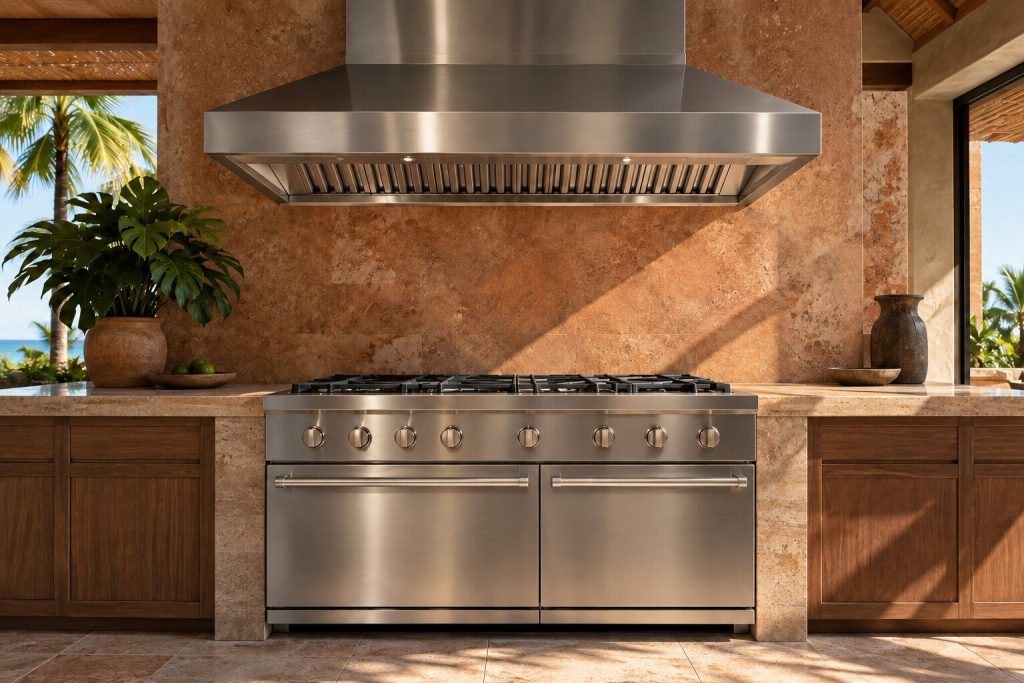
Over the range indoors, over the grill outside DCS range hood repair in Design District
A hood is the machine nobody thinks about until the kitchen stops clearing, and on this badge there are two of them living quite different lives. Indoors it sits over a high-output range and is asked to move a great deal of air quietly; outdoors it sits over a grill in the weather and is asked to survive. The problems divide the same way — indoor hoods bring blowers, speed controls, lights and baffle filters that nobody has washed; outdoor hoods bring corrosion, water where the electrics are, and a duct that has become a home for something. Whether the hood actually vents outside or recirculates through a filter is the first thing we establish, because half the complaints we hear about smoke are a hood doing exactly what it was installed to do.
- Indoor and outdoor hoods on one badge, and they fail for opposite reasons
- Vented or recirculating decides whether the complaint is a problem at all
- Baffle filters are the maintenance nobody was told about
-

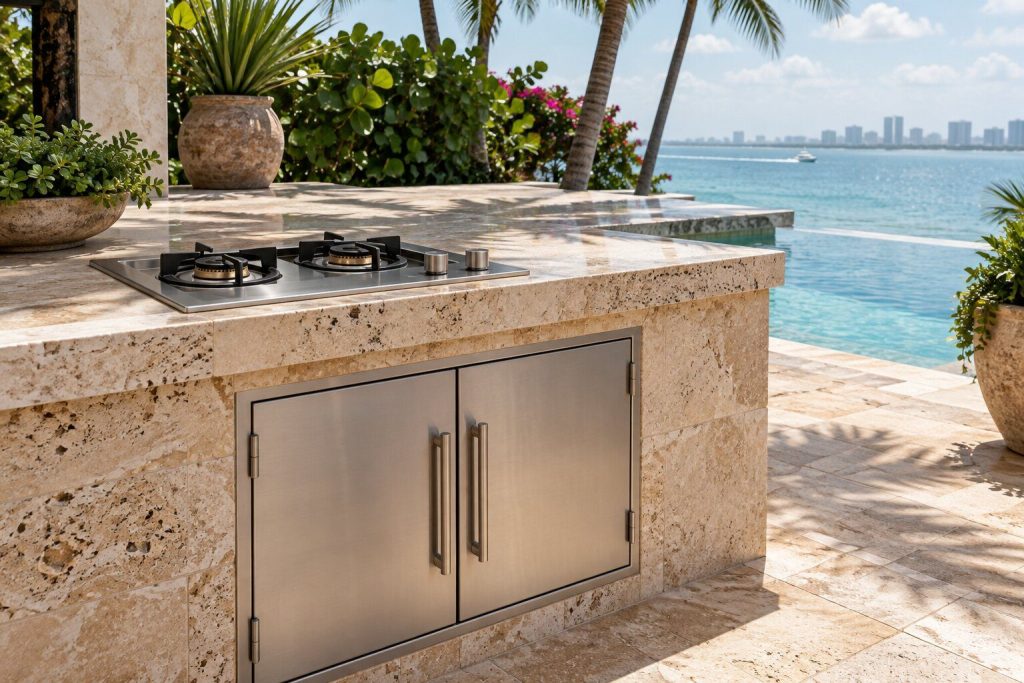
Gas and induction · drop-in, with the range top's burners DCS cooktop repair in Design District
Two quite separate machines share this page because they share a cutout. A gas cooktop is the range's top without the oven under it, and it fails the way that top fails — ignition, seating, a blocked port, a switch. An induction cooktop is an electronics problem wearing a glass lid, and it announces itself in code: this make publishes a short, decoded list, and one of those codes is a voltage complaint rather than a problem in the machine at all. What is in the stone decides the whole visit — down to whether the person who finally solves it works for us or for the power company.
- Gas: ignition, caps, ports and switches — the same story as the range top
- Induction: a decoded code list, and one entry is about the supply rather than the cooktop
- The cutout and the worktop decide whether anything can come out at all
-
Side and power burners, warming drawers, doors and drawers DCS outdoor kitchen appliance repair in Design District
The grill is the part people photograph; the rest of the island is the part that generates the calls. A DCS outdoor kitchen is a run of separate machines sharing one gas manifold and one stone surround — side burners and power burners for a pot, a warming drawer, access doors and drawer stacks, sometimes a vent hood over the whole thing. Each has its own failure and its own access, and they fail in an order the climate sets rather than one the catalog does. Doors and drawers seize long before anything gas-fired stops working, because the hardware is what the rain and the salt reach first.
- Several machines, one manifold and one surround — a supply problem shows up on all of them at once
- Drawer runners, hinges and latches are the first casualties of an outdoor install
- The stone is the constraint: what can be removed was decided when the island was built
By job
The repairs we are called out for in Design District
Starting figures for this equipment in South Florida. What moves them is the model, the access and the part — the exact cost is confirmed after the on-site diagnostic.
-
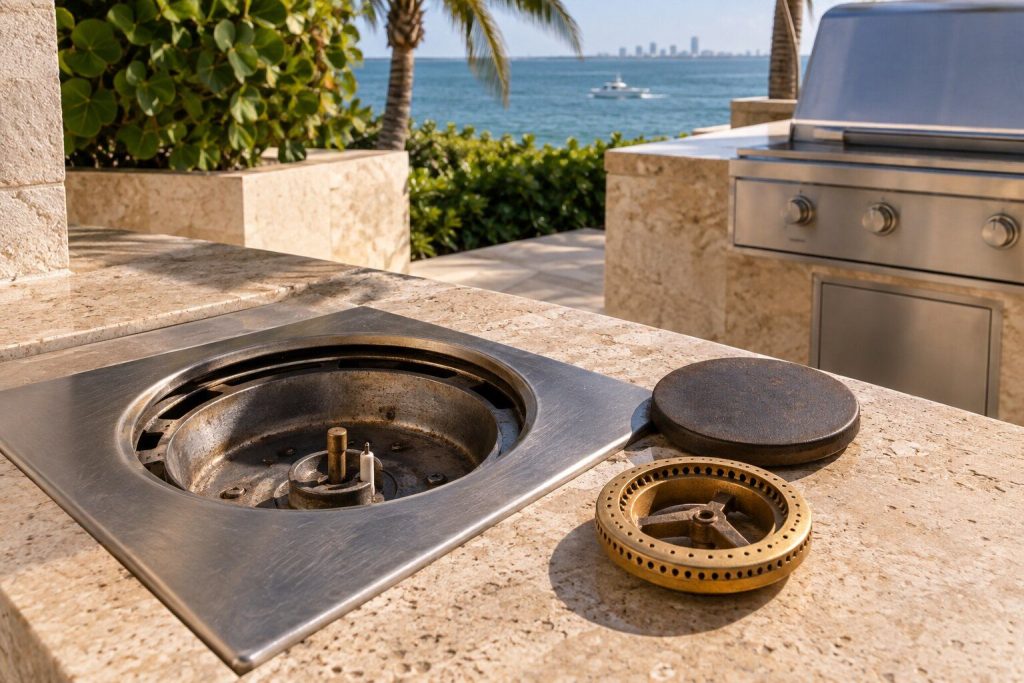
from $145 Side and power burner repair
The burners in the island that are not the grill. They sit lower, closer to the splash and the rain, and they are used less often — which sounds like an advantage and is not, because a burner that stands unused for four months in this climate collects everything. Insects nest in the venturi, the ports carbon up from one boil-over and are never cleared, and the ignition takes the same salt as the grill's does with none of the use to keep it dry. When one of these is dead and the grill beside it is perfect, the diagnosis is already half done.
- Dead on its own with the grill fine: the supply is not the problem
- Low and close to the splash — they collect what the grill never sees
- Little use is a risk factor here, not a protection
-
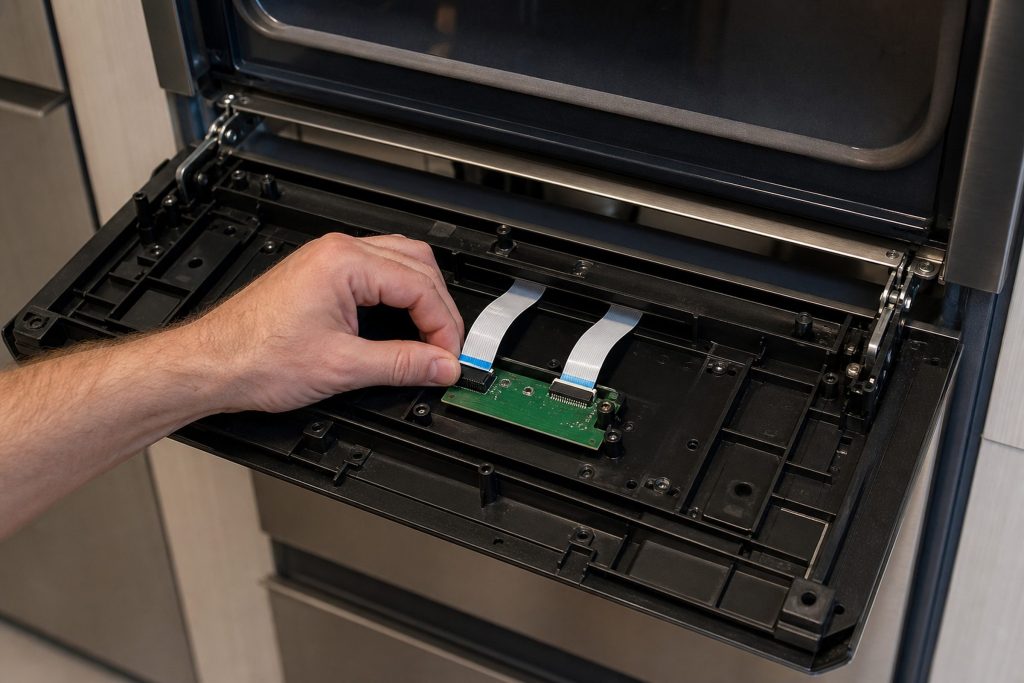
from $155 Range door and hinge service
A heavy door that has stopped closing square costs heat, costs even baking, and eventually costs the seal and the hinges themselves. On this class of range the door is genuinely heavy, which is why it is worth doing properly rather than adjusting by eye: springs and hinges under tension are the part of an oven most likely to hurt somebody who is improvising. The symptoms people describe — a cool corner, a door that stands a few millimeters proud, a hinge that thuds on the last inch — are all one conversation.
- A cool corner is usually the door, not the element
- Hinges under tension are not an improvise-with-a-screwdriver job
- Seal and hinges are checked together, because they fail together
-
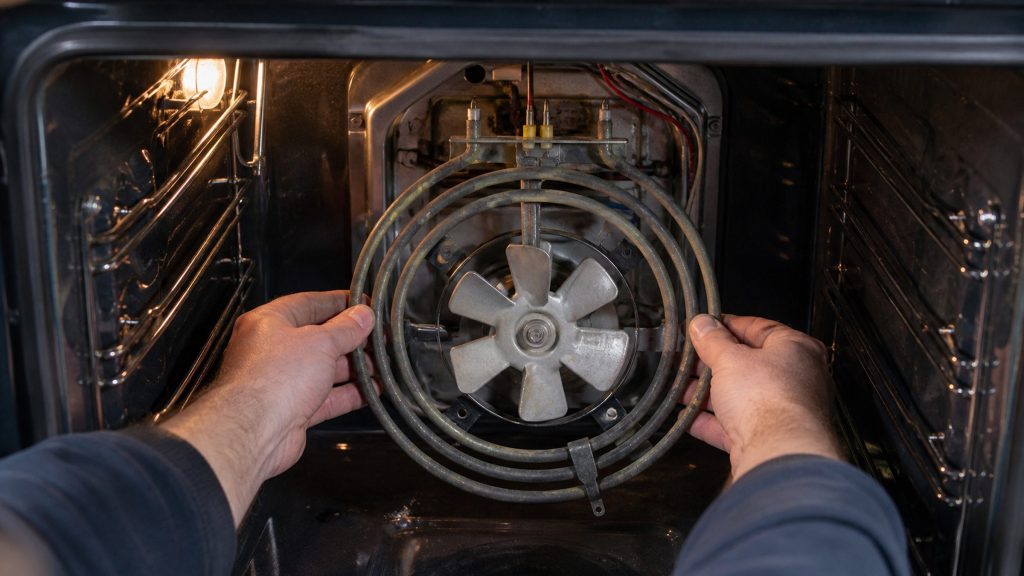
from $185 Wall oven not heating
A built-in cavity that has stopped making heat, or has stopped making the heat it claims. The list of causes is ordinary — element, sensor, thermal fuse, board, door — and the access is not, because everything is at chest height in somebody's joinery. This make publishes a decoded error table for these ovens and the sub-error after the letter separates several quite different visits, including one that means the control does not recognize which model it is fitted to. Reading the whole string to us on the phone regularly saves an entire diagnostic visit.
- Read the whole code — the digits after the letter are the message
- A thermal fuse that has opened after a self-clean is a common and cheap finding
- The cabinet decides whether this is an hour or an afternoon
-
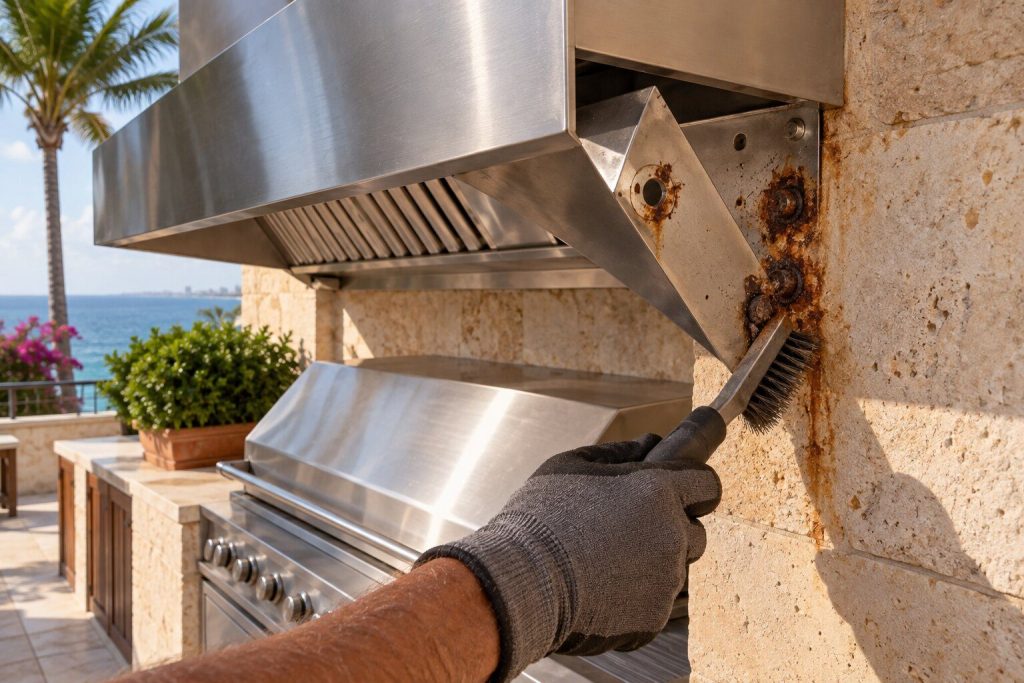
from $185 Outdoor hood corrosion service
A hood over an outdoor grill is a structure as much as an appliance, and in this market the structure is what fails. Mounts, fixings, the underside of the canopy and the housing that carries the electrics all corrode on a schedule set by how close the kitchen is to the water. The work is honest and unglamorous: get to sound material, treat what can be treated, replace what cannot, and route the electrics so water leaves instead of collecting. Done at the right time it adds years. Left too long it becomes a canopy that is not safely holding its own weight, and we will tell you when that line has been crossed.
- It is a structure first — the fixings matter more than the fan
- Proximity to the water is the real service interval on this item
- There is a point where replacement is the honest answer, and we say so
-
from $95 Diagnostic visit
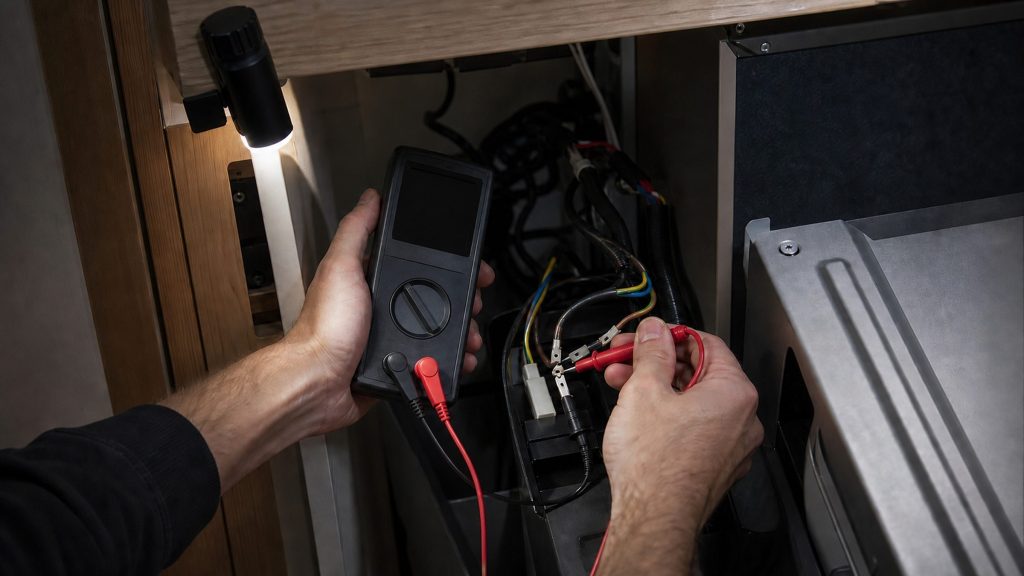
Establishing the problem itself, with nothing quoted until it is established. Two questions come before the symptom on this badge. Is the machine indoors or outdoors — because the indoor line answers in a decoded code and the outdoor line has no codes whatsoever, so the whole method changes. And what is it sitting in — masonry, joinery or a cart — because that, not the problem, sets the length of the visit. Whatever we find is written down with a figure beside it before a spanner is picked up. The charge comes off the repair when you go ahead; when our recommendation is to stop spending money on the machine, you get that recommendation and pay the same.
- Indoors or outdoors decides the method: a code to decode, or flame and smell to read
- Nothing quoted until the problem is established, and the charge comes off the repair
- Told plainly when the machine has stopped being worth the money
-
from $135 Ignition and electrode service
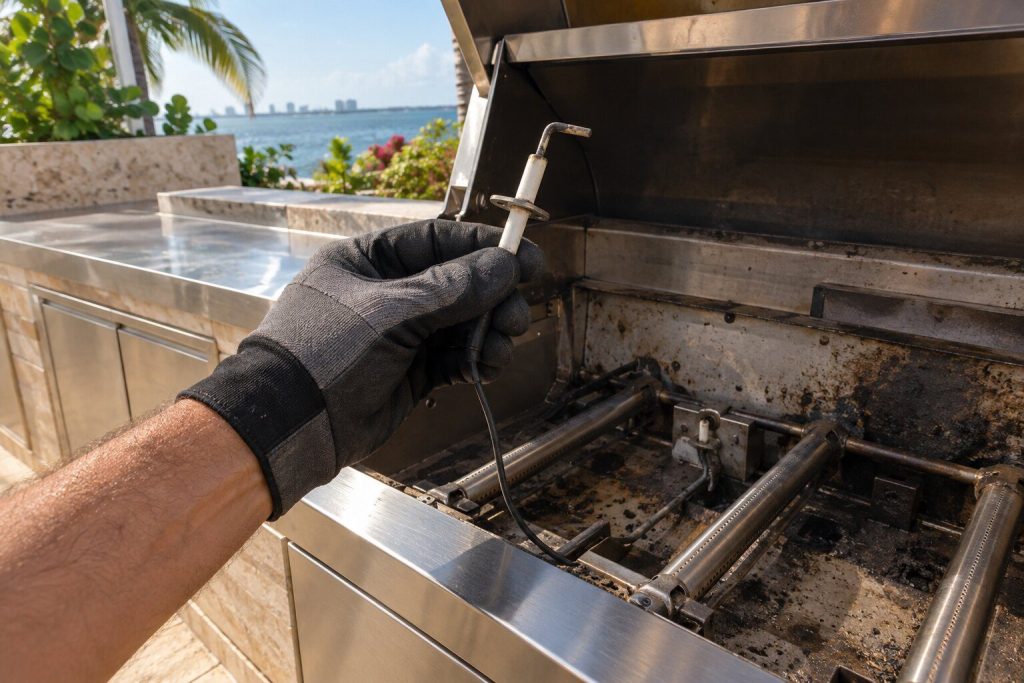
Everything between the button and the flame. On the coast this is the fastest-ageing system on an outdoor kitchen: ceramic insulators absorb salt and crack, electrode gaps move, earth paths corrode where they are bolted to a firebox, and battery modules sit in a damp compartment for years. The symptom is almost always the same — clicking with no light, or lighting on the fourth press instead of the first — and the cause is almost never the same twice. We service the path rather than swapping the part that is easiest to reach.
- Ceramic, electrode, wire, earth and module — a path, not a part
- Lighting on the fourth press is a problem, not a personality
- The same service covers the island's side and power burners
Nearby
Where else we work near Design District
Every place below has its own page, with what the equipment and the access are like there.
Elsewhere in Miami-Dade
In more detail
DCS repair in Design District, in more detail
What DCS equipment is like in Design District
Newer residences with designer kitchens, integrated panels and tight tolerances. Putting everything back so the line of the cabinetry is unbroken is part of the work here, not an extra.
Design District is part of Miami, in Miami-Dade County, and we treat it as its own call rather than a line on a map: the buildings, the access and the age of the installations differ enough from the rest of the city to change how a visit is planned. What does not change is the work — DCS bbq-grill, beverage centers, cooktop, diagnosed on site before anything is priced.
Salt, heat and storms — what they do to a kitchen full of appliances
Close to the water everything ages from the outside in. Salt corrodes the condenser coils and fan motors on the cold side and reaches burner caps, grates and igniters on the hot side, and both fail in the same way: a part that still works, slowly, until the day it does not. In Design District that turns a cleaning interval into a seasonal job rather than an annual one, on both halves of the kitchen.
What that means for the appliances in Design District
- Integrated panels and tight tolerances mean putting everything back so the line of the cabinetry is unbroken is part of the job here, not an extra at the end of it.
- Side burner will not light
- Hood not clearing smoke
- Smell of gas at the grill
- Induction cooktop shuts off mid-cook
- Grill flare-ups
How a visit in Design District is arranged
We ask for the model number from the plate inside the door and a line about what the appliance is doing. That decides which parts ride in the van, and it is the difference between one appointment and two.
- In a building: the service elevator window, the loading bay and the hours contractors are allowed to work
- Behind a gate: how visitors are cleared, arranged before the appointment rather than at it
- Whether the doors are paneled to match the cabinetry, which changes how they come off and go back
- The diagnosis first, then the scope and the price in writing, and your approval before anything is opened
What it costs, and what moves the figure
Prices in Design District are the same as everywhere else we cover: a diagnostic from $95 that is credited toward the repair, and starting figures per job rather than one number for "a repair". What moves it is the model, how the appliance is built into the cabinetry, which part it needs and how quickly that part can be sourced — none of which can be judged over the phone. The repairs we carry out lists what each job involves and the figure it starts at, and the unit pages covers what tends to go wrong on each type.
The exact cost is confirmed after the on-site diagnostic and agreed with you before any work begins. We are an independent repair company — not affiliated with, authorized by, or endorsed by any manufacturer — and our warranty covers the labor we performed.

Before you book
Questions about a visit in Design District
Do you cover Design District?
Yes. Design District is part of Miami, in Miami-Dade County, and it is inside the area we work every week. Give us the address when you book, and say how the DCS is installed — what has to come apart to reach it matters as much as where it is.
How soon can you get to Design District?
We will tell you the earliest slot we can genuinely keep rather than the earliest one that sounds good. Tell us the model number and what the unit is doing when you book: whether we can finish the same day depends on the part far more than on the drive.
Does it cost more because the job is in Design District?
No. The diagnostic and the work are priced the same across Miami-Dade, Broward and Palm Beach. What moves the figure is the model, how the unit is built in and which part it needs — never the address. Where access takes longer, we say so before anything is agreed rather than after.
Our unit is paneled to match the kitchen. Is that a problem?
It is part of the job rather than a complication. A paneled door is heavier, comes off differently and has to go back true or it will not seal — so we plan for it before the visit instead of discovering it in your kitchen.
Booking a visit in Design District
Tell us the model number and what the unit is doing. We will bring the parts that problem usually needs, and you will have a firm price before we start.
This article is based on:
- Official manufacturer documentation
- Internal repair procedures
- Technician repair history
- Company quality standards