Safety & Risks
When an Appliance Smells Faintly of Fish, Stop Using It
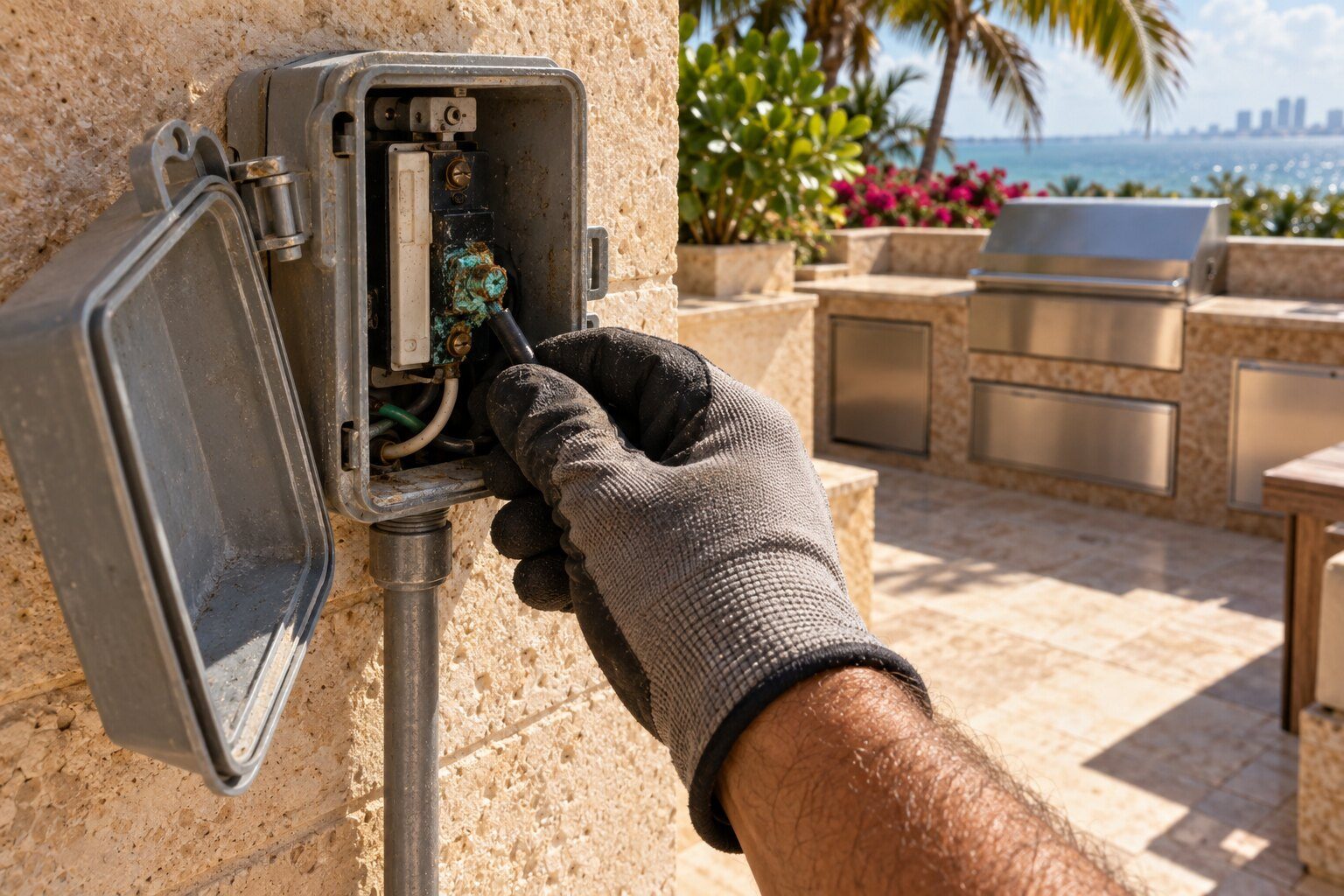
The smell people describe as fish, and sometimes as urine or as something chemical they cannot place, is overheating electrical insulation. The plastics used around terminals and inside switch housings give off exactly that odor when they are run hotter than they were meant to run, and it is worth knowing because it is one of the very few smells in a kitchen with a single cause. Nothing anybody cooked smells like it. It is also an early warning rather than a late one: insulation announces itself well before a connection fails outright, so the smell usually arrives while the fix is still a terminal or a switch rather than a burned harness and a scorched cabinet. On outdoor equipment there is an obvious first suspect. A switch housing on a terrace, a light fitting under a grill hood, or a junction inside an island cabinet has been taking rain, irrigation spray and salt air for years, and corrosion at a connection raises its resistance, which is precisely what makes it run hot. If you can smell it, switch that circuit off at the breaker and leave it off until somebody has measured it under load.
The full guide
Most kitchen smells have several possible explanations. This one has essentially one, which makes it more useful than almost anything else your nose will tell you.
Electrical appliance smells fishy: what is actually producing it
The plastics wrapped around terminals, packed into switch bodies and used as insulation inside a harness are stable at the temperatures they were designed for. Run them hotter and they begin to break down, and what they give off smells like this.
Descriptions vary — fish is the common one, urine is the next, and plenty of people simply say chemical. They are all the same phenomenon.
Nothing you cook produces it. That is the whole value of the signal.
Why it arrives early
Insulation starts outgassing a long way before a connection fails.
That gives you a window in which the problem is still one terminal, one switch, one connector. Acting inside that window is the difference between a small part and a harness, a cabinet interior and a control that was sitting next to it.
It is rare to get a warning this clear this early from a machine, which is why the advice is to act on it immediately rather than to watch it.
Why outdoor equipment is the first place to look
Resistance at a connection generates heat in proportion to the current through it, and corrosion raises resistance.
Outdoors, every connection is a candidate. A hood light switch under a grill canopy takes steam from below and rain from above. A junction inside an island cabinet takes irrigation spray through the vents. Terminals that were bright when the island was built have had years of salt air working on them.
So the honest first question is not which appliance is bad. It is which connection has been getting wet.
What to do, in order
Work out which circuit. Whatever was running when you smelled it. If it appears when the hood light goes on, that is your circuit.
Switch it off at the breaker. Not at the wall switch or the appliance control — the point is to stop current through the connection that is heating, and only the breaker does that reliably.
Leave it off. A connection running hot enough to smell does not settle down. It gets worse under exactly the conditions that produced it.
Do not open the cabinet to look. There is nothing to see, for the reason above, and opening a live outdoor cabinet is not a reasonable trade for confirming what you already know.
What we do with it
Measure under load. A terminal that reads fine at rest can drop a significant voltage when it is actually carrying current, and that drop is the heat you smelled.
Then replace the connection and whatever caused it to get wet — a housing that has lost its seal, a gland that was never tightened, a cover that has cracked in the sun. Replacing the burned part alone is how this comes back.
If it turns out to be a repair
What this leads to, and what it costs
Every job on this site is priced the same way: an on-site diagnostic first, the figure agreed in writing before anybody starts.
-
Standing water in the base of the island Water inside the outdoor cabinet
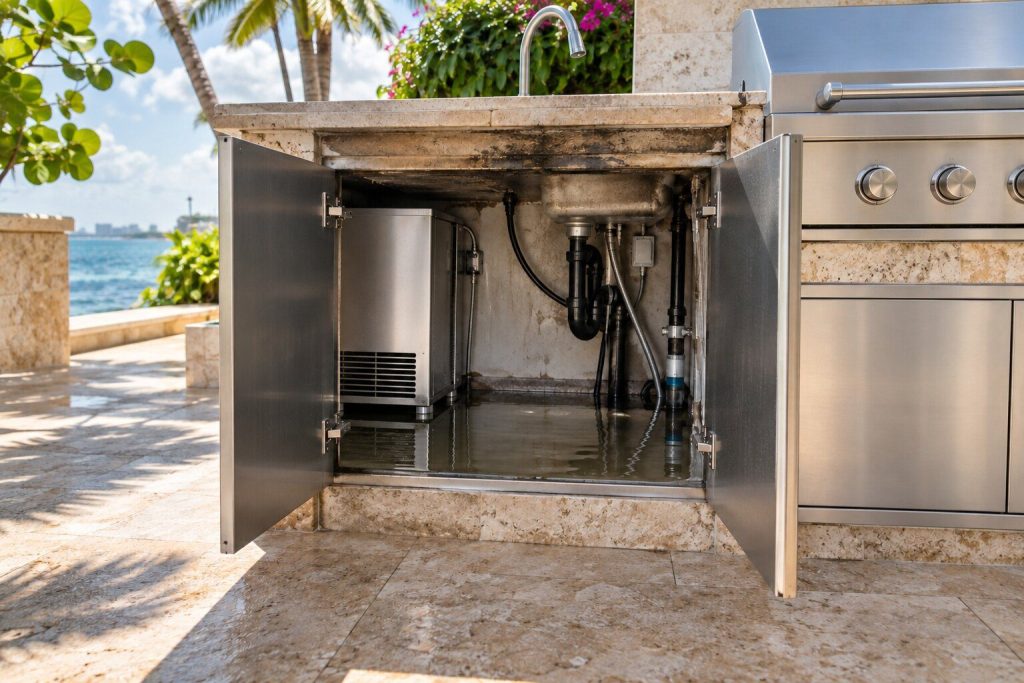
Water in a DCS outdoor kitchen cabinet. An outdoor island is designed to shed water rather than to exclude it, so a little after heavy rain is not automatically a defect — where it collects and whether it leaves are the questions. Water sitting in the base of a cabinet that houses gas fittings and electrical connections is a different matter from water running through and away, and this is one of the few cosmetic-looking problems on the site that we would rather see sooner than later.
- Shedding water is the design; holding it is not
- A gas island with standing water in it is ruining fittings you cannot see
- Constant water rather than after-rain water is usually plumbing or irrigation
-
from $125 Hood light and control repair
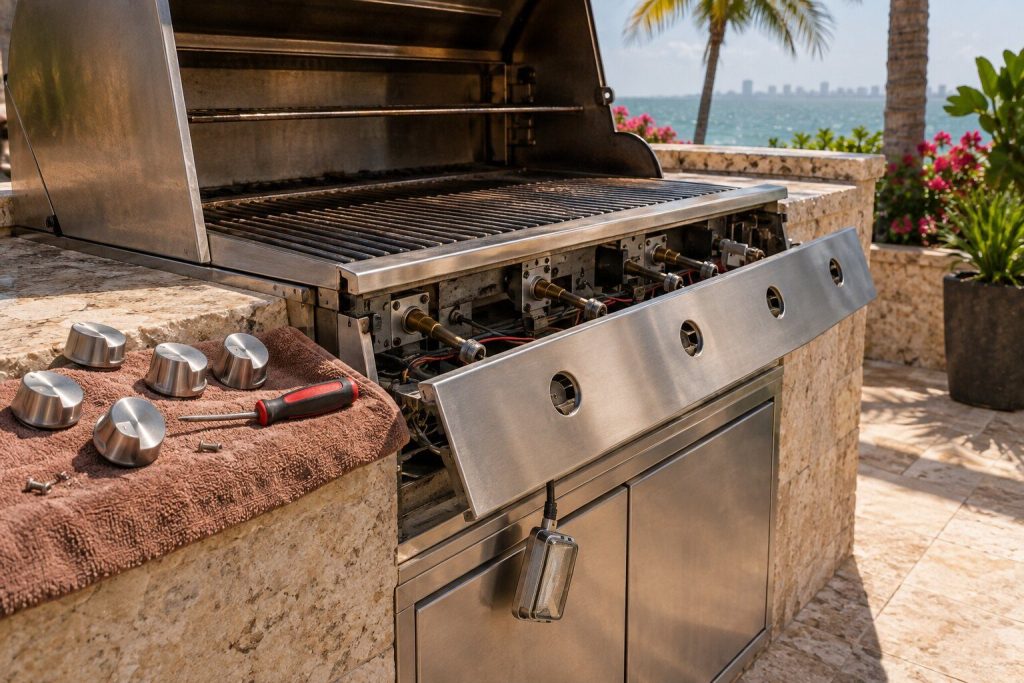
The electrical half of an outdoor grill: hood lights, dial lighting, the switch panel and the wiring that runs through a cabinet exposed to weather. These are the problems people put up with rather than call about, which is a pity, because water in a switch housing on a terrace does not stay a lighting problem. Corroded connectors, a transformer that has taken rain, a switch that has swollen — they all read as a failed light until somebody opens the housing, and by then the corrosion has usually traveled.
- A dead light on an outdoor grill is usually water, not a bulb
- Corrosion travels along a loom — the problem is rarely where the symptom is
- Left alone it stops being an electrical problem and becomes a housing one
-
from $125 Hood light and switch repair
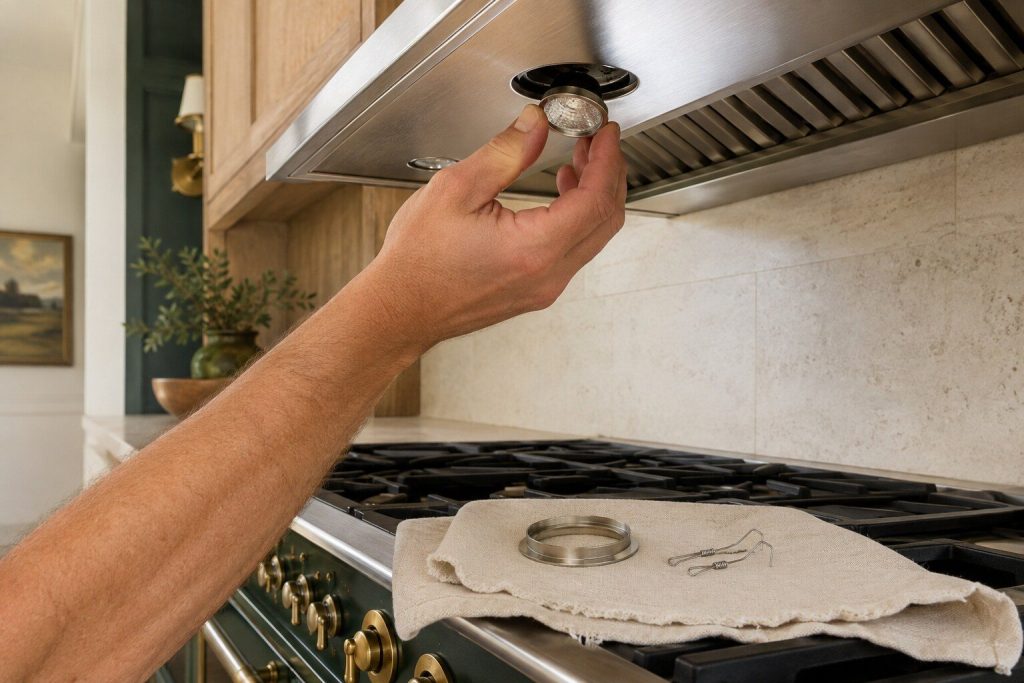
Dead lamps, a speed control stuck on one setting, buttons that work when they feel like it. Indoors these are usually the switch, the control or a lamp holder cooked by years of heat directly above a high-output range. Outdoors they are usually water. The split is diagnostic: lights dead with the blower alive, or the reverse, points at a control or that circuit; everything dead points at the supply or the board. It is a cheap repair to make and an easy one to keep living with, which is why it is often years old by the time somebody calls.
- One half dead and the other alive is the most useful symptom here
- Heat cooks lamp holders above a high-output range — it is not the bulb
- On an outdoor hood, start at water rather than at electronics

Questions people ask about this
Nothing looks burned. Are you sure it is electrical?
That is the normal state of affairs, and it is the reason the smell is useful. Insulation warms and outgasses long before anything discolors. By the time there is something to see, the repair has usually grown from one terminal to a harness and whatever it was sitting against.
It comes and goes. Which appliance is it?
Whichever one is running when it appears — the connection only gets hot while it is carrying current. Note what was switched on the last two or three times you smelled it. That list is genuinely useful to us, and it is faster than opening four cabinets.
Can I just replace the switch myself?
You can replace a switch. The question is whether the switch was the cause or the casualty, and outdoors it is often the second — water reached it, the terminal corroded, resistance rose and the heat followed. A new switch onto the same wet, corroded conductor smells the same within a month.
Safety & Risks
More guides like this one
-

What Is Still Live on an Outdoor Kitchen After You Switch It Off
Turning a grill off turns the burners off. It does not close the gas at the manifold or cut power to the lights, the ignition module and the rotisserie — and on an island those are shared.
Read more -
A Gas Smell With Everything Switched Off Is a Different Problem
Gas at a burner you were about to light is one thing. Gas with every control off is another, because it means something upstream of the controls is passing — and outdoors that run was sealed into masonry years ago.
Read more -

A Grease Fire on a Grill or a Range: What Actually Puts It Out
Water spreads burning fat. The response that works is starvation, and the one most people reach for first makes it larger — then there is the question of why the flare-ups started at all.
Read more
Tell us the model number and what it is doing.
This article is based on:
- Official manufacturer documentation
- Internal repair procedures
- Technician repair history
- Company quality standards