Safety & Risks
A Grease Fire on a Grill or a Range: What Actually Puts It Out
Burning fat is put out by taking away its air, and every effective response is a version of that: heat off, cover it, leave it covered. On a range that means sliding a lid or a sheet pan over the pan from the side, turning the burner off, and not moving the pan. On a grill it means every burner off, the gas off at the source, and the lid down — a closed hood starves a flare-up quickly, and opening it to look feeds it again. Water is the one thing that must not be used. It flashes to steam under the burning layer and throws that layer outward, which turns a contained fire into a spread one, and on a hot grill that happens instantly. Baking soda works on a small pan fire, flour does not, and a kitchen extinguisher is the right tool if it is already within reach rather than across the house. The larger point is what comes afterward. Repeated flare-ups are not a cooking style; they are a grease path that has stopped carrying grease away, and putting that right takes about an hour.
The full guide
Every effective answer to burning fat is the same answer said differently: take away the air and stop adding heat. Everything that goes wrong here goes wrong because somebody adds something instead.
How to stop a grease fire on stove: on a range
Slide a lid, a sheet pan or a baking tray over the pan from the side, keeping your arm out of the rising heat. Turn the burner off. Then leave it.
Do not carry the pan anywhere. Moving burning oil is how it ends up on a floor, a doorway or a person, and the sink is the worst destination of all.
Baking soda works on a small fire, poured generously rather than shaken. Flour does not — it is combustible dust and it will make things considerably worse.
On a grill
Every burner off. Gas off at the source — the cylinder valve or the manual shutoff. Lid down.
A closed hood over a grill with no gas feeding it is a very effective way to starve a fire. The mistake is lifting it to see how things are going, which feeds fresh air to fat that is still far above its ignition temperature.
Leave it closed until the grill is genuinely cool. Fifteen or twenty minutes, not thirty seconds.
The thing that must never be used
Water.
It sinks under the burning layer, flashes to steam, and throws that layer up and outward. Indoors that puts fire across a counter. On a grill, where everything is already at temperature, it happens faster than you can step back.
This is the single most important sentence on this page, and it is worth saying out loud to anybody else who cooks in the house.
What repeated flare-ups are actually telling you
A fat-heavy cut over open flame produces some flare. That is cooking.
Flare on every session, in the same place, that persists after the food has stopped dripping, is a grease path that has stopped working. Radiants that have warped and no longer shed sideways. A drip tray that drains to a point that is no longer the low point. A channel packed hard enough that new drippings sit above it and cook.
At that point the grill is storing fuel in a hot box, and the flare-ups are the visible part of it.
What fixing it involves
Trays and radiants out, the burner box cleaned down to metal, the channel and the drain cleared to where they actually run, and the drip tray checked for whether it still sits at the angle it was designed to.
An hour or so, no parts on most machines, and it is the least expensive work anybody does on an outdoor kitchen. It is also the piece of maintenance with the clearest safety argument behind it, which is why we would rather talk about it before a fire than after one.
If it turns out to be a repair
What this leads to, and what it costs
Every job on this site is priced the same way: an on-site diagnostic first, the figure agreed in writing before anybody starts.
-
Grill flare-ups
DCS grill flare-ups every time something fatty goes on. Occasional flame when fat hits heat is cooking; a grill that burns everything on it is telling you the grease path has stopped working. That path is a design — radiants spread the heat and shed what falls on them, a tray collects it, a channel carries it to a cup — and when any part of it is loaded, missing or refitted the wrong way round, the drippings go straight onto the burners instead. In this market it is the commonest cause of a grill fire.
- Persistent flare-ups are a grease path problem, not a cooking technique problem
- Radiants refitted the wrong way round defeat the whole design
- The cheapest work on an outdoor kitchen, with the highest consequence if skipped
-
Grease management service
The service that is sold as cleaning and is really fire safety. A grill is designed to take rendered fat away from the flame — radiants spread the heat and shed the drippings, a tray collects what comes through, a channel takes it somewhere it can be emptied. When any part of that path is loaded, missing or refitted wrong, fat arrives on the burners instead, and the result is the flare-ups people describe as the grill 'getting angry'. In this market we see this most on grills that are spotless on the grates and untouched underneath. It is the cheapest work on an outdoor kitchen and the one with the highest consequence.
- Flare-ups at every cook are a grease path problem, not a cooking technique problem
- Radiants refitted the wrong way round defeat the whole design
- The single highest-consequence, lowest-cost job on this site
-
Grill signal Flare-ups
DCS grill · no code is displayed — this is a safety signal. Grease is reaching flame, and where it is sitting is the whole question.
What the lights are telling you
Questions people ask about this
How long do I leave the lid down?
Until the grill is cool, not until the flames stop. Fat well above its ignition temperature re-lights the moment air returns, and the instinct to check after thirty seconds is what turns one fire into two. Give it fifteen or twenty minutes with the gas already off.
Is baking soda really enough?
On a small contained pan fire, yes, and generously rather than sprinkled. On a grill it is not the tool — the fire is spread across a tray and a burner box, and a closed lid with the gas off starves it faster than anything you could pour on it.
The grill flares every time we cook fatty cuts. Is that normal?
Some flare is ordinary with fat over an open flame. Flare that repeats every session means the drippings are not leaving — warped radiants, a tray that no longer drains, and a channel packed solid. That is a service rather than a technique problem, and it is the cheapest work on the island.
Safety & Risks
More guides like this one
-
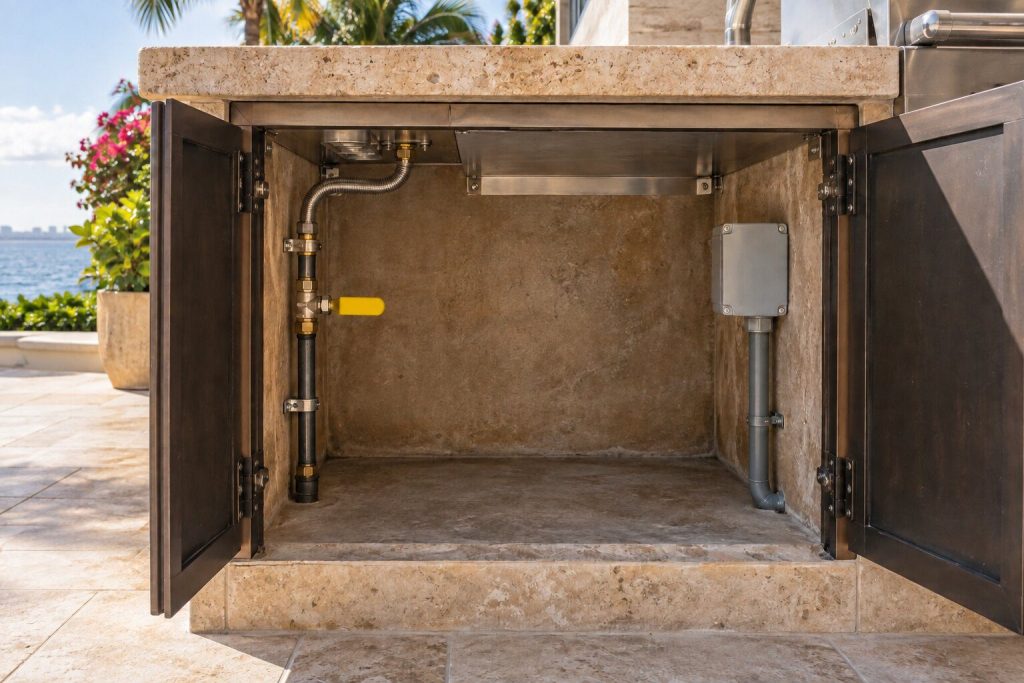
What Is Still Live on an Outdoor Kitchen After You Switch It Off
Turning a grill off turns the burners off. It does not close the gas at the manifold or cut power to the lights, the ignition module and the rotisserie — and on an island those are shared.
Read more -
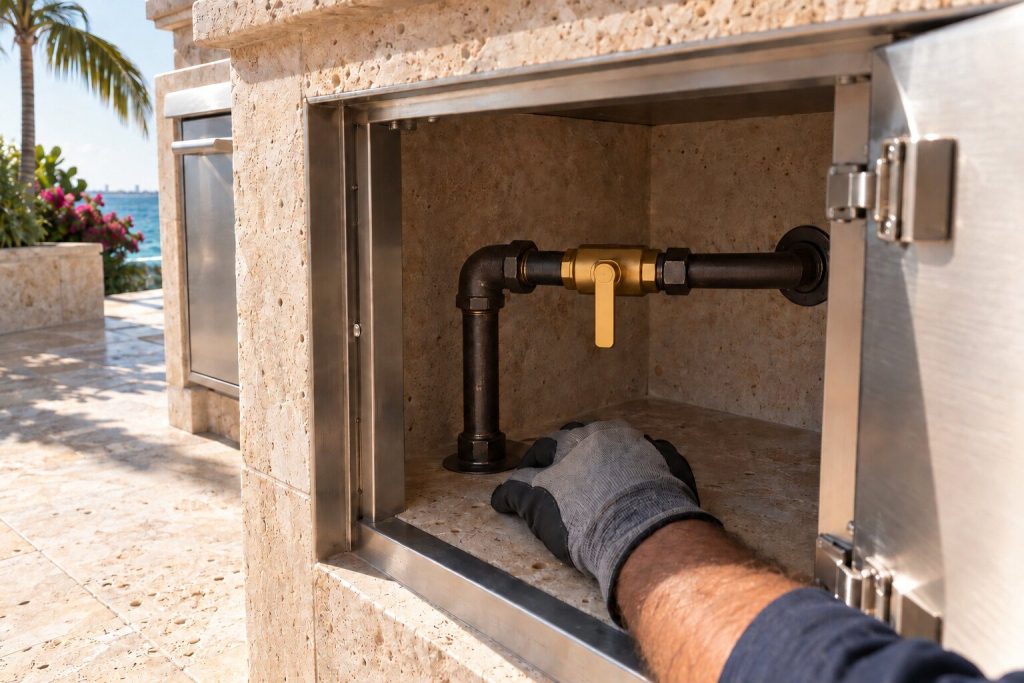
A Gas Smell With Everything Switched Off Is a Different Problem
Gas at a burner you were about to light is one thing. Gas with every control off is another, because it means something upstream of the controls is passing — and outdoors that run was sealed into masonry years ago.
Read more -
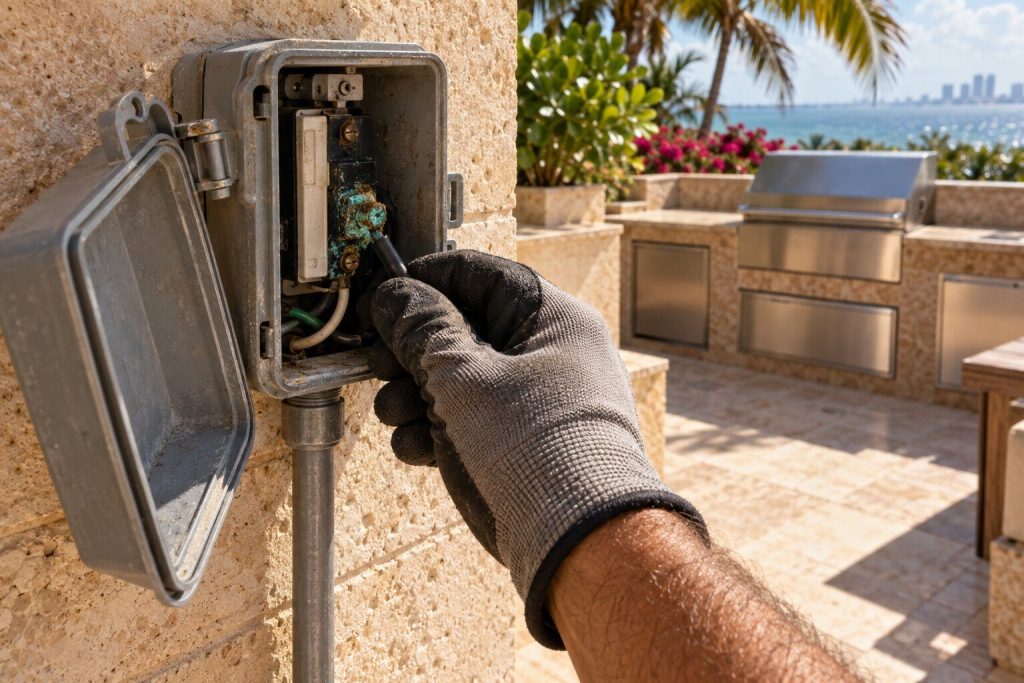
When an Appliance Smells Faintly of Fish, Stop Using It
It is one of the few smells in a kitchen that means exactly one thing, and nothing anybody cooked produces it. Overheating insulation smells like this before anything visibly fails.
Read more
Tell us the model number and what it is doing.
This article is based on:
- Official manufacturer documentation
- Internal repair procedures
- Technician repair history
- Company quality standards