Service
DCS gas supply and regulator service
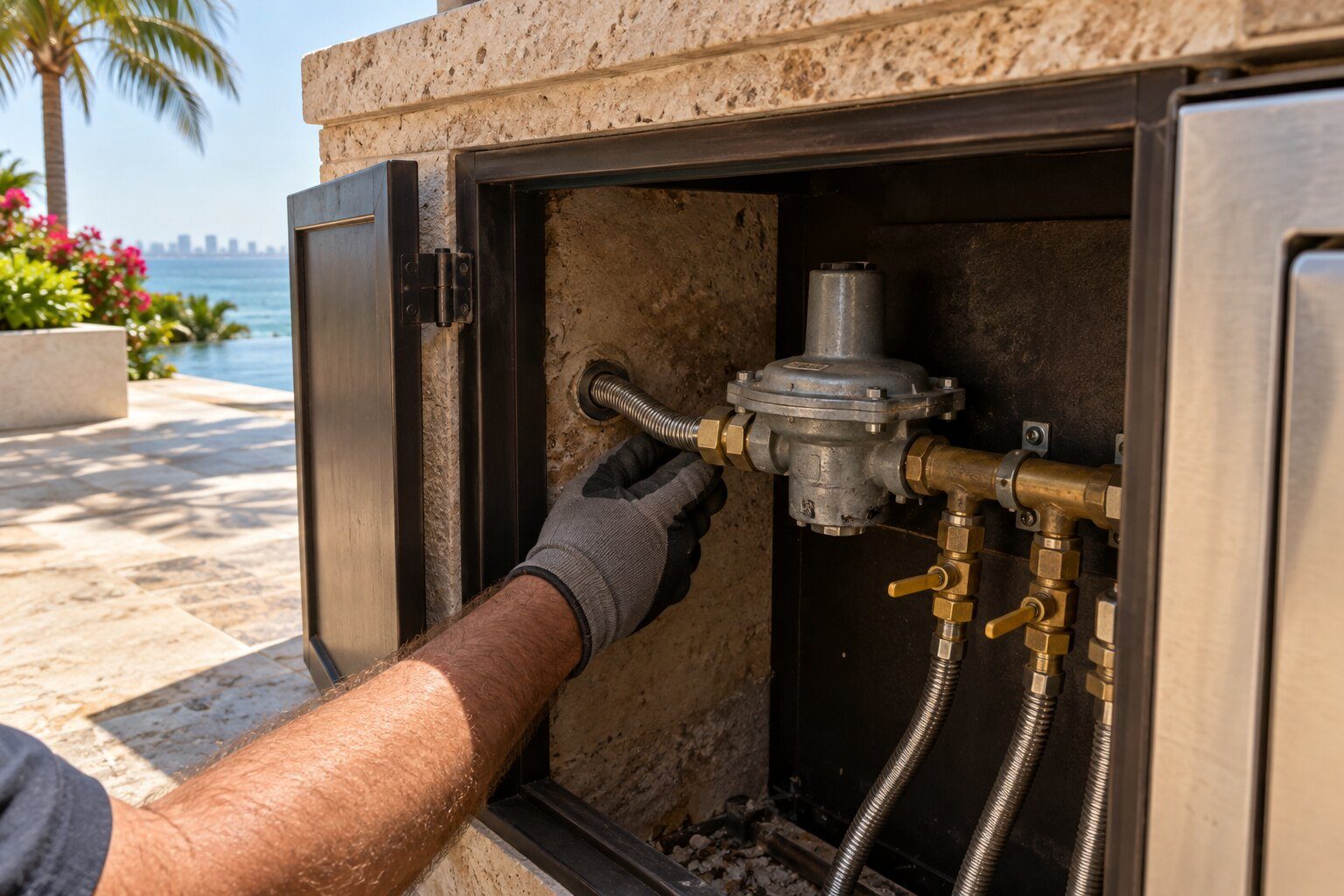
Everything upstream of the burner, which is where a large share of outdoor problems actually live. Weak flame on every burner at once, a grill that will not reach temperature, a cylinder that empties faster than it should, a limiting device that trips every time the valve is opened quickly — none of those are the grill. Under an island the fittings, the flexible connector and the manifold live in a space nobody has looked at since the mason closed it, in air that corrodes. We test rather than guess, and where the answer belongs to a gas contractor rather than to us, we say that.
- From $95 diagnostic, credited to the repair
- 59 cities and neighborhoods covered
- OEM parts available on order
- In writing the price, before anything is opened
Before you read on
What this job costs and how it is agreed
A starting figure, not a quote. What moves it is the model, how the unit is built in and which part it needs — settled after the on-site diagnostic.
Starts at
from $155
After a diagnostic from $95, which comes off the bill when you go ahead.
or call (305) 526-4714
Diagnostic
From $95, credited to the repair
The price
In writing, before anything is opened
Warranty
On the labor we performed
On the visit
How this visit actually goes
The same order every time, so nothing is opened and nothing is charged before you have seen the figure and said yes.
-
01
Measure rather than infer
Pressure at the manifold under load, not just at rest. A supply that holds pressure with everything off and collapses with three burners running is a very common and very invisible problem.
-
02
Inspect the parts of the run that are hidden
The flexible connector, the fittings at each end and the manifold joints inside the island. Salt air reaches all of them and none of them are inspected by anybody in the normal course of events.
-
03
Leak-check and document
Every joint disturbed is tested, and the result is written down. On gas we do not rely on memory or on smell, and we do not close an island back up without proving it.
Applies to
The DCS units we carry this work out on
-
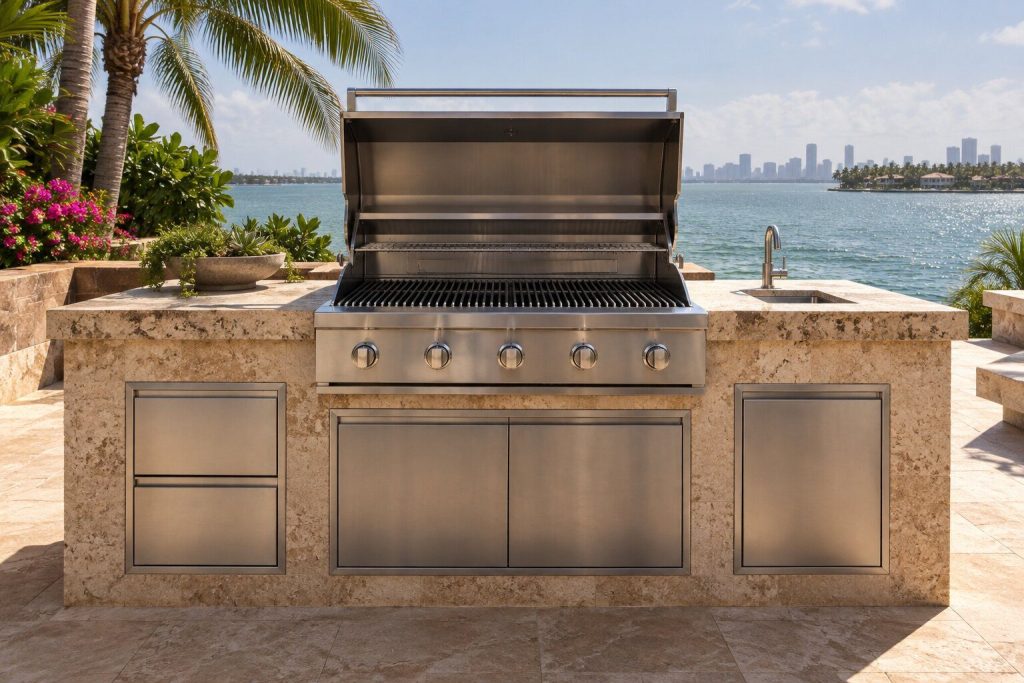
Built into the island, or on a cart · Series 7 and Series 9 DCS grill repair in Miami
This is the machine most people mean when they say DCS, and in South Florida it is the one that ages fastest. A grill dropped into a stone island is plumbed to gas, wired for its lights and rotisserie, and then left to face salt air for eleven months of the year with a cover on it. What fails is rarely the thing the owner expects: burners and ignitors are consumables here, the radiant trays and grease tray are part of the fire risk rather than part of the cleaning, and half the calls we take turn out to be a supply problem at the cylinder or the manifold rather than anything inside the hood. The ones built into an island are the slower visits — the surround decides what can come out and in which order.
- Built-in and cart versions of the same cooking platform — the surround decides the visit
- No error codes anywhere on this half of the brand: the grill tells you in flame, smell and sound
- Salt air is the second owner of every outdoor stainless part in this market
-

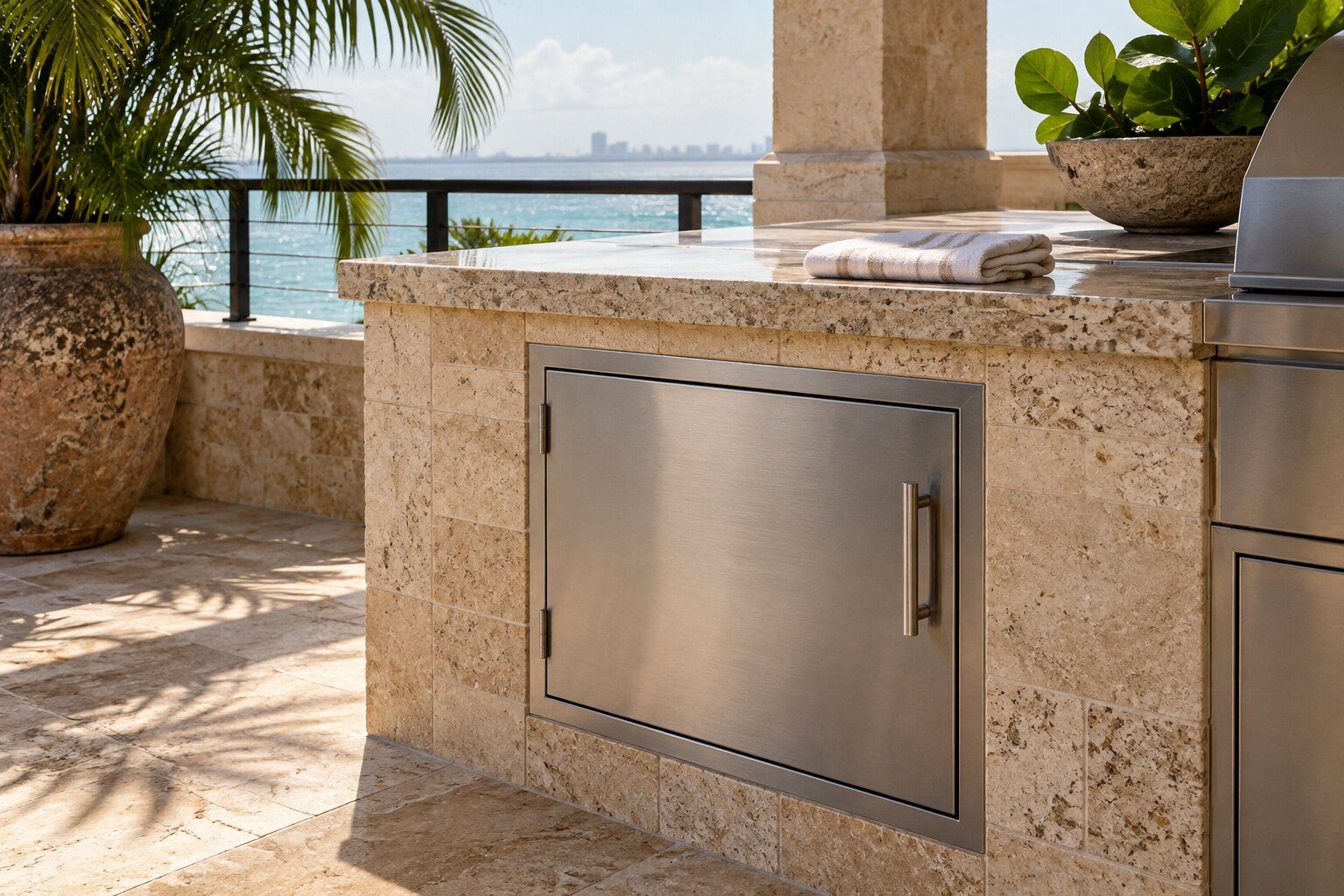
Side and power burners, warming drawers, doors and drawers DCS outdoor kitchen appliance repair in Miami
The grill is the part people photograph; the rest of the island is the part that generates the calls. A DCS outdoor kitchen is a run of separate machines sharing one gas manifold and one stone surround — side burners and power burners for a pot, a warming drawer, access doors and drawer stacks, sometimes a vent hood over the whole thing. Each has its own failure and its own access, and they fail in an order the climate sets rather than one the catalog does. Doors and drawers seize long before anything gas-fired stops working, because the hardware is what the rain and the salt reach first.
- Several machines, one manifold and one surround — a supply problem shows up on all of them at once
- Drawer runners, hinges and latches are the first casualties of an outdoor install
- The stone is the constraint: what can be removed was decided when the island was built
In more detail
About DCS gas supply and regulator service
The half of the system sealed inside somebody's masonry
When an outdoor kitchen is built, the gas run is made, tested and then closed inside stone. From that day it is invisible, and the air around it carries salt. That is why supply work here is its own service rather than a step inside a repair: the fittings, the flexible connector and the manifold joints age on a schedule nobody is watching, and the only way to know is to open it and measure. The measurement that matters is taken under load rather than at rest, because a supply that holds perfectly with everything off and collapses with three burners running is both extremely common out here and completely invisible any other way.
This article is based on:
- Official manufacturer documentation
- Internal repair procedures
- Technician repair history
- Company quality standards
Before you book
Questions about DCS gas supply and regulator service
Everything is weak, not just one burner.
Then it is almost certainly not the burners, and cleaning them will change nothing. Weakness across the whole machine at once points upstream — cylinder, regulator, or a run that cannot deliver under load — and that is measured with a gauge rather than inspected.
Do you work on the run itself?
We test it, find where it is failing, and do the work that belongs to the appliance and its connections. Where the answer lies beyond that, we say so and tell you who to call. Gas is not somewhere to improvise, and an island is not somewhere to guess.
Where we do it
Across Miami-Dade, Broward, and Palm Beach
Same terms everywhere we go: an on-site diagnostic first, the price agreed in writing, and the exact figure confirmed once we have seen the unit.
Neighborhoods people ask for by name