
Maintenance & Prevention
How Often Range Hood Filters Actually Need Washing
Baffle filters over a commercial-style range need washing far more often than the manuals suggest and considerably more often than anybody does them. The honest interval is set by what is cooked rather than by a calendar: high-output burners, and a griddle in particular, render fat at a rate a domestic hob never approaches, and a filter that is saturated is a filter that is no longer filtering. Monthly is a reasonable rhythm for a kitchen that cooks meat regularly; every two or three months for lighter cooking. The test is simpler than the schedule — hold one up to a window, and if light does not come through, neither does air. They go in a dishwasher. What makes this more than housekeeping is what a loaded filter is: grease held in a metal frame directly above open flame, which is the arrangement a commercial kitchen has rules about. And the airflow difference before and after is immediately obvious, which is more persuasive than any interval anybody writes down.
The full guide
The honest answer is more often than the manual says and much more often than anybody does it.
How often should hood filters be cleaned? Why the interval is about the cooking
A baffle filter works by making air change direction sharply. Grease, being heavier, cannot make the turn and collects on the blades. That is the whole mechanism, and it means the loading rate is set entirely by how much fat is going up.
A domestic hob boiling pasta puts up almost nothing. A griddle doing burgers on a Saturday puts up a great deal. So an interval from a manual — written for the average kitchen, which is not this one — is guesswork.
The rate at which yours loads is a fact about your household, and the only way to know it is to look.
The test that replaces the schedule
Take a filter out and hold it up to a window.
If light comes through the gaps, air does. If it does not, your hood is running at a fraction of what it can do and you have been putting up with a kitchen that does not clear.
Once you have seen a clean one and a loaded one side by side, the interval sets itself.
Washing them
Stainless baffles go in the dishwasher, top rack, on a hot cycle. They come out looking new and it takes no effort at all.
Two practical notes. Do it when the dishwasher is otherwise empty, because what comes off them is considerable. And put them back the right way up — they have an orientation, and upside down the drainage channel that returns grease to the tray runs the wrong way.
The half that is not about airflow
A loaded baffle is grease held in a metal frame, directly above open burners, at the point where flame is most likely to reach.
Commercial kitchens have rules about this, and the rules exist because of what happens when a flare-up meets a saturated filter. A home kitchen with a commercial-style range has the same physics and none of the inspections.
That is the real argument for doing it monthly rather than annually, and it is why we treat filters as safety work rather than cleaning.
When clean filters change nothing
Then it was never the filters. The rest of the system is inside the building: the duct, its joints, and the flap on the outside wall.
A blower can be in perfect health while the route it is pushing into is crushed, disconnected or blocked. That is a different visit, and it starts by following the duct rather than by testing the fan.
If it turns out to be a repair
What this leads to, and what it costs
Every job on this site is priced the same way: an on-site diagnostic first, the figure agreed in writing before anybody starts.
-
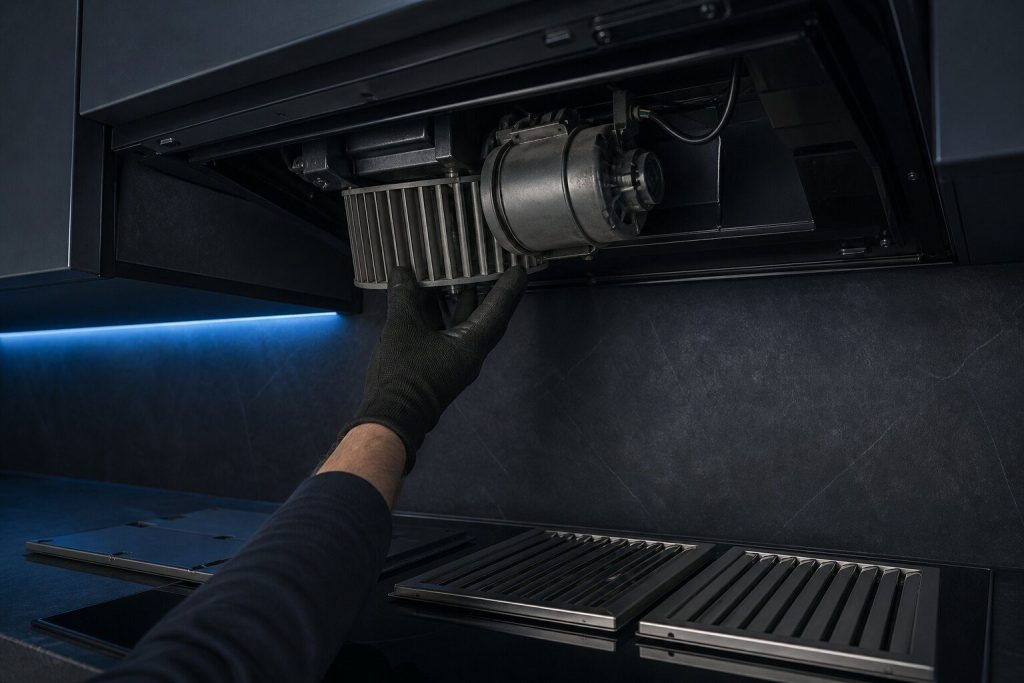
from $155 Filter and duct service
The maintenance nobody was told about, and the answer to a large share of 'the hood does not clear the kitchen' calls. Baffle filters above high-output burners or a griddle load quickly, and a loaded filter is both an airflow problem and fuel sitting over flame. Beyond the filters, the duct itself is worth looking at in this climate: a wall cap with a nest behind it, a damper that has stopped opening, or flexible ducting that has been crushed above a ceiling will defeat any blower. We check the whole route rather than the part that is easy to reach.
- Loaded filters over a griddle are a fire question, not a housekeeping one
- A wall cap with a nest in it is a routine finding here, not an exotic one
- Any blower loses to a crushed or blocked duct
-

The fan runs and the room still fills Hood not clearing smoke
DCS range hood not clearing the kitchen. Before anything is opened there is a question that resolves a surprising share of these calls: where is the air actually going. Air that leaves the building behaves nothing like air that is filtered and handed back, and a large share of these calls turn out to be the second kind of hood doing precisely what it was fitted to do. On a hood that genuinely vents outside, the suspects are filters nobody has washed, ducting flattened by whoever worked in the ceiling, a wall cap whose flap has stopped lifting, or a wheel turning at a fraction of the speed it should.
- If the air never leaves the room, steam never leaves it either — that is the install
- Something living behind the exterior flap is an ordinary finding here
- Over burners this size, filter grease is both restriction and fuel
-

Over the range indoors, over the grill outside Range hoods
A hood is the machine nobody thinks about until the kitchen stops clearing, and on this badge there are two of them living quite different lives. Indoors it sits over a high-output range and is asked to move a great deal of air quietly; outdoors it sits over a grill in the weather and is asked to survive. The problems divide the same way — indoor hoods bring blowers, speed controls, lights and baffle filters that nobody has washed; outdoor hoods bring corrosion, water where the electrics are, and a duct that has become a home for something. Whether the hood actually vents outside or recirculates through a filter is the first thing we establish, because half the complaints we hear about smoke are a hood doing exactly what it was installed to do.
- Indoor and outdoor hoods on one badge, and they fail for opposite reasons
- Vented or recirculating decides whether the complaint is a problem at all
- Baffle filters are the maintenance nobody was told about
Questions people ask about this
Can baffle filters really go in the dishwasher?
Stainless baffles, yes — that is what they are for, and a hot cycle does a better job than anything by hand. Mesh filters are a different item and some of them do not survive it. If yours are a honeycomb of fine mesh rather than interlocking metal blades, wash those by hand.
The kitchen still does not clear with clean filters.
Then the filters were not the problem and the duct probably is. Flexible ducting crushed above a ceiling, a joint that separated years ago, an exterior flap painted shut — any of those defeats any blower, and none of them is visible from the kitchen.
What about the outdoor hood over the grill?
Same filters, harder life, and one extra reason to keep on top of it: on a terrace the grease film that collects on everything around the hood is what holds salt against the metal. Cleaning the filters there is corrosion maintenance as much as airflow maintenance.
Maintenance & Prevention
More guides like this one
-

Seasoning DCS Grill Grates, and the Months Nobody Cooks
Seasoning is corrosion protection as much as cooking practice, and four blocks from salt water that changes the arithmetic. A grate scrubbed back to bare metal has nothing left defending it.
Read more -
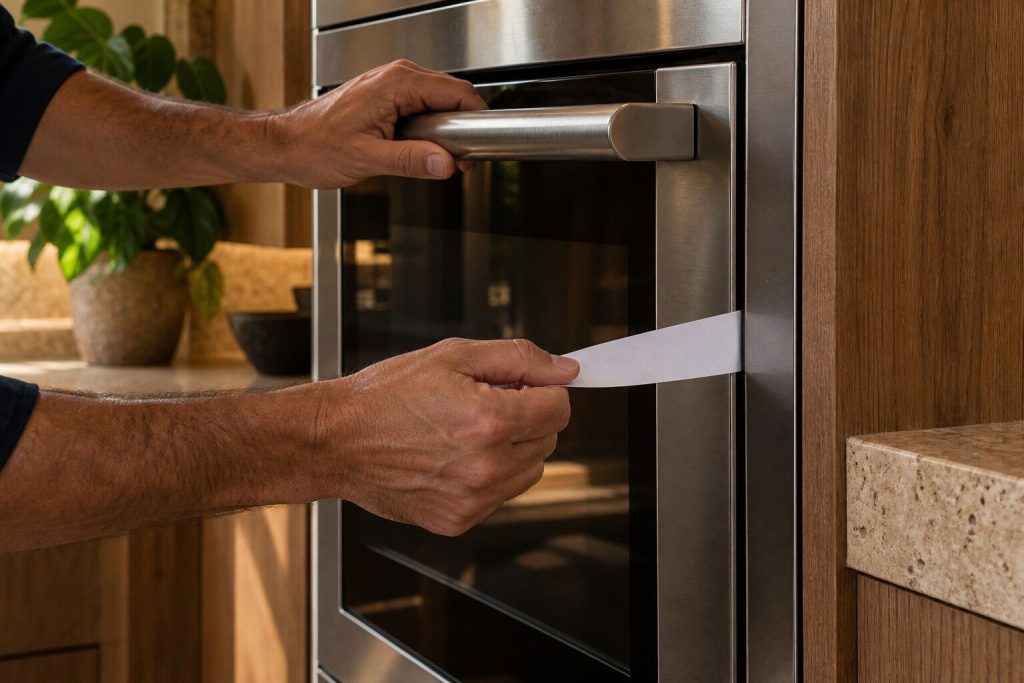
What a Self-Clean Cycle Does to a DCS Oven, and What to Check After
The cycle is the hottest hours of the oven's year. Things that were marginal beforehand frequently do not survive it — and they show up in the week after, not during.
Read more -

Do DCS Grill Covers Help in South Florida? Sometimes the Opposite
A cover keeps rain and salt spray off, which is worth having. It also makes a still, dark, humid box — and a cover pulled over a warm or wet grill traps exactly what corrodes it.
Read more
Tell us the model number and what it is doing.
This article is based on:
- Official manufacturer documentation
- Internal repair procedures
- Technician repair history
- Company quality standards