Maintenance & Prevention
Seasoning DCS Grill Grates, and the Months Nobody Cooks
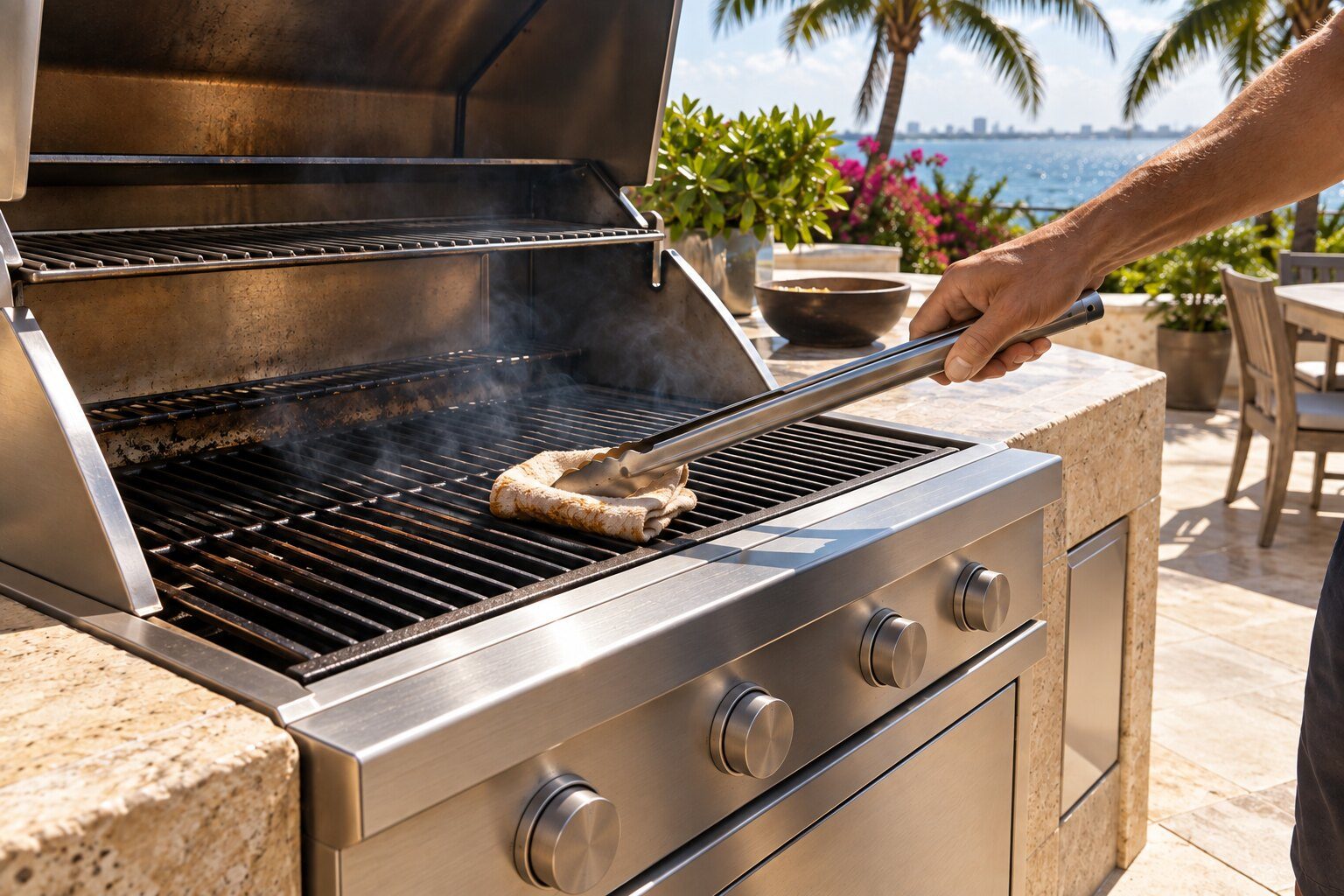
Seasoning a DCS grill grate means building a thin, hard film of polymerized oil onto clean metal, and near the ocean it is doing two jobs rather than one. Heat the grill until the grates are hot, brush off what is loose, wipe a high smoke point oil on thinly with a cloth held in tongs, and let the grill run until it stops smoking. Thin is the whole technique — a thick coat goes sticky rather than hard and collects everything that touches it. Repeat after two or three cooks until the surface darkens and stops looking like bare metal. What matters more in this market is the other half: five months when nobody cooks. A grate scrubbed back to bright steel and then left under a cover through a humid summer has nothing at all defending it, which is why grills come out of the quiet season with surface rust their owners did not expect. Cover it cold and dry, never warm or wet, and run the grill occasionally through the off months rather than sealing it away.
The full guide
Everywhere else, seasoning a grate is about cooking. Four blocks from the ocean it is also the only thing standing between that metal and the air.
How to season DCS grill grates: what seasoning actually is
Oil, heated past the point where it stops being oil. It polymerizes — cross-links into a hard, thin, slightly rough film that is bonded to the metal rather than sitting on it.
That film does two things. Food releases from it, which is the reason everybody knows about. And it excludes moisture from the steel underneath, which is the reason that matters here.
The method, briefly
Run the grill until the grates are properly hot. Brush off anything loose — food, flakes of carbon — while it is hot, because it comes away easily and takes nothing with it.
Fold a cloth into tongs, dip it in a high smoke point oil, and wipe the grates thinly. Thin is not a suggestion: a heavy coat never fully hardens, stays tacky, and collects every particle that passes.
Close the hood and let the grill run until it has stopped smoking. That is the film forming.
Do it again after the next couple of cooks. After three or four rounds the surface darkens and stops behaving like bare metal.
The part that belongs to this market
Six months of the year the grill is used most weekends and looks after itself. The other five it sits, covered, in air at eighty percent humidity, and that is where the damage happens.
A grate that was scrubbed hard at the end of the season — cleaned properly, as everybody thinks they should — has been stripped of the only protection it had, and then put away wet in a still, dark box.
So the off-season routine is the opposite of tidying up:
Season it before you stop using it, not after you start again.
Cover it cold and dry. A cover on a warm grill condenses. A cover on a wet grill holds the water there.
Run it occasionally. Twenty minutes on high once a month burns off moisture and keeps the venturi tubes uninteresting to anything looking for somewhere to nest.
Why this connects to the repairs we do
Almost every yellow flame we see in the first weeks of the season came from the months before it. Almost every seized fixing was seized months before anybody tried to undo it.
Seasoning a grate does not prevent either of those directly. What it prevents is the habit that causes them — the deep clean followed by five months of neglect — and it replaces it with something that takes ten minutes and keeps the grill in the condition it was in.
If it turns out to be a repair
What this leads to, and what it costs
Every job on this site is priced the same way: an on-site diagnostic first, the figure agreed in writing before anybody starts.
-
from $175 Appliance maintenance
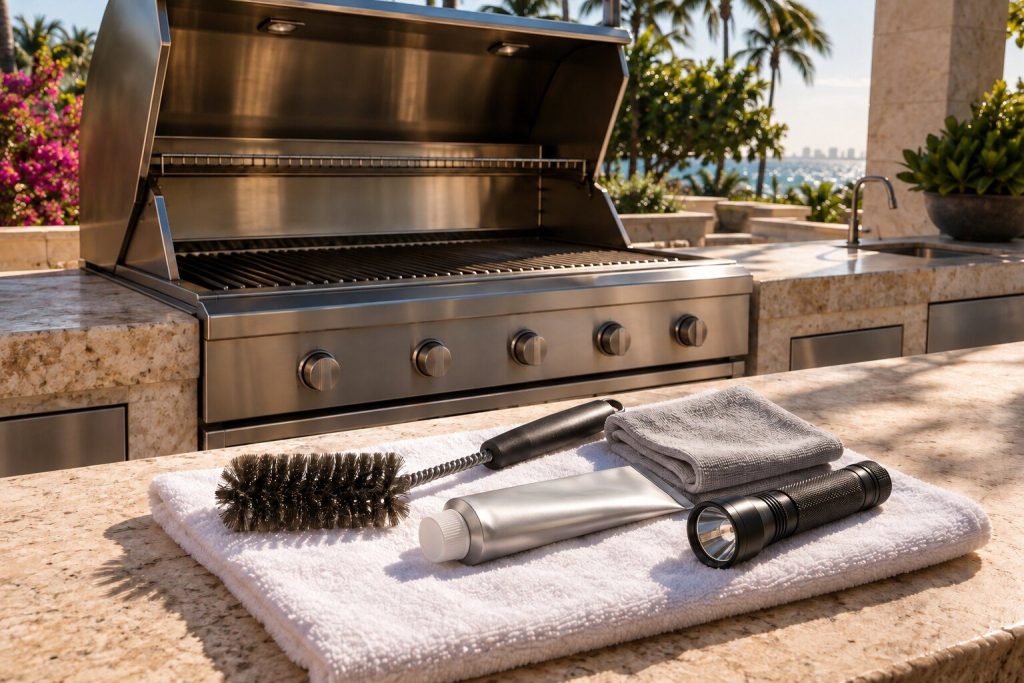
The visit that is booked rather than called in. Outdoor cooking equipment in this market does not fail on a schedule set by hours of use — it fails on one set by salt, rain and the months it spends under a cover with humidity trapped underneath. A maintenance visit is where burners come out and get looked at before they are the reason dinner stopped, where the grease path is cleared before it is a fire, where drawer runners are treated before they pit, and where an undercounter refrigerator's condenser is cleaned before August asks it for everything. Indoors it is the ordinary and useful work: seals, hinges, sensor accuracy, filters, and the parts of a high-output range that quietly drift.
- Built around salt and season rather than around hours of use
- The grease path is treated as a fire question, because that is what it is
- Findings written down, so next year's visit starts from evidence
-
from $195 Salt air protection service
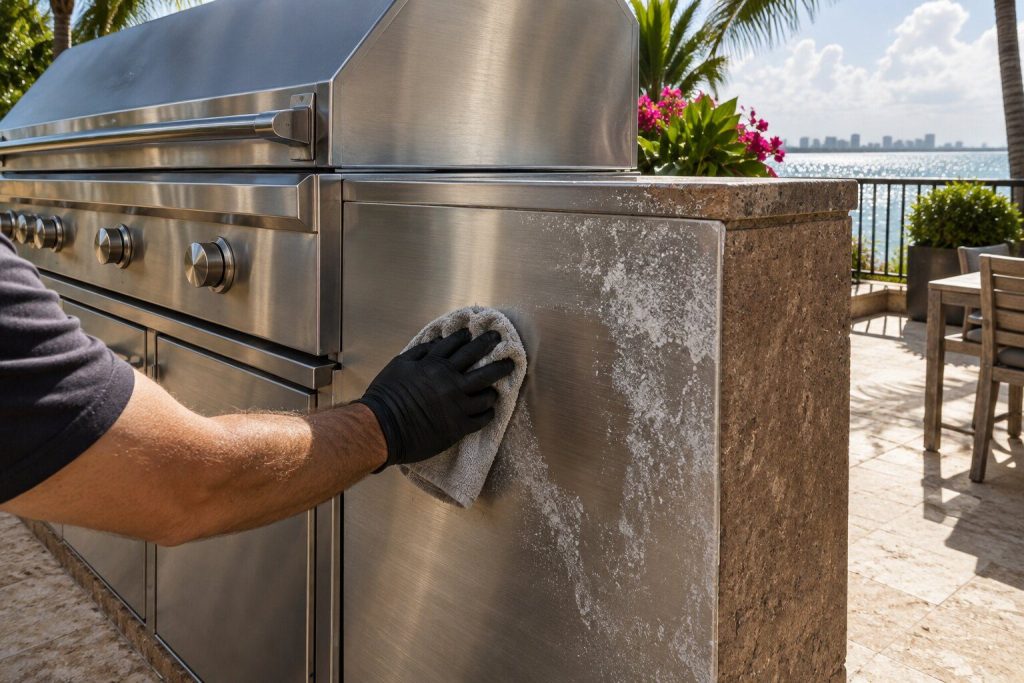
A visit that exists because of where this equipment lives. Four of the seven machines on this site stand outdoors in air that carries salt, and the difference between a kitchen four blocks from the water and one four miles inland is measured in years of service life. This is the planned, unglamorous work that changes that number: stainless cleaned and protected in the right direction, fixings inspected and replaced with the right grade before they seize, ignition components and electrical housings treated and re-sealed, hardware caught while it is stiff rather than after it is stuck. It is not a cosmetic service, although the kitchen does look better afterwards.
- Distance from the water is the real service interval on this coast
- Fixings replaced with the right grade before they seize, not after
- Not a polish — the point is the fixings, the housings and the hardware
-
Brown speckling on doors, handles and fixings Outdoor stainless is pitting and rusting
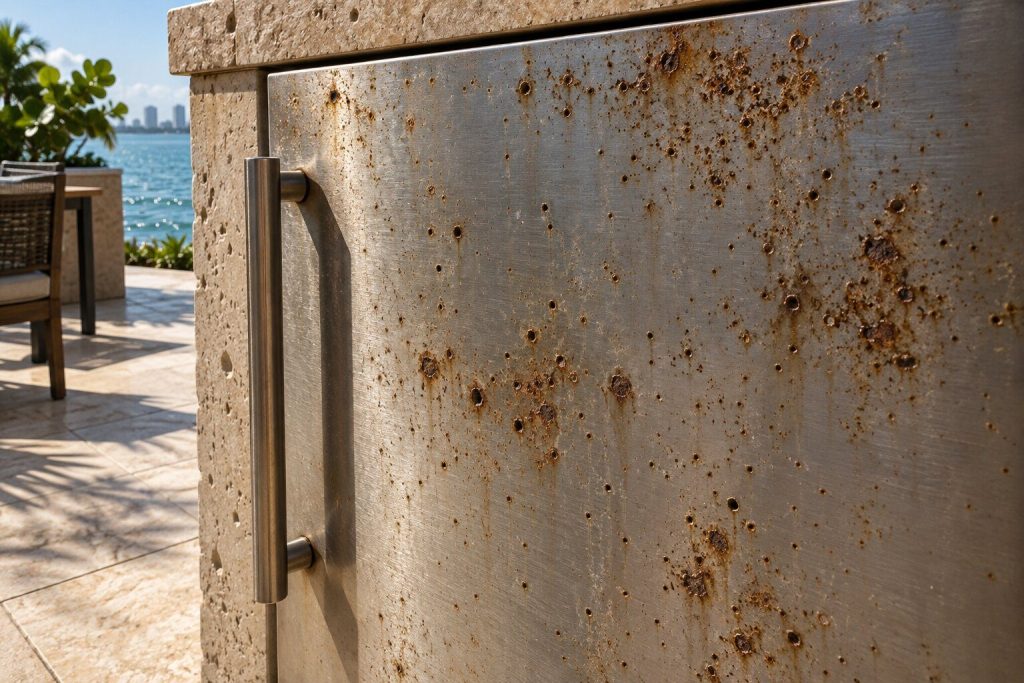
DCS outdoor stainless rusting. Outdoor-rated stainless resists salt; it does not ignore it. Brown speckling on a door or a handle is cosmetic and is slowed a great deal by rinsing with fresh water and drying, and there is no shame in a waterfront grill showing it. What is not cosmetic is corrosion around the vents, the hinges, the mounts and the fixings — those are the parts holding cabinets square and seals true, and they are the ones worth acting on.
- Speckling on a face is cosmetic; corrosion at a fixing is structural
- Fresh water and drying does more than any polish
- Distance from the water is the real interval — four blocks is not four miles

Questions people ask about this
Which oil?
Anything with a high smoke point — grapeseed, canola, refined avocado. Olive oil smokes too low and leaves a soft residue rather than a hard film. It matters less than people think; applying it thinly matters more.
Should I scrub the grates back to bare metal?
Not routinely, and that is the part most people get backwards. The dark, hard film is what you are trying to keep. Brush off food and loose carbon while the grill is hot, and leave the seasoning alone. Stripping back to bright steel is for a grate that has genuinely gone bad, and it is followed by re-seasoning the same day.
Does a cover make it worse?
It can, and this is the local version of the question. A cover on a dry, cold grill keeps rain and salt spray off, which helps a great deal. A cover pulled over a grill that is still warm, or one that is wet, traps humidity against the metal for weeks — which is exactly the condition that corrodes it.
Maintenance & Prevention
More guides like this one
-
What a Self-Clean Cycle Does to a DCS Oven, and What to Check After
The cycle is the hottest hours of the oven's year. Things that were marginal beforehand frequently do not survive it — and they show up in the week after, not during.
Read more -
How Often Range Hood Filters Actually Need Washing
More often than almost anybody does them. Over high-output burners or a griddle a saturated baffle is two things at once: most of your airflow gone, and fuel sitting over open flame.
Read more -
Do DCS Grill Covers Help in South Florida? Sometimes the Opposite
A cover keeps rain and salt spray off, which is worth having. It also makes a still, dark, humid box — and a cover pulled over a warm or wet grill traps exactly what corrodes it.
Read more
Tell us the model number and what it is doing.
This article is based on:
- Official manufacturer documentation
- Internal repair procedures
- Technician repair history
- Company quality standards