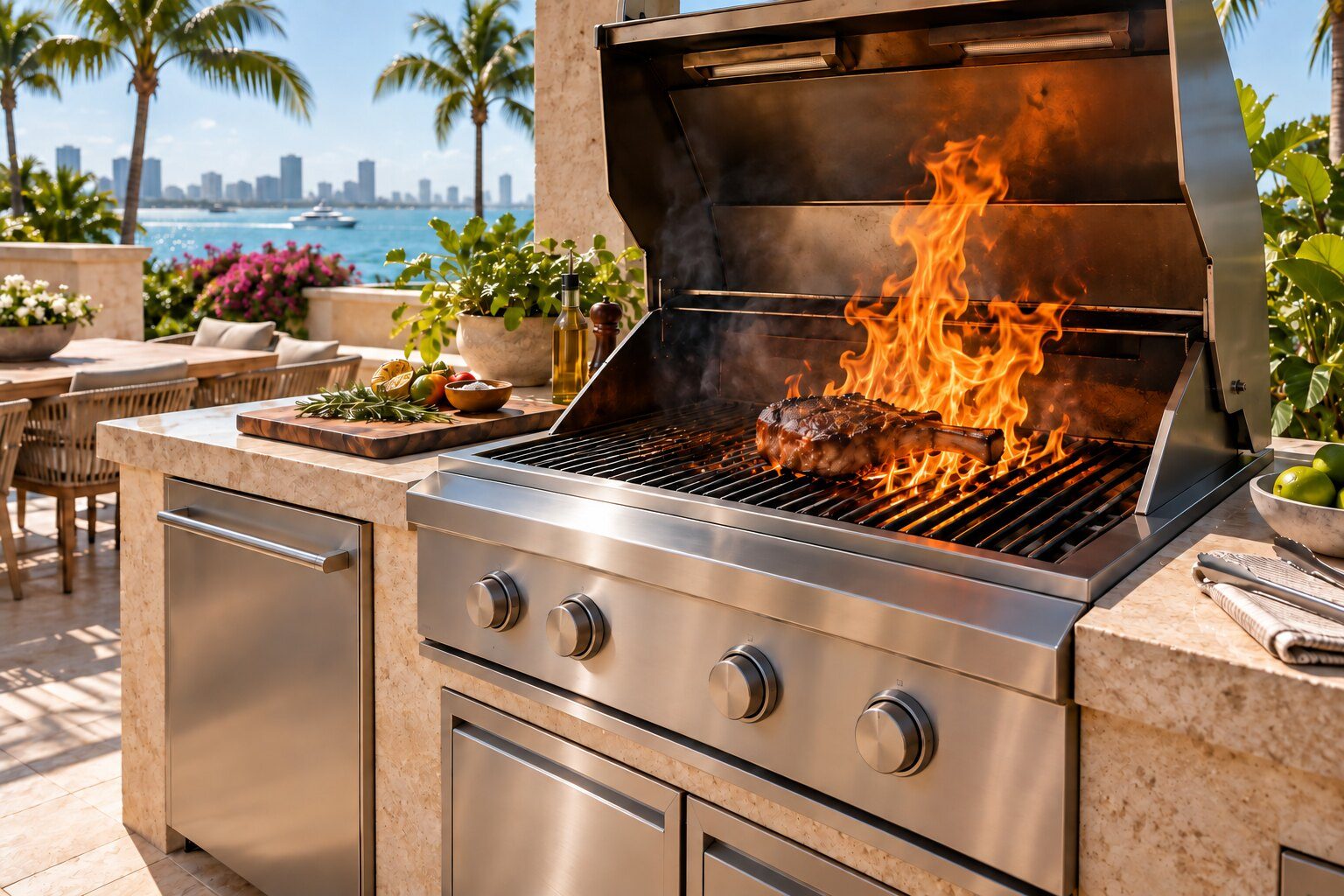
- “Persistent flare-ups are a grease path problem, not a cooking technique problem”
- “Radiants refitted the wrong way round defeat the whole design”
- “The cheapest work on an outdoor kitchen, with the highest consequence if skipped”
Symptom
DCS grill flare-ups
DCS grill flare-ups every time something fatty goes on. Occasional flame when fat hits heat is cooking; a grill that burns everything on it is telling you the grease path has stopped working. That path is a design — radiants spread the heat and shed what falls on them, a tray collects it, a channel carries it to a cup — and when any part of it is loaded, missing or refitted the wrong way round, the drippings go straight onto the burners instead. In this market it is the commonest cause of a grill fire.
- From $95 diagnostic, credited to the repair
- 59 cities and neighborhoods covered
- OEM parts available on order
- In writing the price, before anything is opened
Three ordinary causes
What this usually turns out to be
Cheapest and commonest first, which is also the order we check them in. They sit hundreds of dollars apart, and only the unit settles which one is yours.
-
The grease path is loaded
Tray full, channel blocked, cup overflowed. Everything rendered out then lands on the burners, which is precisely what the design exists to prevent.
Grease management service from $165 -
The radiants are warped, holed or wrongly fitted
They are not heat shields for their own sake — their shape sheds drippings sideways. Warped, holed or upside down, they funnel fat down instead.
Grease management service from $165 -
The burners are cooking unevenly
A burner that has burned through puts a hot column where the design did not intend one, and fat that would have rendered gently ignites instead.
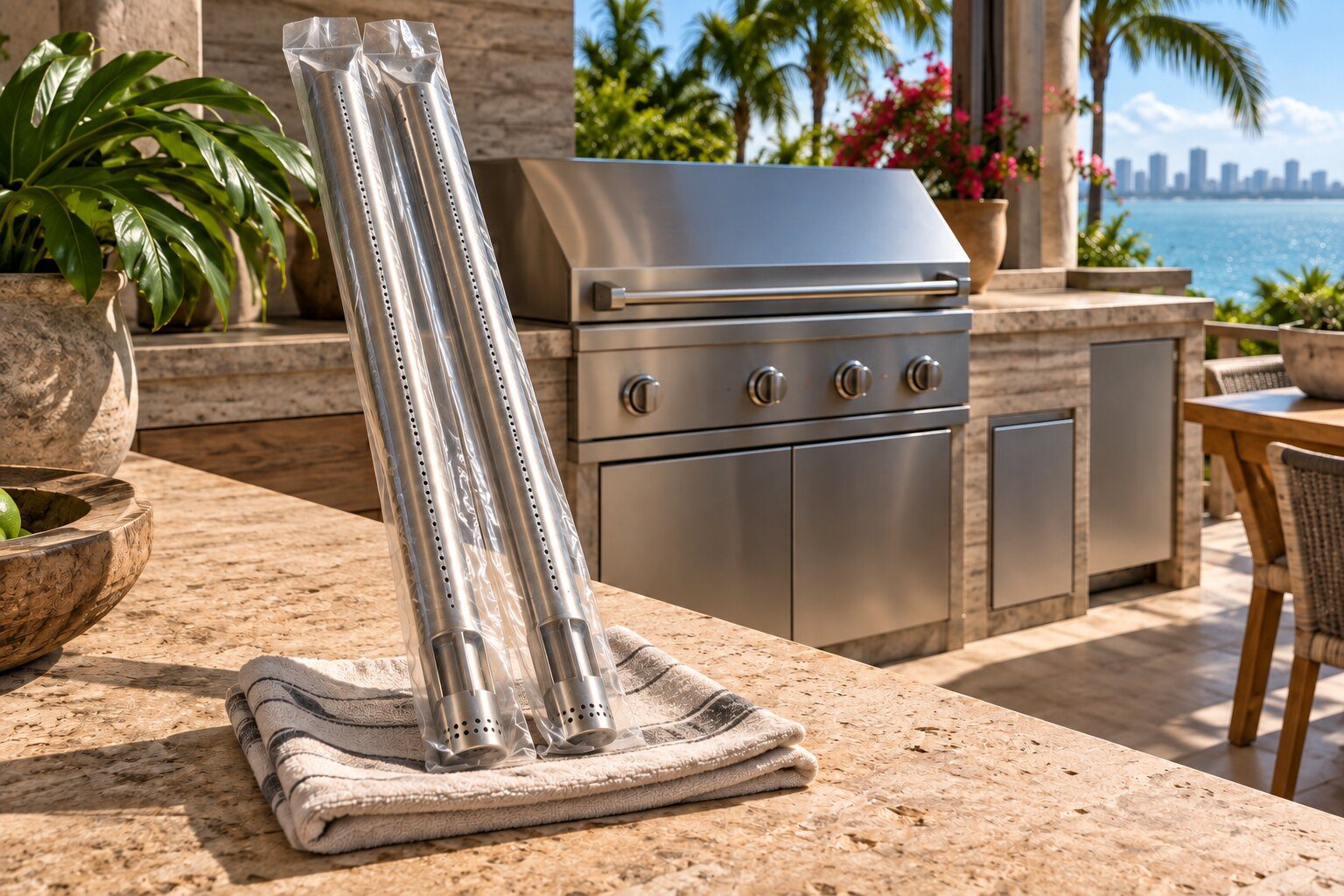
Grill burner replacement from $185
In five minutes
Before you call anybody
None of it needs tools, and all of it makes the visit shorter.
-
01
When did anybody last take the radiants out?
Not the grates — the trays underneath them. On most grills we open, the answer is never, and that is the finding.
-
02
Is the drip cup overflowing?
If it is full, everything upstream of it is full too, and the path has been backing up for a while.
-
03
Do the flare-ups happen on one area or across the grill?
A single hot spot points at one burner or one radiant. Across the whole width points at the tray and the channel.
How it shows up
What people describe when they call
Two shortcuts
Narrow it down before anybody arrives
A description of the behaviour leaves a few possible causes. A code names the subsystem, and the model number says which parts to bring. Either one shortens the visit; both together usually settle it.
If the display is showing something
Photograph it before it clears — codes do not wait. Search the full code list
In more detail
About DCS grill flare-ups
What to do in the next ten minutes
If the flames are persistent rather than occasional, turn the burners off and close the lid — starving it is safer than moving the food. Once everything is cold, lift out the grates, the radiants and the tray underneath and look at all three. Fat with nowhere to go is usually obvious the moment the tray comes out. Check the radiants go back the way they came out.
It is a fire question, not a cleaning one
We treat this as a safety call and that is not caution for its own sake. A loaded grease path is fuel lying directly over open burners in a closed metal box, and once it takes hold it is not something a lid will always contain. The work to prevent it is an hour and costs less than almost anything else on the island, which is the least comfortable part of the arithmetic.
Clean on top, untouched underneath
Almost every badly flaring grill we open has spotless grates. The cleaning that people do is the cleaning they can see, and the part that matters is one layer below it. If you do nothing else after reading this, take the radiants out once and look at the tray beneath them — the state of it will tell you how often this needs doing for the way you actually cook.
This article is based on:
- Official manufacturer documentation
- Internal repair procedures
- Technician repair history
- Company quality standards
Before you book
Questions about DCS grill flare-ups
Should I spray water on a flare-up?
No. Water on burning fat spreads it, and on a hot grill it can turn a contained flare into something much worse. Turn the burners off, close the lid and let it starve. Then find out why the fat was there.
Would a different cooking method help?
It would mask it. Trimming fat and using indirect heat produces fewer flare-ups on any grill, but a grill whose grease path works handles fatty food without drama. If yours cannot, the path is the thing to fix rather than the menu.
Where we do it
Across Miami-Dade, Broward, and Palm Beach
Same terms everywhere we go: an on-site diagnostic first, the price agreed in writing, and the exact figure confirmed once we have seen the unit.
Neighborhoods people ask for by name