Safety & Risks
A Gas Smell With Everything Switched Off Is a Different Problem
There are two versions of this and they are not the same question. A brief smell while lighting, or at a burner whose dial has been left open, is gas that has been admitted by a control doing exactly what it was asked to do; the answer there is ventilation and attention to the dials. A smell with every control shut is different in kind, because it means gas is passing something that is supposed to be closed — a manifold connection, a valve seat, a regulator, or a joint in the supply run. Outdoors that run was made, pressure tested and then sealed inside masonry when the island was built, and in most houses nobody has looked at it since; it has been sitting in salt air the whole time. This page carries no test procedure on purpose. Every meaningful test involves the gas being on, and at a leak that is not a household task. What it does carry is the order of shutting down, which is the same whether the smell is faint or obvious: no ignition sources, no switches either way, gas off at the source, air moving, and everybody out while it clears.
The full guide
Two sentences that sound alike describe different situations. "I smell gas when I light it." And "I smell gas and nothing is on." Only the second one is on this page.
Gas smell from oven but no leak: why the second one is worse
With a control open, gas is where it was told to go. A burner that did not catch, a dial nudged while somebody reached past, a cylinder valve opened onto an appliance already turned on — the gas arrived because a valve was asked to pass it.
With every control shut, nothing was asked. Gas is getting past something whose only job is to stop it: a valve seat, a manifold joint, a regulator diaphragm, a fitting in the supply run. That is a defect rather than a mistake, and it does not correct itself.
The part nobody has looked at
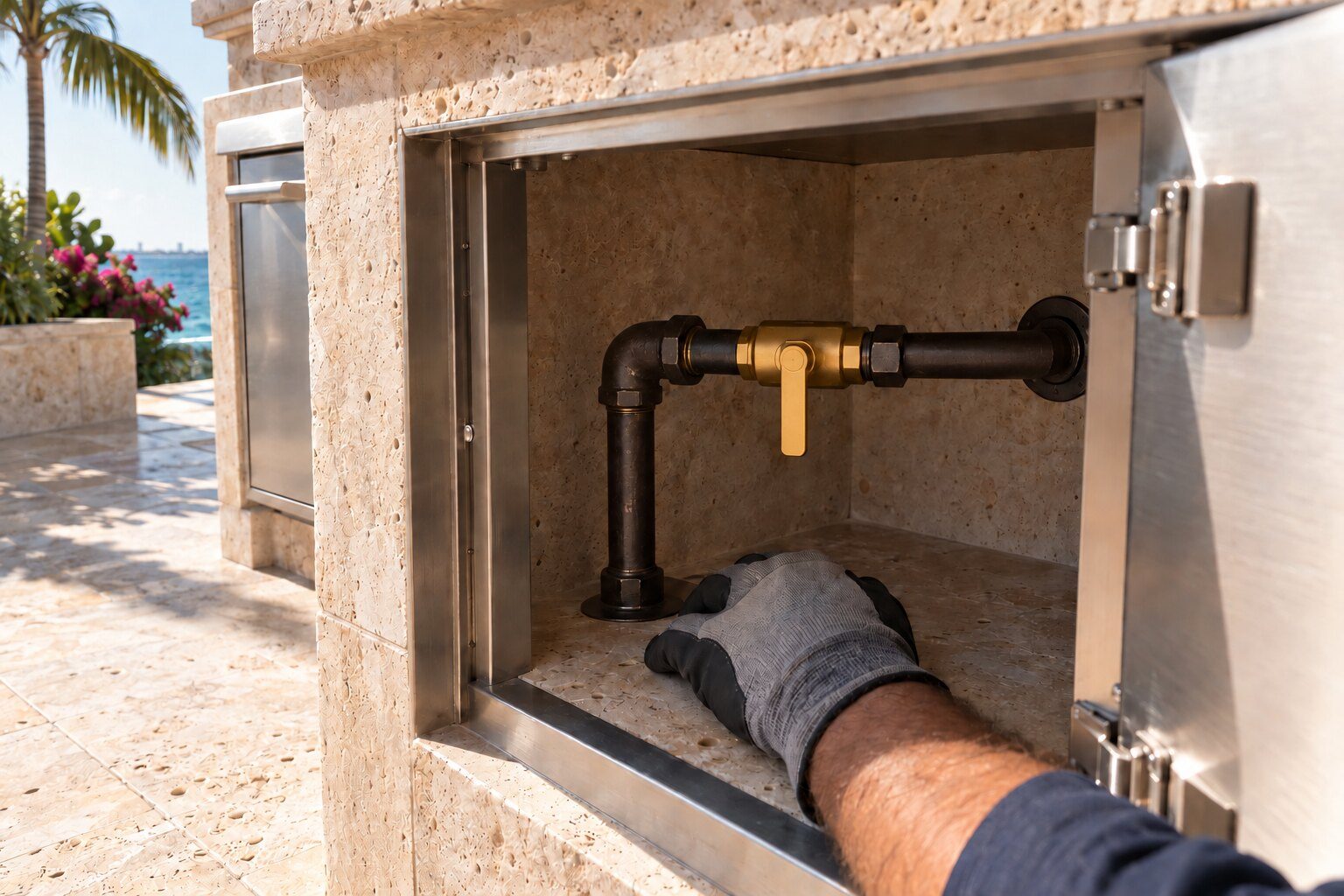
On a built-in outdoor kitchen, the supply run was made and tested when the island was built, then sealed behind stone.
Since then it has been in salt air, through summers in a hot cabinet, alongside a grill that heats and cools every weekend. Fittings that were sound at the pressure test have had years to move and to corrode, and nothing about the cabinet invites anybody to check.
That is why a smell with everything off, on a terrace, is not the same statement as the same smell in a kitchen.
The order of shutting down
Do this in this order, and do it the same way whether the smell is faint or obvious.
No flames, no matches, no lighter. That includes something already burning somewhere else nearby.
Do not operate switches. Not lights, not the hood, not a fan, and not to turn something off. A switch sparks in both directions. Leave every switch exactly as you found it.
Shut the gas off at the source. The cylinder valve on a propane island, or the manual shutoff on a natural gas line. If that valve is inside the cabinet the smell is coming from, do not go in after it.
Move air. Open doors and windows by hand. Do not switch a fan on to help.
Get everybody out and stay out. From outside, call the gas company or the fire service. Not a repair company first.
Why there is no procedure on this page
You will find pages telling you to brush soapy water along the joints and look for bubbles. That is the right test, and it requires gas flowing through the line you suspect is leaking.
A technician does it having already established what can be isolated and how fast. Doing it yourself means reopening the supply you just closed, in order to hunt the leak by feeding it, usually in a confined cabinet. The value of finding it yourself does not come close to the cost of getting that wrong.
Where it becomes ours
Once the supply is safe and the finding is the appliance — a manifold connection, a valve that no longer seats, a regulator that has stopped holding, a flex connector that has corroded where it enters the island — that is our work, and it is common work here.
If instead the finding is in the house line or the meter, it stays with the gas company, and we will say so rather than opening a cabinet that is not ours to open.
If it turns out to be a repair
What this leads to, and what it costs
Every job on this site is priced the same way: an on-site diagnostic first, the figure agreed in writing before anybody starts.
-
Smell of gas at the grill
Smell of gas at a DCS grill or outdoor kitchen. This is the one page on the site with no troubleshooting on it. Gas with a dial on and the burner unlit is one thing; gas with everything shut off is another and a more serious one. Outdoors in salt air a joint that was sound three seasons ago is not automatically sound now, and the fittings under a stone island are the ones nobody has looked at since the mason closed it up.
- Shut the supply off at the cylinder or the wall valve and leave it off
- No ignition sources nearby — that includes the grill's own ignitor
- We do not diagnose this by telephone and we do not ask you to test it
-
Grill signal A smell of gas
DCS grill · no code is displayed — stop and shut off. This is the one signal on the site with no troubleshooting attached to it.
What the lights are telling you -
Gas supply and regulator service
Everything upstream of the burner, which is where a large share of outdoor problems actually live. Weak flame on every burner at once, a grill that will not reach temperature, a cylinder that empties faster than it should, a limiting device that trips every time the valve is opened quickly — none of those are the grill. Under an island the fittings, the flexible connector and the manifold live in a space nobody has looked at since the mason closed it, in air that corrodes. We test rather than guess, and where the answer belongs to a gas contractor rather than to us, we say that.
- All burners weak at once is a supply question, not a burner question
- The fittings under an island are the ones nobody has ever seen
- Where it belongs to a gas contractor, we say so instead of improvising

Questions people ask about this
The smell goes away after a minute. Is that still serious?
If it happened with every control off, yes. A small passing leak clears in moving air and comes back when the air is still, which is why people notice it in the morning and not in the afternoon. Intermittent describes when you can smell it, not how much is escaping.
Can I use soapy water to find it myself?
That test requires gas in the line, and it is the standard method for a technician who has already isolated the area and has the means to shut it down. With gas off it shows nothing; with gas on you are looking for a leak while feeding it. This is the one job on the island we would rather you did not start.
Who do I call — the gas company or you?
The gas company or the fire service first, always, and without waiting. They make the area safe, which is not what we do. Once it is safe and the finding points at the appliance, its manifold or its regulator, that part is ours.
Safety & Risks
More guides like this one
-
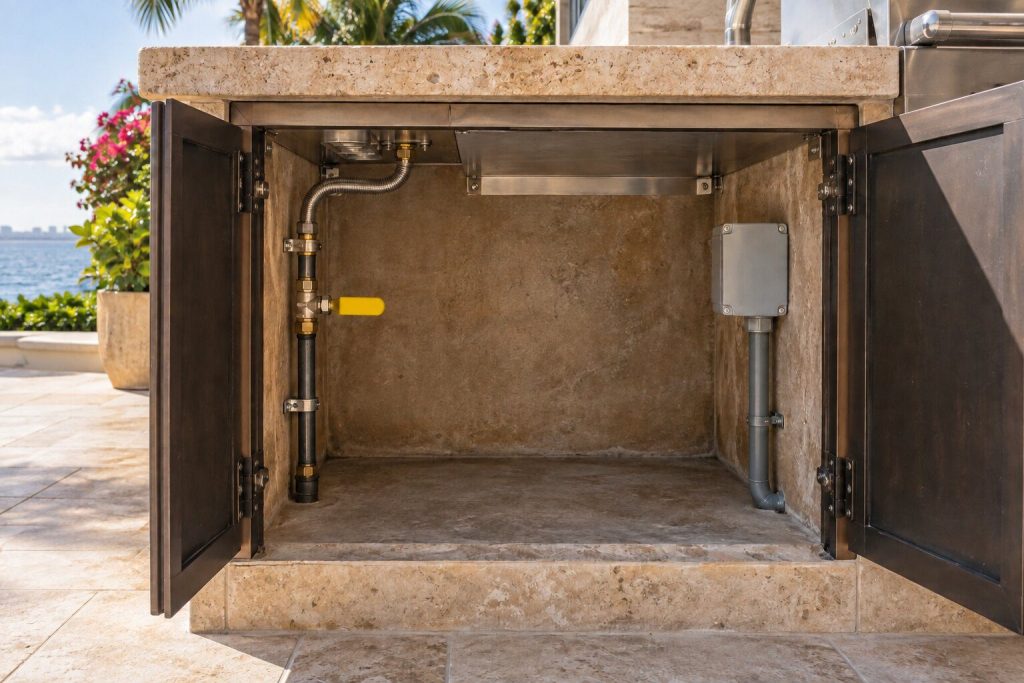
What Is Still Live on an Outdoor Kitchen After You Switch It Off
Turning a grill off turns the burners off. It does not close the gas at the manifold or cut power to the lights, the ignition module and the rotisserie — and on an island those are shared.
Read more -

A Grease Fire on a Grill or a Range: What Actually Puts It Out
Water spreads burning fat. The response that works is starvation, and the one most people reach for first makes it larger — then there is the question of why the flare-ups started at all.
Read more -
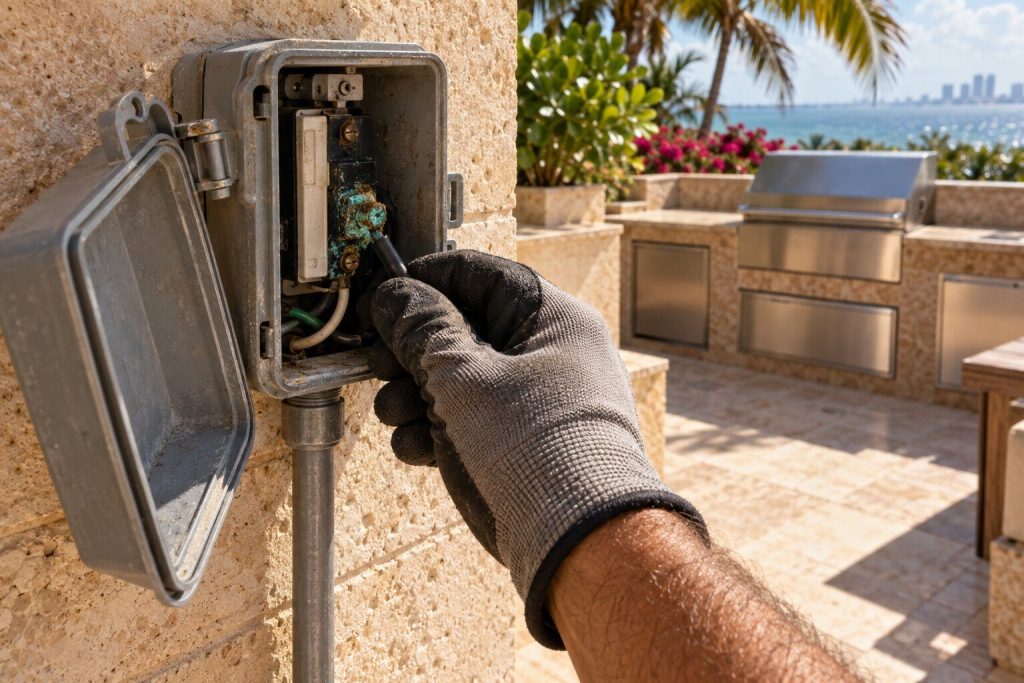
When an Appliance Smells Faintly of Fish, Stop Using It
It is one of the few smells in a kitchen that means exactly one thing, and nothing anybody cooked produces it. Overheating insulation smells like this before anything visibly fails.
Read more
Tell us the model number and what it is doing.
This article is based on:
- Official manufacturer documentation
- Internal repair procedures
- Technician repair history
- Company quality standards