Troubleshooting
A DCS Oven Door That Has Locked Itself Shut
A DCS oven door that has locked itself is one of three quite different things. It may be a self-clean cycle that has run and has not finished cooling — the latch stays engaged until the cavity is below a safe temperature, which can be well over an hour after the cycle ends, and nothing is wrong. It may be a control lock somebody enabled without meaning to, usually by holding a button while wiping the panel, in which case the same button combination clears it. Or the latch motor has failed partway through its travel, which is the only one of the three that needs anybody. Telling them apart takes two questions and costs nothing: has the oven been self-cleaned in the last few hours, and is there a lock symbol on the display. Forcing the door is what turns the cheapest of these into the most expensive, because a latch under motor tension does not yield before the door furniture does.
The full guide
The first thing worth saying is the least satisfying: on the commonest cause, the answer is to leave it alone for an hour.
DCS oven door locked: one: the self-clean has not finished
A high-temperature cleaning cycle locks the door because the cavity reaches temperatures that would be dangerous to open into. The lock is released by temperature rather than by the timer, so the cycle finishing and the door unlocking are two different events with an hour or more between them.
On a heavy cavity in a warm kitchen that gap is longer than people expect, and it is the single most common reason we are called about a locked door.
If you self-cleaned this morning and it is locked now, wait. If you self-cleaned yesterday, read on.
Two: the control lock is on
Most ovens have a lock intended to stop a child changing settings, and most of them enable it by holding one button for a few seconds. That is exactly the gesture somebody makes while wiping a control panel.
There is usually a symbol on the display when it is engaged — a padlock, or a word. Holding the same button clears it.
This one is worth checking before anything else because it costs nothing and it is embarrassing to pay for.
Three: the latch has failed
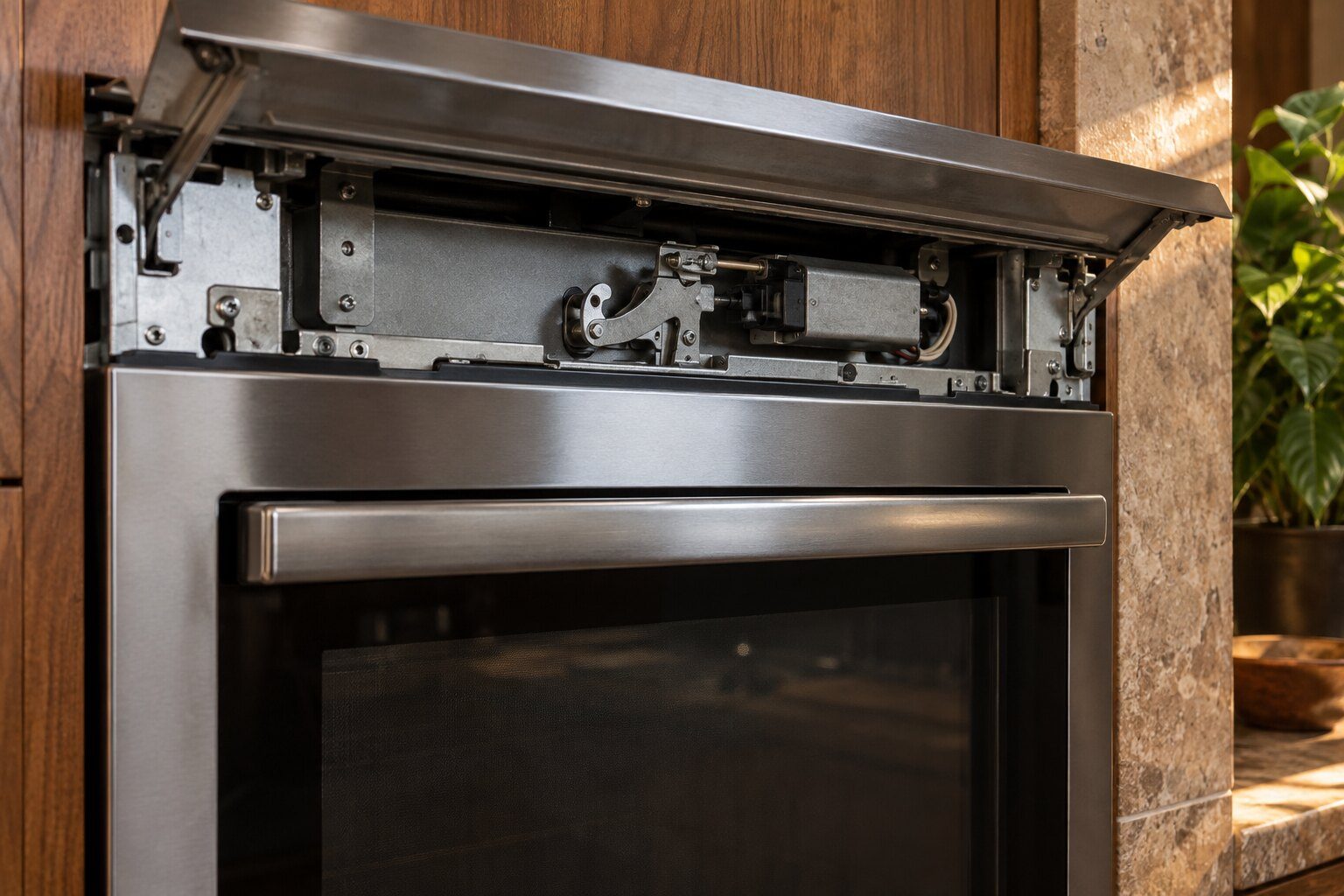
The latch is driven by a small motor that swings a hook into place and back out again. When that motor fails partway through its travel, the hook is in and will not come out, and there is no cycle and no button that will release it.
This is a real repair and a modest one. What makes it expensive is the next paragraph.
Why forcing it is the costly move
A latch hook under motor tension is stronger than the parts around it. Pulled hard, what gives is the door — a bent inner panel, a handle pulled out of its fixings, a hinge taken past its stop, the glass stack disturbed.
We have replaced doors on ovens whose latch would have been an hour's work. If it will not open, it will not open, and nothing about waiting makes it worse.
What to tell us when you call
Whether the oven has been self-cleaned recently. Whether there is a lock symbol. Whether the display shows a code. And whether anything is shut inside it — that changes the priority rather than the diagnosis, and we would rather know.
The related problem worth mentioning
A door that will not lock is the same mechanism failing the other way, and it matters because a self-clean will not start without it. If your oven refuses to begin a cleaning cycle, the latch is the first thing to look at rather than the control.
If it turns out to be a repair
What this leads to, and what it costs
Every job on this site is priced the same way: an on-site diagnostic first, the figure agreed in writing before anybody starts.
-
An icon, a beep, and a letter with two digits Oven shows an error code
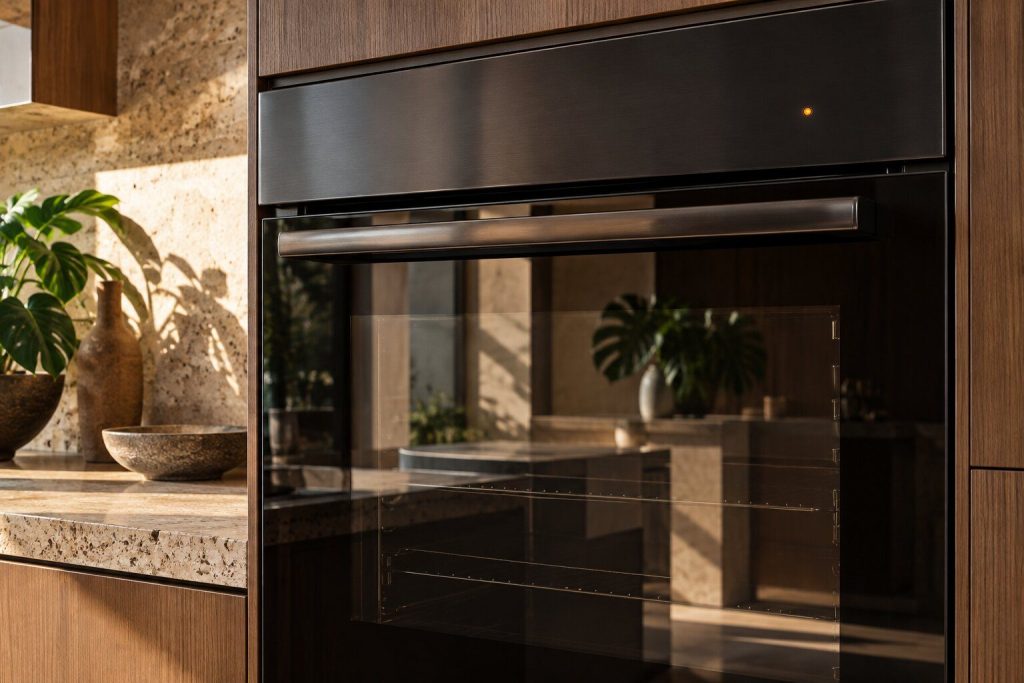
DCS oven error code. On the indoor half of this make the codes are decoded rather than bare — the manufacturer publishes what each one means, and the two digits after the letter separate a missing power board from a software error from two different communication errors from a model identity mismatch. That last one is the interesting case: it is not a failure at all but a mismatch, usually created by an earlier repair, and no further replacing will clear it. Write the whole string down before it goes.
- The letter alone narrows nothing — the digits after it are the message
- One of the published codes means an earlier repair fitted the wrong variant
- Power down at the breaker for a full minute before deciding anything
-
from $155 Range door and hinge service
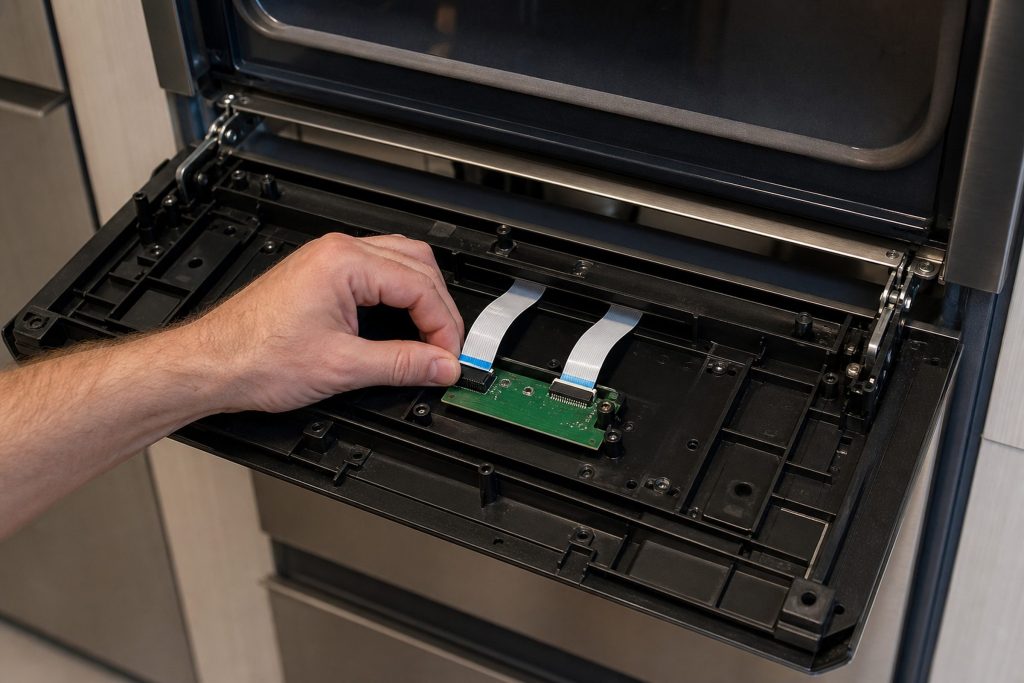
A heavy door that has stopped closing square costs heat, costs even baking, and eventually costs the seal and the hinges themselves. On this class of range the door is genuinely heavy, which is why it is worth doing properly rather than adjusting by eye: springs and hinges under tension are the part of an oven most likely to hurt somebody who is improvising. The symptoms people describe — a cool corner, a door that stands a few millimeters proud, a hinge that thuds on the last inch — are all one conversation.
- A cool corner is usually the door, not the element
- Hinges under tension are not an improvise-with-a-screwdriver job
- Seal and hinges are checked together, because they fail together
-
from $185 Wall oven not heating
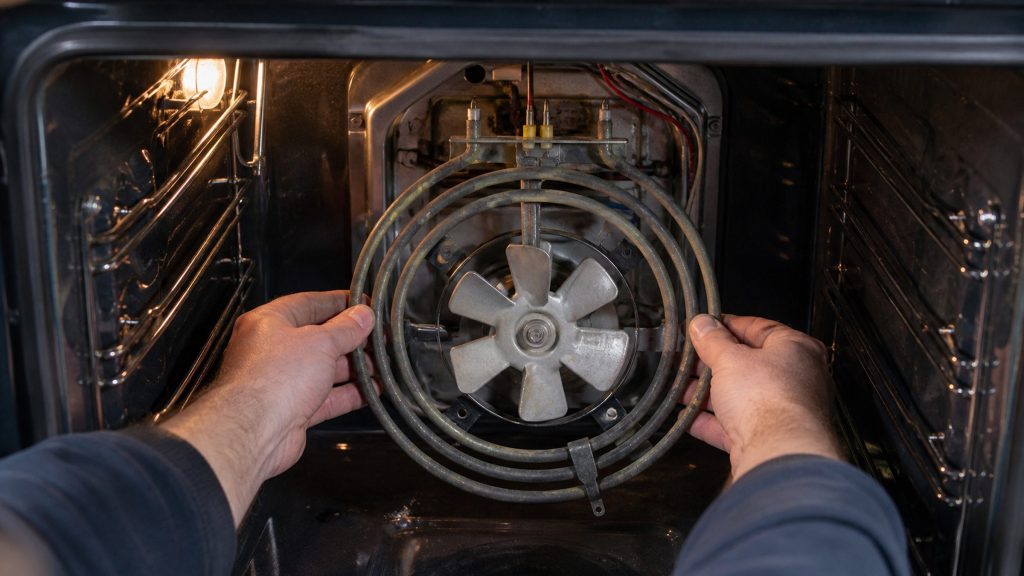
A built-in cavity that has stopped making heat, or has stopped making the heat it claims. The list of causes is ordinary — element, sensor, thermal fuse, board, door — and the access is not, because everything is at chest height in somebody's joinery. This make publishes a decoded error table for these ovens and the sub-error after the letter separates several quite different visits, including one that means the control does not recognize which model it is fitted to. Reading the whole string to us on the phone regularly saves an entire diagnostic visit.
- Read the whole code — the digits after the letter are the message
- A thermal fuse that has opened after a self-clean is a common and cheap finding
- The cabinet decides whether this is an hour or an afternoon
Questions people ask about this
How long should I wait after a self-clean?
Until the oven says it is done rather than until the cycle timer ends — those are different moments. On a heavy cavity the cooling alone can run past an hour, and on a hot day in a closed kitchen longer. If it has been several hours and it is still locked, something else is going on.
There is a padlock symbol on the display.
Then it is the control lock and not a mechanical one, which is the good outcome. It is cleared by holding the same button that set it, usually for a few seconds. If the symbol will not clear, that is worth a call, but it is a control conversation rather than a latch one.
Can the door be opened manually in an emergency?
There is usually a way in from the front panel, and it is not a job to improvise with a screwdriver on a door under spring tension. If there is food shut in an oven that has cooled, it can wait for somebody. If the oven is still hot and something is burning inside, cut the power at the breaker and call.
Troubleshooting
More guides like this one
-
Resetting a DCS Oven Control, and What a Reset Actually Proves
A reset is a test, not a repair. If the error stays away, that was the whole story. If it comes back, the reset has just told you something valuable for nothing.
Read more -
Reading a DCS Oven Error Code: the Digits Are the Message
The letter narrows almost nothing. The two digits after it separate five components and one earlier repair — and one of them is not a failure at all.
Read more -
A DCS Oven That Will Not Turn On at All
Nothing on the panel is a different problem from an oven that lights up and will not heat. Start further back than the oven — frequently further back than the kitchen.
Read more
Tell us the model number and what it is doing.
This article is based on:
- Official manufacturer documentation
- Internal repair procedures
- Technician repair history
- Company quality standards