Safety & Risks
What Is Still Live on an Outdoor Kitchen After You Switch It Off
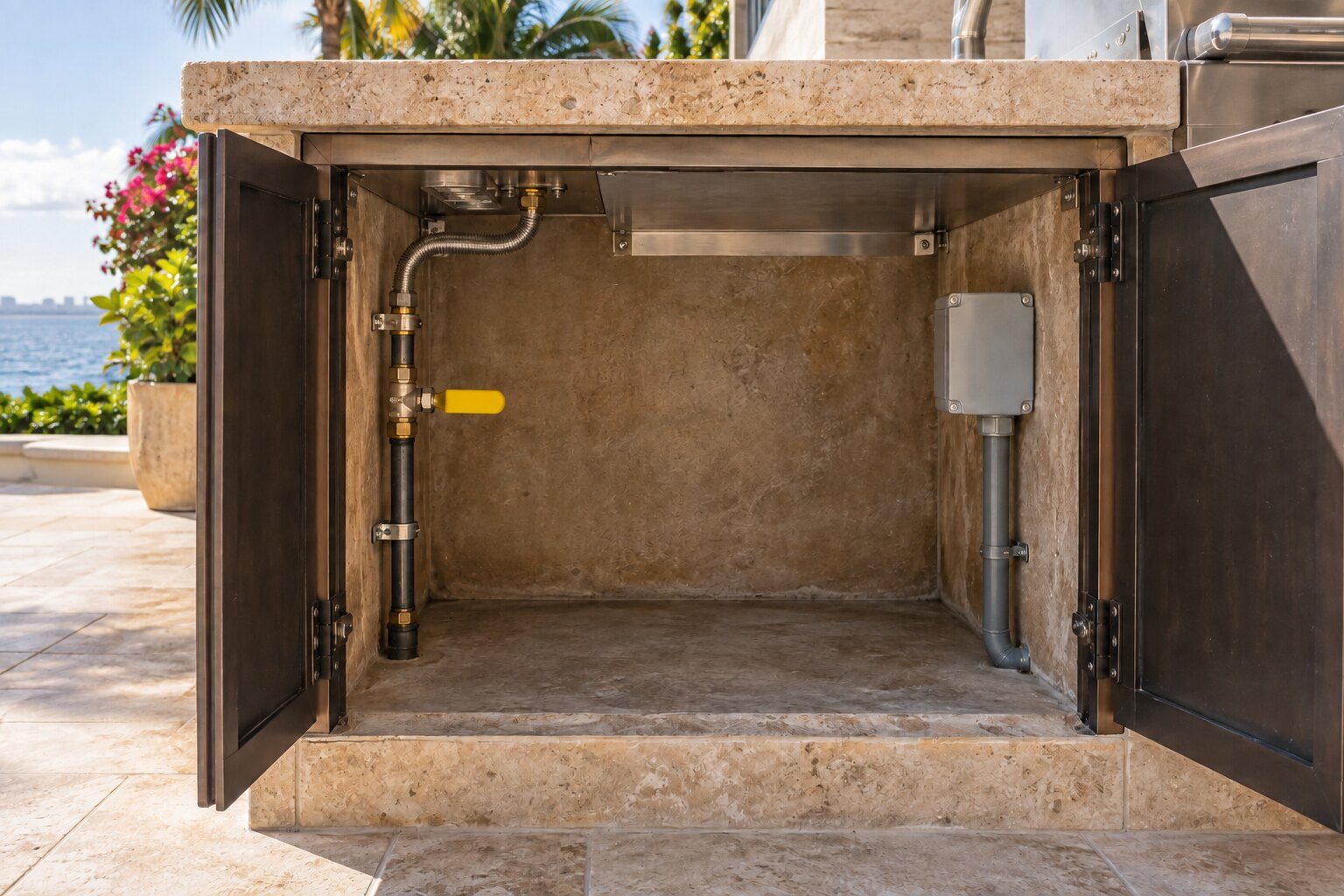
Each control on an outdoor kitchen isolates less than people assume, and knowing which is which matters more here than indoors. Turning the burner dials off closes the burner valves and nothing else: gas is still present at the manifold, right up to those valves, and it stays there until something upstream is closed. The grill's own switches turn off the light, the rotisserie motor or the ignition module individually; they do not de-energize the cabinet they sit in, and the wiring that feeds them stays live. On an island several machines usually share one circuit and one gas supply, so switching the grill off does nothing at all about the refrigerator, the ice machine or the hood beside it. The two controls that actually isolate are the gas shutoff — the cylinder valve or the manual valve on the natural gas line — and the breaker that feeds the island. For everyday use none of this matters. It starts to matter when a fitting has been corroding inside a cabinet for five years, when water has reached a switch housing, or when anybody is about to work inside the island — and before a long absence, closing both is simply the sensible habit.
The full guide
"It's off" is four different statements on an outdoor kitchen, and only two of them isolate anything.
Can an unplugged appliance start a fire? What each control actually does
The burner dials. They close the burner valves. Gas remains in the manifold, up against those valves, at supply pressure. That is the design working correctly — it is how a grill lights in two seconds — but "off" here means "not passing", not "not present".
The appliance switches. A hood light, a rotisserie motor, an interior lamp. Each one interrupts its own load. The wiring feeding them, the switch terminals themselves and anything else in that cabinet stay live.
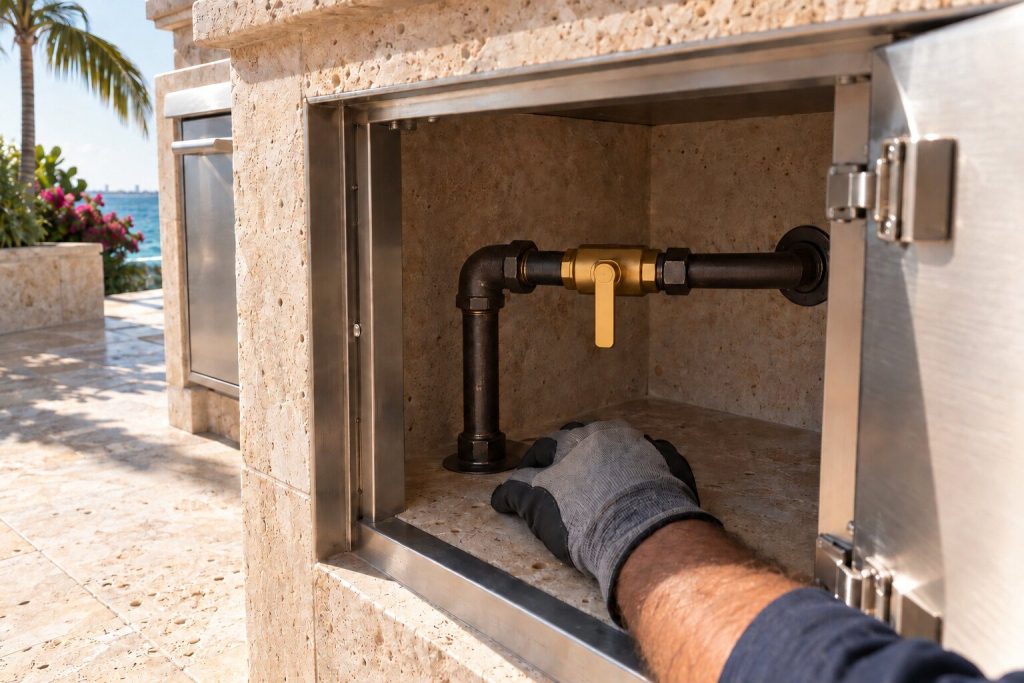
The gas shutoff. The cylinder valve on propane, the manual valve on a natural gas line. This one genuinely closes the supply, and it is the control that matters when there is any question about gas.
The breaker. The only thing that de-energizes the island. Everything else turns something off; this one takes the power away.
The part that surprises people
On most islands the grill, the hood, the refrigerator, the ice machine and the lighting share one circuit and, where the gas appliances are concerned, one supply run.
So switching the grill off has no effect on the machine beside it, and the shutoff that serves the grill may be the shutoff that serves the side burner too. Before anybody works in a cabinet, that question has a real answer and it is worth knowing it rather than assuming.
Why any of it matters
For ordinary weekends it does not. A grill with gas at the manifold and a live cabinet is the normal, safe state of a working outdoor kitchen.
It starts to matter in three situations.
When the island has been quietly corroding. A flex connector, a fitting or a terminal five years into salt air is a different proposition from the same part when the island was built, and the supply is sitting against it the entire time.
When water has reached something electrical. Irrigation through a vent, rain into a switch housing, steam under a hood canopy. A live circuit and a wet junction is the combination worth removing.
When anybody is about to work inside. Including you, changing a bulb.
The habit worth having
Close the gas and drop the breaker before a long absence.
A house empty for a month, with a supply standing against valves in a hot cabinet and a live circuit in a wet one, is the scenario where a small defect has time to become something. Two controls, ten seconds, and it costs nothing but remembering to switch the refrigerator question out separately.
Before you open a cabinet
If you are going in there — for a bulb, a cylinder change, or to see where the water is coming from — close the gas, drop the breaker, and open the doors first to let anything that has collected clear.
And if the reason you are opening it is a smell of gas, do not open it at all. That one is a different page and a different phone call.
If it turns out to be a repair
What this leads to, and what it costs
Every job on this site is priced the same way: an on-site diagnostic first, the figure agreed in writing before anybody starts.
-
Standing water in the base of the island Water inside the outdoor cabinet
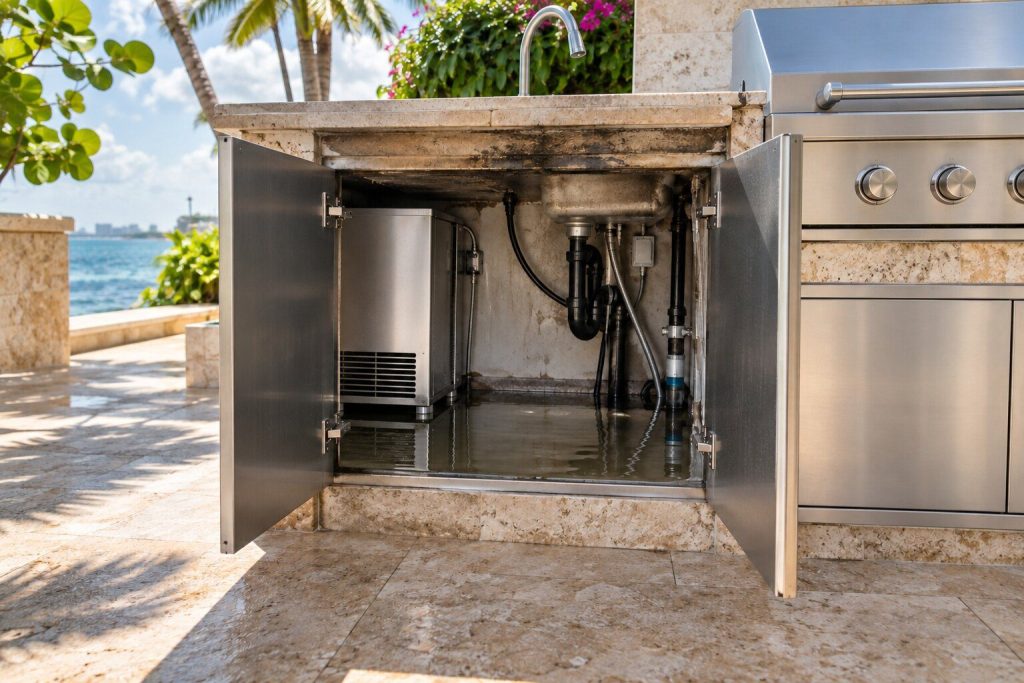
Water in a DCS outdoor kitchen cabinet. An outdoor island is designed to shed water rather than to exclude it, so a little after heavy rain is not automatically a defect — where it collects and whether it leaves are the questions. Water sitting in the base of a cabinet that houses gas fittings and electrical connections is a different matter from water running through and away, and this is one of the few cosmetic-looking problems on the site that we would rather see sooner than later.
- Shedding water is the design; holding it is not
- A gas island with standing water in it is ruining fittings you cannot see
- Constant water rather than after-rain water is usually plumbing or irrigation
-
from $155 Gas supply and regulator service
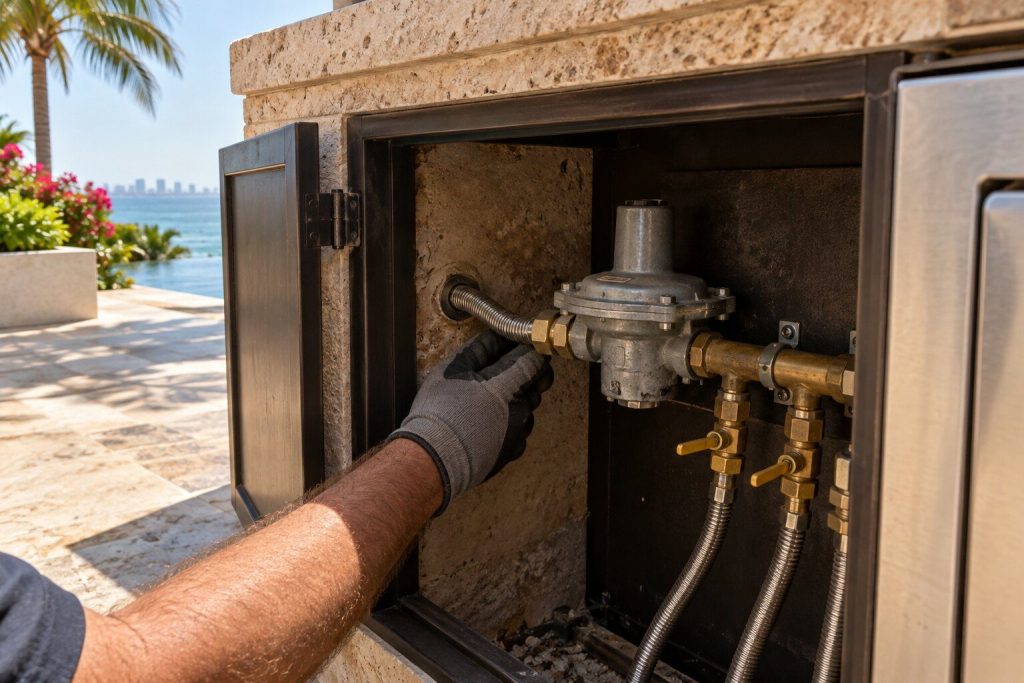
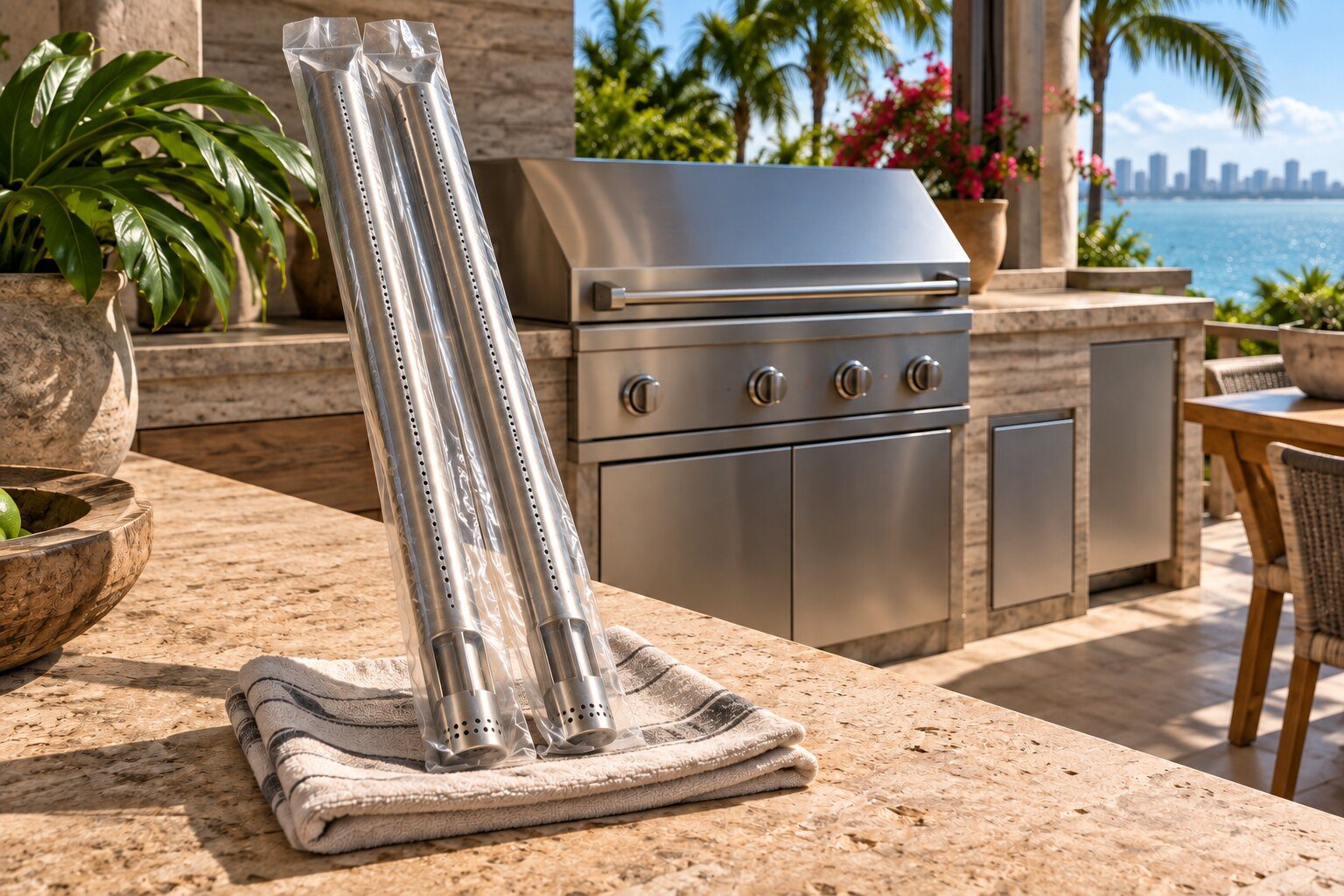
Everything upstream of the burner, which is where a large share of outdoor problems actually live. Weak flame on every burner at once, a grill that will not reach temperature, a cylinder that empties faster than it should, a limiting device that trips every time the valve is opened quickly — none of those are the grill. Under an island the fittings, the flexible connector and the manifold live in a space nobody has looked at since the mason closed it, in air that corrodes. We test rather than guess, and where the answer belongs to a gas contractor rather than to us, we say that.
- All burners weak at once is a supply question, not a burner question
- The fittings under an island are the ones nobody has ever seen
- Where it belongs to a gas contractor, we say so instead of improvising
-
from $125 Hood light and control repair
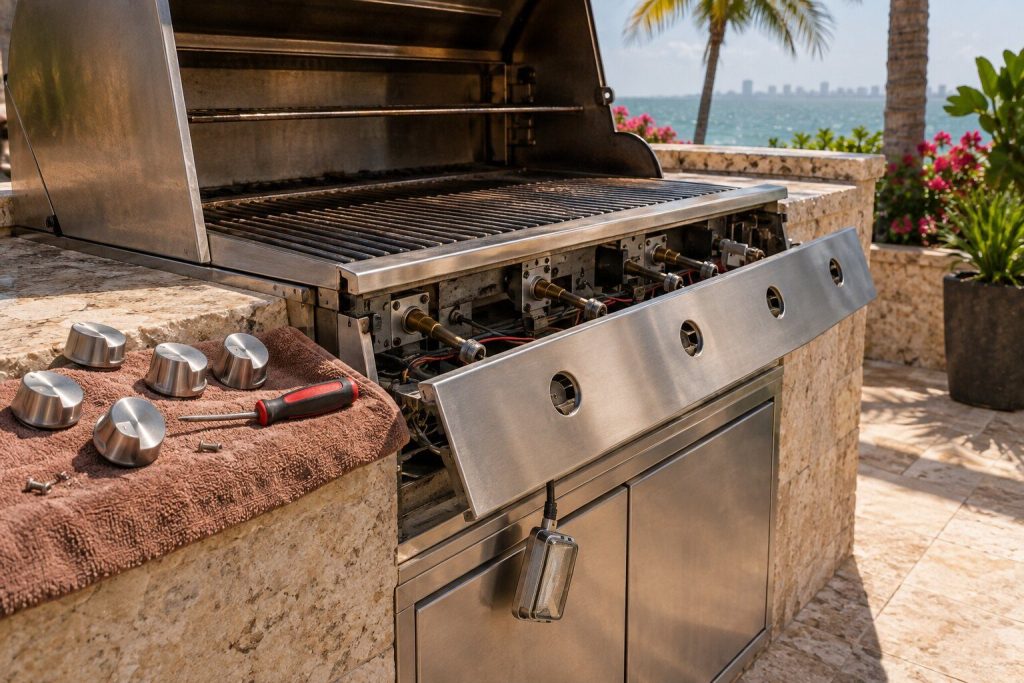
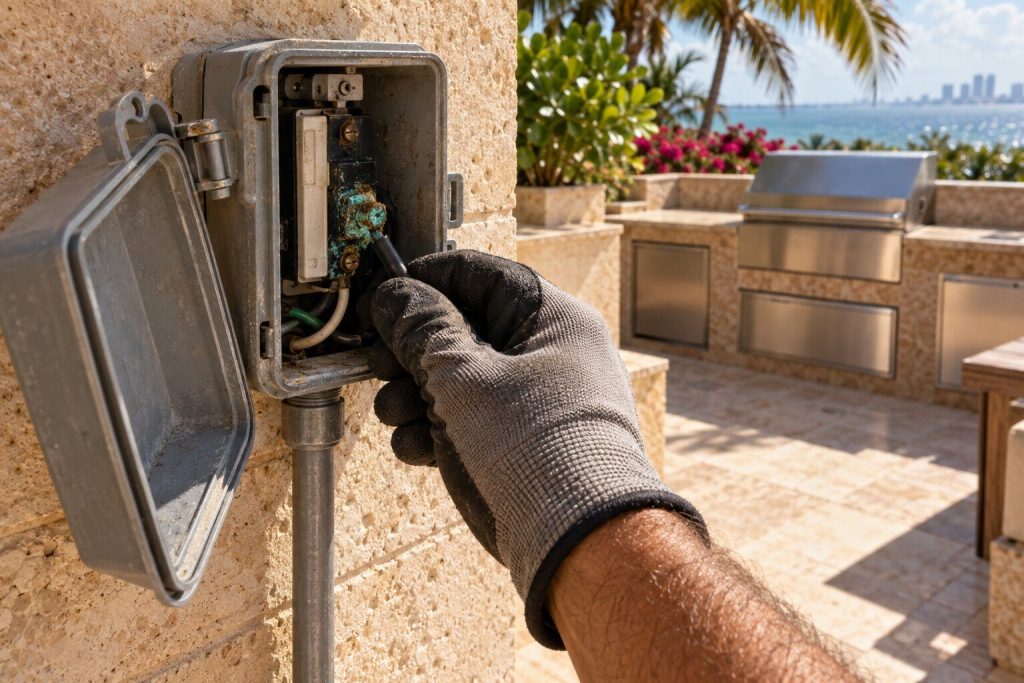
The electrical half of an outdoor grill: hood lights, dial lighting, the switch panel and the wiring that runs through a cabinet exposed to weather. These are the problems people put up with rather than call about, which is a pity, because water in a switch housing on a terrace does not stay a lighting problem. Corroded connectors, a transformer that has taken rain, a switch that has swollen — they all read as a failed light until somebody opens the housing, and by then the corrosion has usually traveled.
- A dead light on an outdoor grill is usually water, not a bulb
- Corrosion travels along a loom — the problem is rarely where the symptom is
- Left alone it stops being an electrical problem and becomes a housing one
Questions people ask about this
Should I close the cylinder valve after every cook?
It is a good habit and it costs nothing but a few seconds. It is worth being strict about it in two cases in particular: if the island has ever smelled of gas, and before you leave the house for more than a weekend. The rest of the time it is a preference rather than a rule.
Is there a plug I can pull instead of using the breaker?
Occasionally there is an outlet inside the cabinet, and pulling it isolates that one machine. It does not isolate the outlet, the circuit or anything else sharing it, and on many islands the wiring is direct rather than plugged. The breaker is the control that means what you want it to mean.
Does any of this apply to the refrigerator under the counter?
It shares the circuit, which is the part worth knowing. Cutting power to the island to work on the grill also warms the refrigerator, so we plan that order deliberately rather than discovering it afterward — and on a long absence there is a separate conversation about whether to leave it running at all.
Safety & Risks
More guides like this one
-
A Gas Smell With Everything Switched Off Is a Different Problem
Gas at a burner you were about to light is one thing. Gas with every control off is another, because it means something upstream of the controls is passing — and outdoors that run was sealed into masonry years ago.
Read more -
A Grease Fire on a Grill or a Range: What Actually Puts It Out
Water spreads burning fat. The response that works is starvation, and the one most people reach for first makes it larger — then there is the question of why the flare-ups started at all.
Read more -
When an Appliance Smells Faintly of Fish, Stop Using It
It is one of the few smells in a kitchen that means exactly one thing, and nothing anybody cooked produces it. Overheating insulation smells like this before anything visibly fails.
Read more
Tell us the model number and what it is doing.
This article is based on:
- Official manufacturer documentation
- Internal repair procedures
- Technician repair history
- Company quality standards