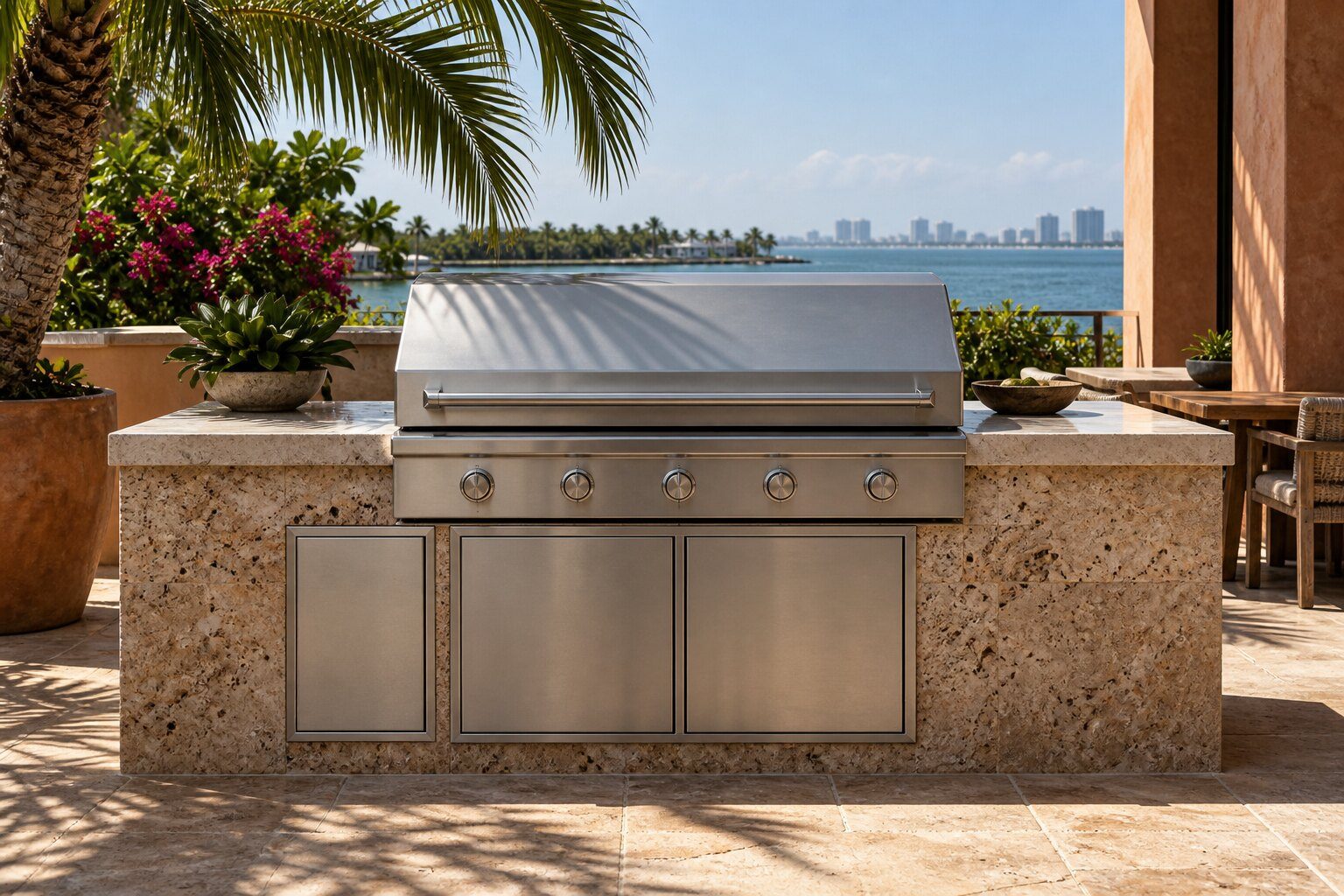
Model
BE1-48C repair
DCS BE1-48C repair in Miami: what owners of this Series 9 unit search for, what those symptoms usually point at, and what the work involves. Diagnostic from $95, credited toward the repair.
- From $95 diagnostic, credited to the repair
- 59 cities and neighborhoods covered
- OEM parts available on order
- In writing the price, before anything is opened
The short version
What the number tells us
The full model number decides which parts exist, how quickly they arrive and what a repair on this unit is worth. It is the first thing we ask for.
Model
BE1-48C
Give us this number when you book and the technician arrives knowing what the unit is and which parts it takes.
or call (305) 526-4714
Parts
OEM on order; legacy parts take longer
Diagnostic
From $95, credited to the repair
What we can tell you
What this number means for a repair
Not a specification table. Capacity, dimensions and production years are not something we can verify, and a plausible-looking table of them would be invention rather than information.
-
The full number is the first thing we ask for
It decides what the display can tell you and how easily parts are found, and the data plate settles it in one line. Letters after the digits are not decoration — they identify the configuration, and two units sharing the digits can take different components.
-
What we ask you to read off the unit
The data plate, not the box or the invoice. On this equipment it sits inside the cabinet — along a side wall, behind the lowest drawer, or under the lid of a wine cabinet — and it carries the full number and the service index together. A photograph of it is worth more than any table we could publish.
What owners of this model ask about
The symptoms searched most often with the BE1-48C
Taken from real search suggestions rather than from a list we made up. Each page says what the symptom usually points at and what to check first.
-
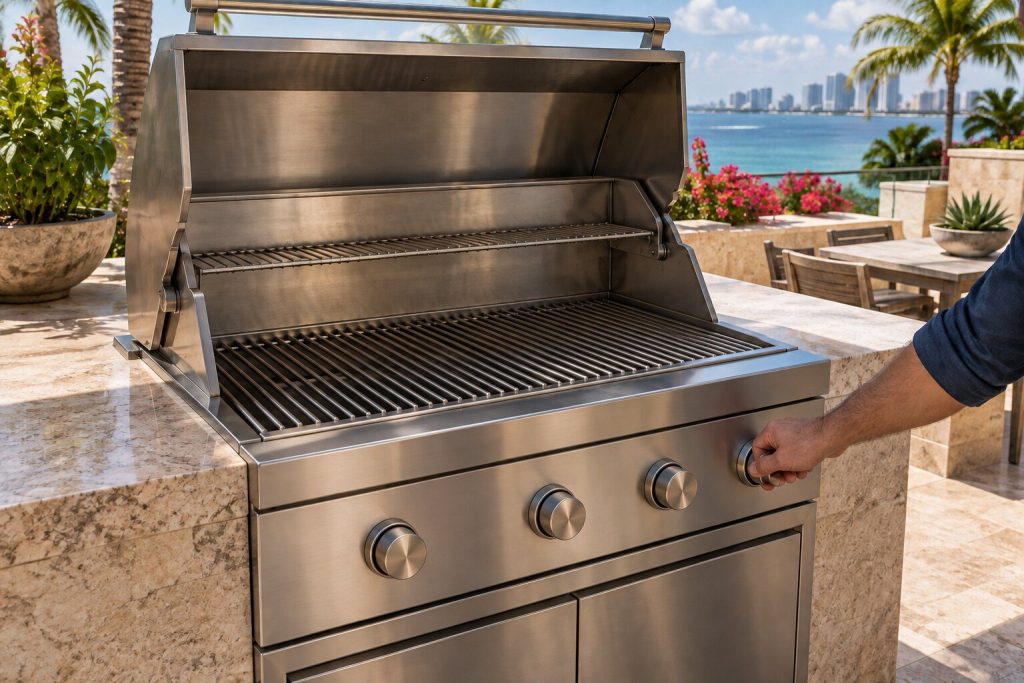
Clicking, or nothing at all, and no flame Grill will not light
DCS grill will not light. Nothing here displays anything, so the work is done from four things an owner already knows: how many burners are affected, what has happened at the cylinder lately, whether a match succeeds where the spark does not, and whether there is any smell of gas. That last one ends the process on the spot. The other three separate a supply problem from an ignition problem from a burner problem, and in this market the first is far commoner than people expect.
- How many burners are affected cuts the search in half before anyone arrives
- Lights from a match but not from the ignitor: the gas is fine, the spark is not
- A cylinder valve opened too quickly trips a limiter and starves the whole grill
-
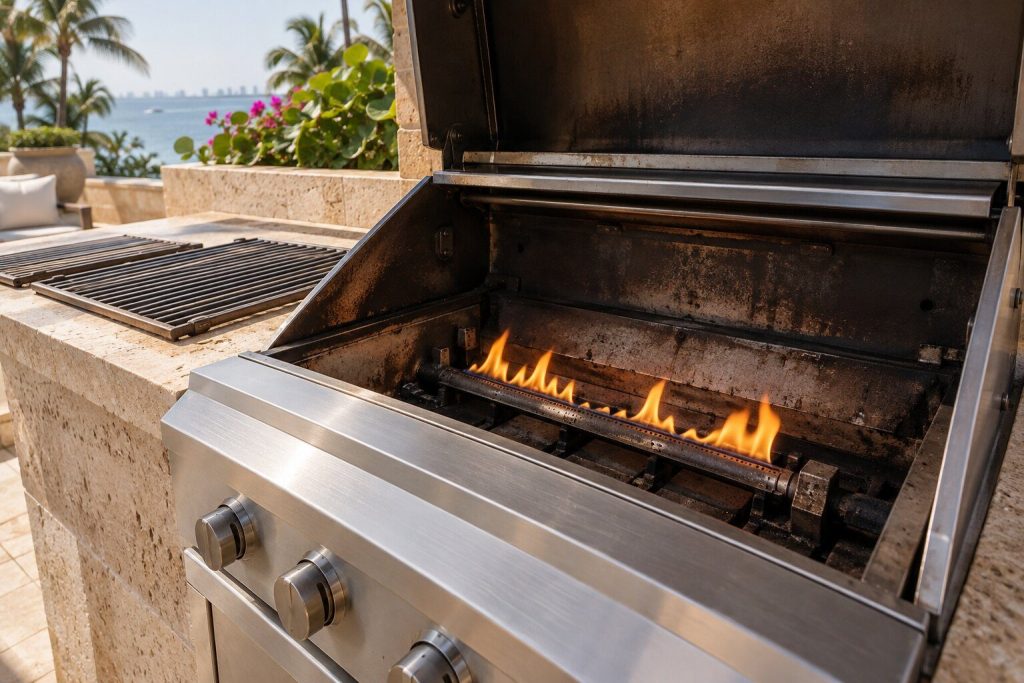
Blue flame gone lazy and yellow-tipped Grill flame is yellow or orange
DCS grill flame yellow instead of blue. Blue is what a correctly proportioned mixture looks like; yellow says the ratio has drifted. It is worth taking seriously rather than cooking through: a badly mixing flame deposits soot on food and on the inside of the hood, and the cause is usually something obstructing the air side. In South Florida the obstruction is very often alive — insects find a venturi tube an excellent place to spend a season.
- Nine times in ten the air side is starved, not the gas side
- A lone offender is local; the whole set accuses the regulator
- A grill left under a cover all summer is an invitation to a nest
-
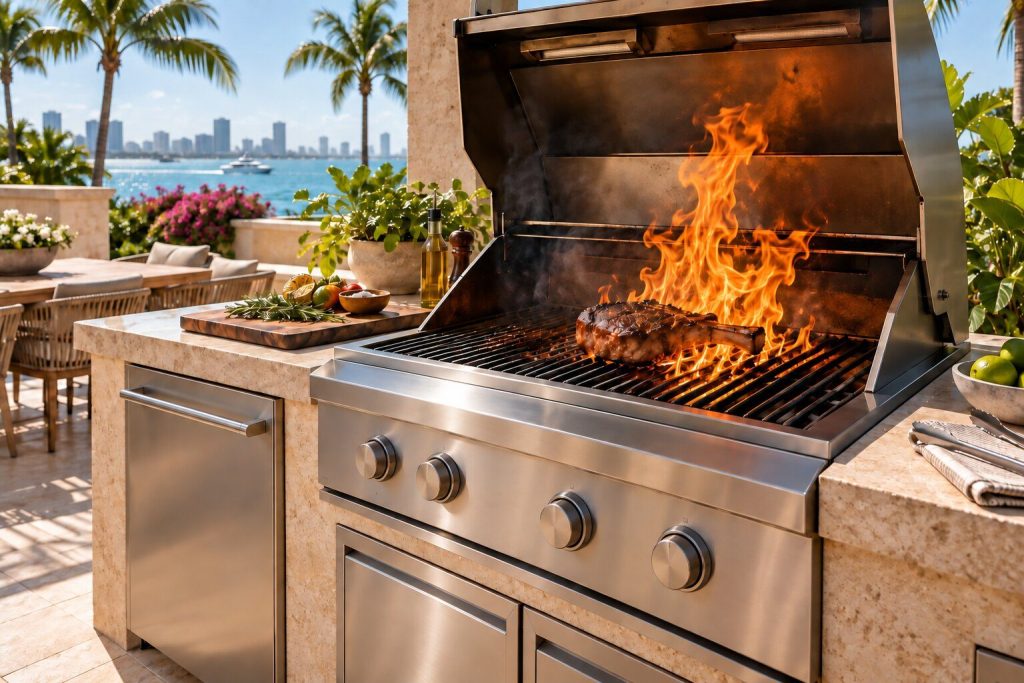
Flames coming up through the grates at every cook Grill flare-ups
DCS grill flare-ups every time something fatty goes on. Occasional flame when fat hits heat is cooking; a grill that burns everything on it is telling you the grease path has stopped working. That path is a design — radiants spread the heat and shed what falls on them, a tray collects it, a channel carries it to a cup — and when any part of it is loaded, missing or refitted the wrong way round, the drippings go straight onto the burners instead. In this market it is the commonest cause of a grill fire.
- Persistent flare-ups are a grease path problem, not a cooking technique problem
- Radiants refitted the wrong way round defeat the whole design
- The cheapest work on an outdoor kitchen, with the highest consequence if skipped
-
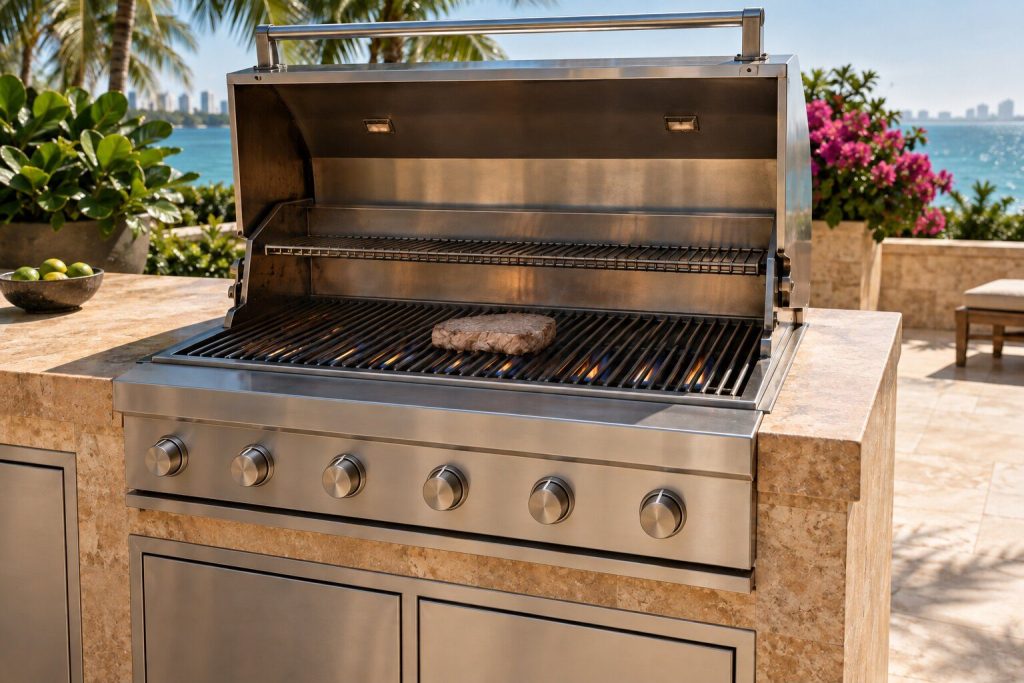
Lights and runs, but will not sear Grill not getting hot enough
DCS grill not getting hot enough. Everything works and nothing is hot, which nearly always means how much gas is arriving rather than anything inside the hood. The classic version is a cylinder whose flow limiting device has activated — it passes enough to light and simmer and never enough to sear. Before any of that, though, there is a question worth settling: a grill of this size that has been preheating for five minutes is not underperforming, it is not finished.
- Give it a full fifteen minutes with the hood down before judging it
- A tripped limiter on an LP cylinder is the classic cause and resets in a minute
- A supply that is fine at rest can still collapse with three burners running
-
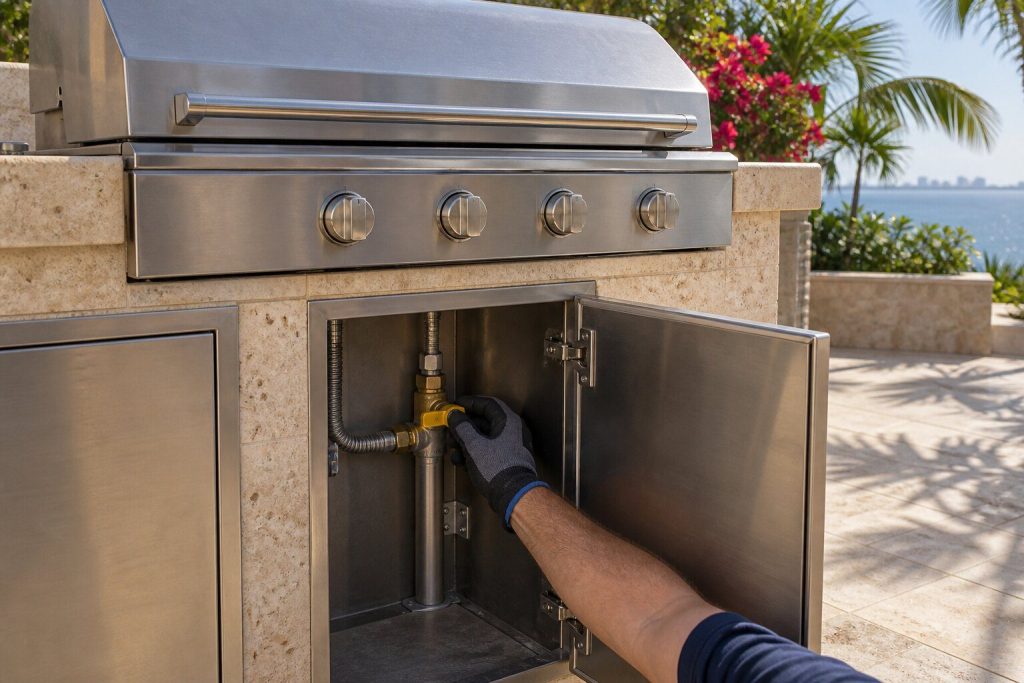
Gas can be smelled with the burners off Smell of gas at the grill
Smell of gas at a DCS grill or outdoor kitchen. This is the one page on the site with no troubleshooting on it. Gas with a dial on and the burner unlit is one thing; gas with everything shut off is another and a more serious one. Outdoors in salt air a joint that was sound three seasons ago is not automatically sound now, and the fittings under a stone island are the ones nobody has looked at since the mason closed it up.
- Shut the supply off at the cylinder or the wall valve and leave it off
- No ignition sources nearby — that includes the grill's own ignitor
- We do not diagnose this by telephone and we do not ask you to test it
-
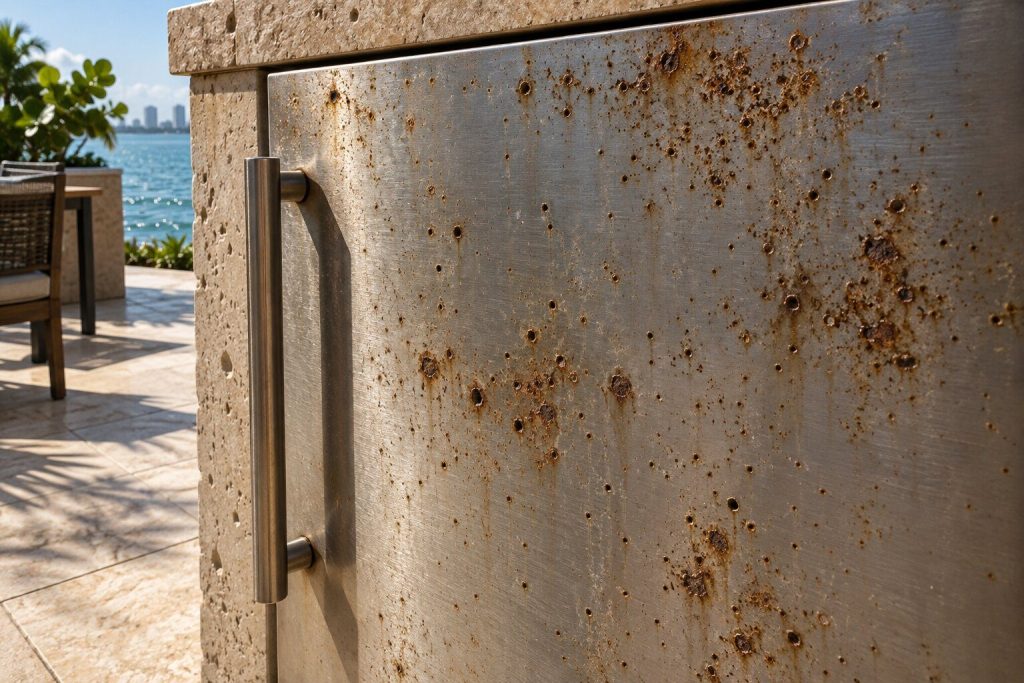
Brown speckling on doors, handles and fixings Outdoor stainless is pitting and rusting
DCS outdoor stainless rusting. Outdoor-rated stainless resists salt; it does not ignore it. Brown speckling on a door or a handle is cosmetic and is slowed a great deal by rinsing with fresh water and drying, and there is no shame in a waterfront grill showing it. What is not cosmetic is corrosion around the vents, the hinges, the mounts and the fixings — those are the parts holding cabinets square and seals true, and they are the ones worth acting on.
- Speckling on a face is cosmetic; corrosion at a fixing is structural
- Fresh water and drying does more than any polish
- Distance from the water is the real interval — four blocks is not four miles
Also called out to on this equipment
- Rotisserie will not turn or stay lit
- Side burner will not light
- Outdoor drawers and doors seized
- Water inside the outdoor cabinet
- Range burner clicks and will not light
- Oven will not hold its temperature
- Oven shows an error code
- Induction zone not working
- Induction cooktop shuts off mid-cook
- Gas cooktop flame is uneven
- Hood not clearing smoke
- Hood blower has become loud
- Beverage center not getting cold
- Water inside the beverage center
In more detail
About BE1-48C repair
What owners of the BE1-48C search for
These are the phrases people pair with this model number, taken from real search suggestions rather than from a list we made up. They are a fair map of what tends to go wrong on it — and each one has a page of its own explaining the likely causes.
- dcs be1-48c
- dcs be1-48c repair
- dcs be1-48c parts
What the display can tell you
The Series 9 reports very little through its display, which is why more of the diagnosis on this generation is measured rather than read. If something is showing on yours, photograph it before it clears and look it up in the full error code list — codes do not wait, and the number is often gone by the time a technician arrives.
What we do not publish about it
No specification table: capacity, dimensions, configuration and production years are not something we can verify, and a plausible-looking table of them would be invention rather than information. What we can tell you is what the number means for a repair — which generation it is, what its display can report, and how easily parts are found.
Before you call
- Check the full model number on the data plate — the three digits are the family, and the letters after them matter for parts
- Photograph the display if anything is showing on it
- Look at the condenser through the grille
- Note whether this started after a power cut
This article is based on:
- Official manufacturer documentation
- Internal repair procedures
- Technician repair history
- Company quality standards
Before you book
Questions about BE1-48C repair
Is the BE1-48C still worth repairing?
Usually. The Series 9 was built to be repaired, and a cabinet in good condition with sound cabinetry is worth keeping well past twenty years. Where the work approaches what the unit is worth, or a second major failure is already visible, we say so on the visit rather than after.
Can you still get parts for the BE1-48C?
For most of what fails, yes — OEM parts are ordered against your model. Legacy parts can take a few days to source, which is why we confirm a part is the problem before ordering it rather than after.
Where do I find the full model number on a BE1-48C?
On the data plate on the appliance itself, which is usually inside a door frame or behind a grille. Photograph the whole plate rather than writing it down — the letters after the digits decide which parts fit, and they are the part people misread most often.
What tends to go wrong on the BE1-48C?
Judging by what its owners search for: grill will not light, grill flame is yellow, grill flare ups, grill not hot enough, grill smells of gas, and outdoor stainless is rusting. Each of those has a page explaining the likely causes and what to check before booking anything.
Do you publish specifications for the BE1-48C?
No. Capacity, dimensions, configuration and production years are not something we can verify, and a plausible-looking table of them would be invention rather than information. What we can tell you is what the number means for a repair.