Appliance
DCS grills
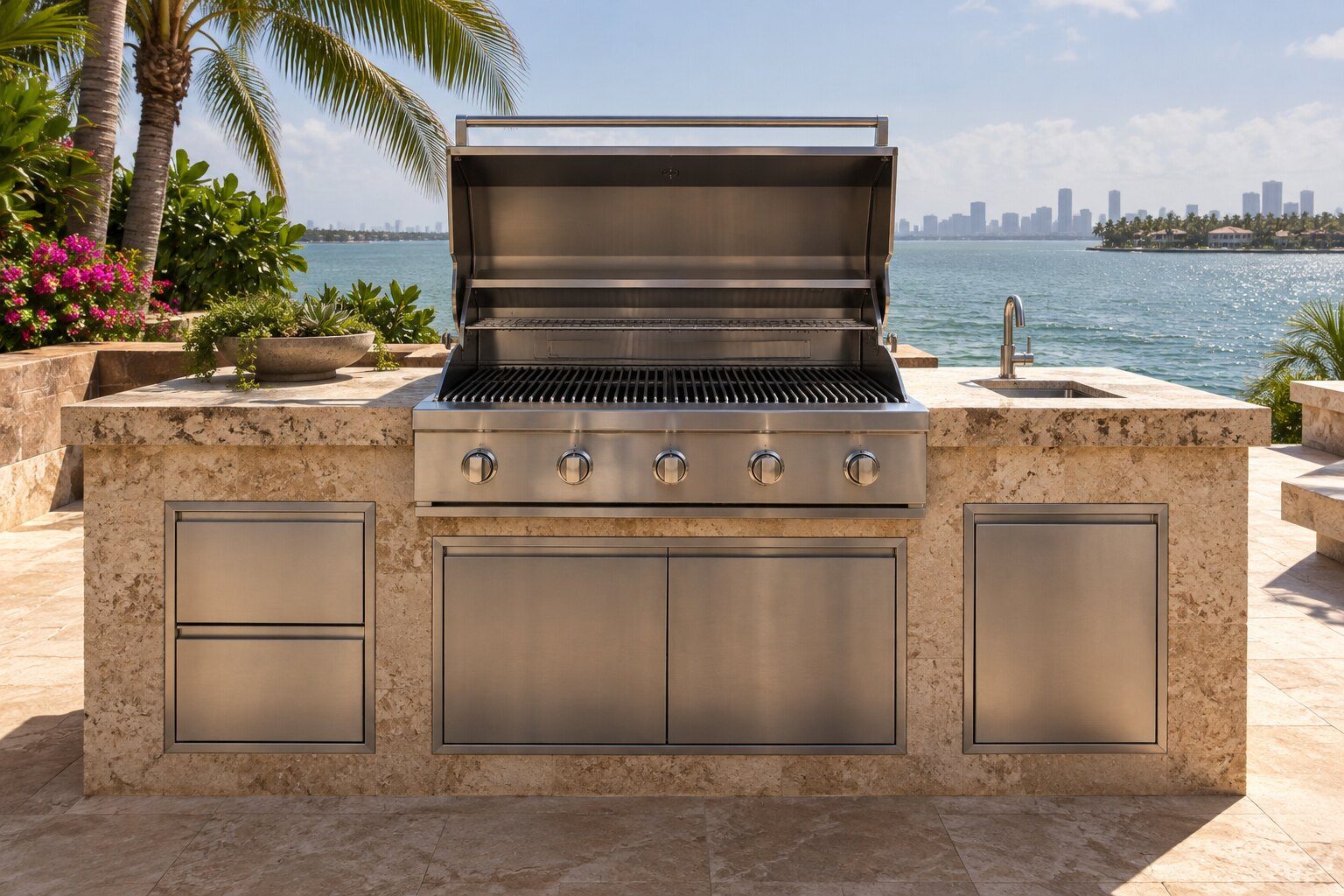
This is the machine most people mean when they say DCS, and in South Florida it is the one that ages fastest. A grill dropped into a stone island is plumbed to gas, wired for its lights and rotisserie, and then left to face salt air for eleven months of the year with a cover on it. What fails is rarely the thing the owner expects: burners and ignitors are consumables here, the radiant trays and grease tray are part of the fire risk rather than part of the cleaning, and half the calls we take turn out to be a supply problem at the cylinder or the manifold rather than anything inside the hood. The ones built into an island are the slower visits — the surround decides what can come out and in which order.
- 7 symptoms we are called out to
- From $95 diagnostic, credited to the repair
- 59 cities and neighborhoods covered
- OEM parts available on order
The short version
What this equipment is, for a repair
Configurations
Built into the island, or on a cart · Series 7 and Series 9
Access
Planned before the visit, not discovered on arrival
Parts
OEM, available on order
Diagnostic
From $95, credited to the repair
What goes wrong with it
Symptoms we are called out to on DCS grills
Each one covers the likely causes in the order they are worth checking, and what to do in five minutes before booking anything.
-
Clicking, or nothing at all, and no flame Grill will not light
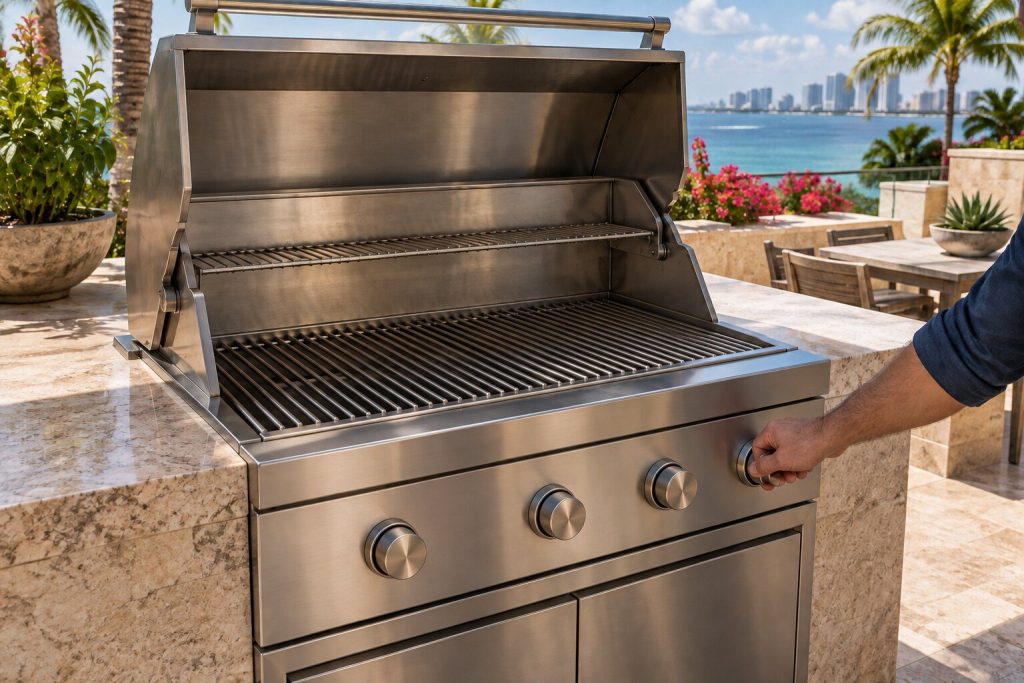
DCS grill will not light. Nothing here displays anything, so the work is done from four things an owner already knows: how many burners are affected, what has happened at the cylinder lately, whether a match succeeds where the spark does not, and whether there is any smell of gas. That last one ends the process on the spot. The other three separate a supply problem from an ignition problem from a burner problem, and in this market the first is far commoner than people expect.
- How many burners are affected cuts the search in half before anyone arrives
- Lights from a match but not from the ignitor: the gas is fine, the spark is not
- A cylinder valve opened too quickly trips a limiter and starves the whole grill
-
Blue flame gone lazy and yellow-tipped Grill flame is yellow or orange
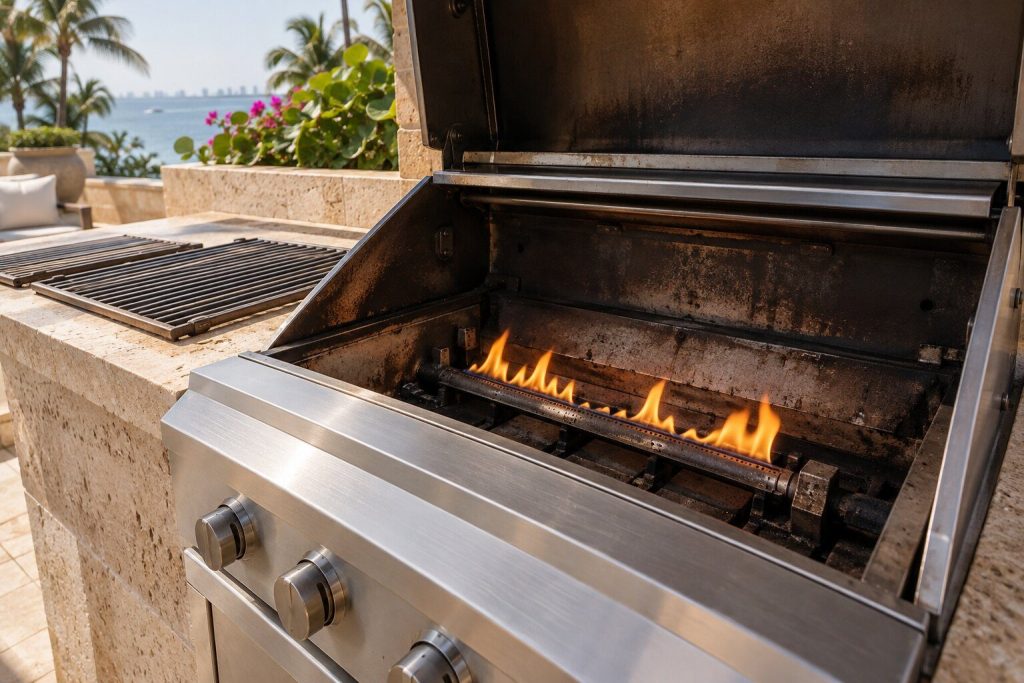
DCS grill flame yellow instead of blue. Blue is what a correctly proportioned mixture looks like; yellow says the ratio has drifted. It is worth taking seriously rather than cooking through: a badly mixing flame deposits soot on food and on the inside of the hood, and the cause is usually something obstructing the air side. In South Florida the obstruction is very often alive — insects find a venturi tube an excellent place to spend a season.
- Nine times in ten the air side is starved, not the gas side
- A lone offender is local; the whole set accuses the regulator
- A grill left under a cover all summer is an invitation to a nest
-
Flames coming up through the grates at every cook Grill flare-ups
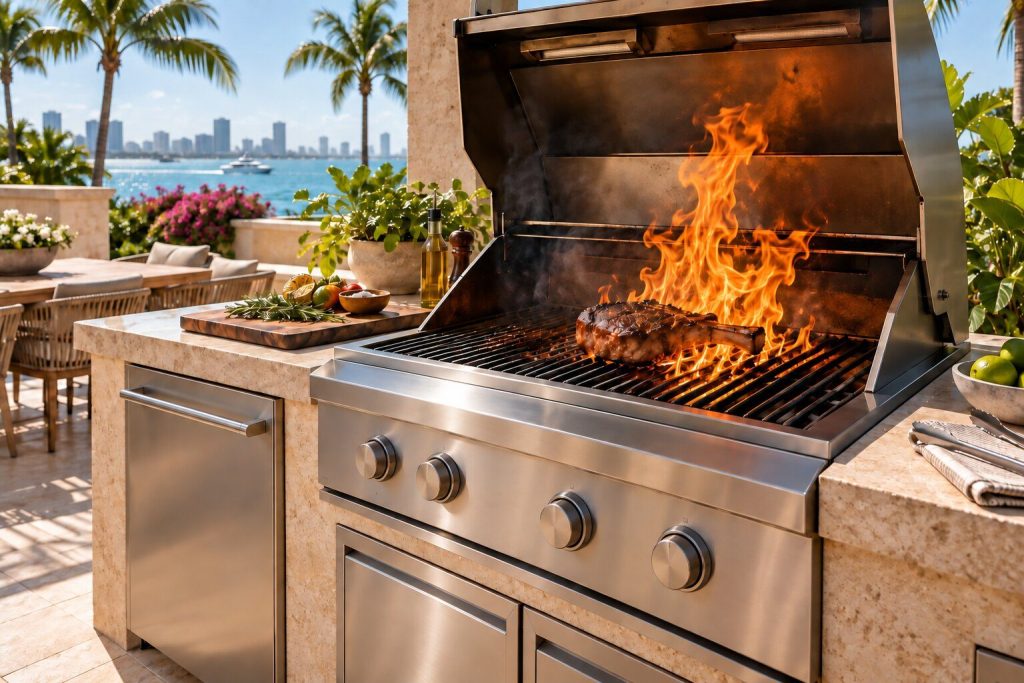
DCS grill flare-ups every time something fatty goes on. Occasional flame when fat hits heat is cooking; a grill that burns everything on it is telling you the grease path has stopped working. That path is a design — radiants spread the heat and shed what falls on them, a tray collects it, a channel carries it to a cup — and when any part of it is loaded, missing or refitted the wrong way round, the drippings go straight onto the burners instead. In this market it is the commonest cause of a grill fire.
- Persistent flare-ups are a grease path problem, not a cooking technique problem
- Radiants refitted the wrong way round defeat the whole design
- The cheapest work on an outdoor kitchen, with the highest consequence if skipped
-
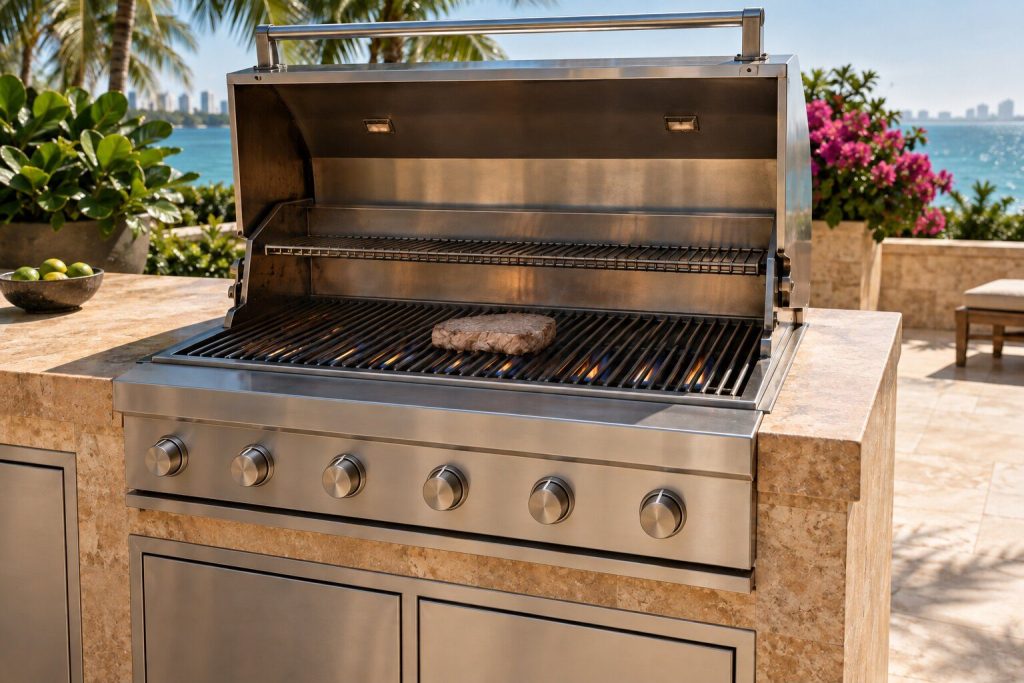
Lights and runs, but will not sear Grill not getting hot enough
DCS grill not getting hot enough. Everything works and nothing is hot, which nearly always means how much gas is arriving rather than anything inside the hood. The classic version is a cylinder whose flow limiting device has activated — it passes enough to light and simmer and never enough to sear. Before any of that, though, there is a question worth settling: a grill of this size that has been preheating for five minutes is not underperforming, it is not finished.
- Give it a full fifteen minutes with the hood down before judging it
- A tripped limiter on an LP cylinder is the classic cause and resets in a minute
- A supply that is fine at rest can still collapse with three burners running
-
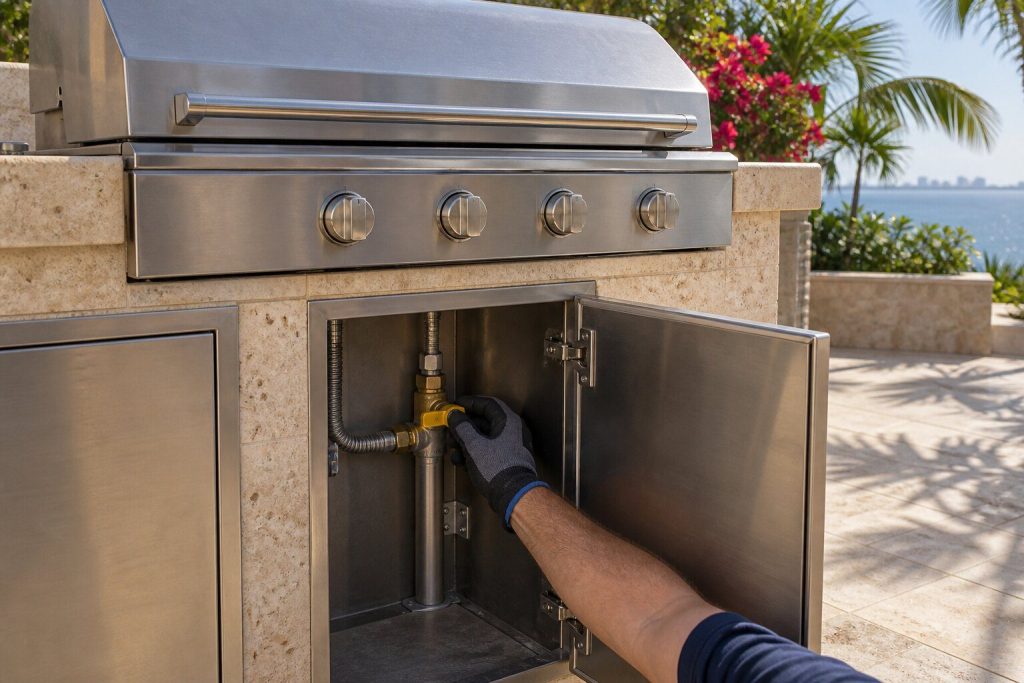
Gas can be smelled with the burners off Smell of gas at the grill
Smell of gas at a DCS grill or outdoor kitchen. This is the one page on the site with no troubleshooting on it. Gas with a dial on and the burner unlit is one thing; gas with everything shut off is another and a more serious one. Outdoors in salt air a joint that was sound three seasons ago is not automatically sound now, and the fittings under a stone island are the ones nobody has looked at since the mason closed it up.
- Shut the supply off at the cylinder or the wall valve and leave it off
- No ignition sources nearby — that includes the grill's own ignitor
- We do not diagnose this by telephone and we do not ask you to test it
-
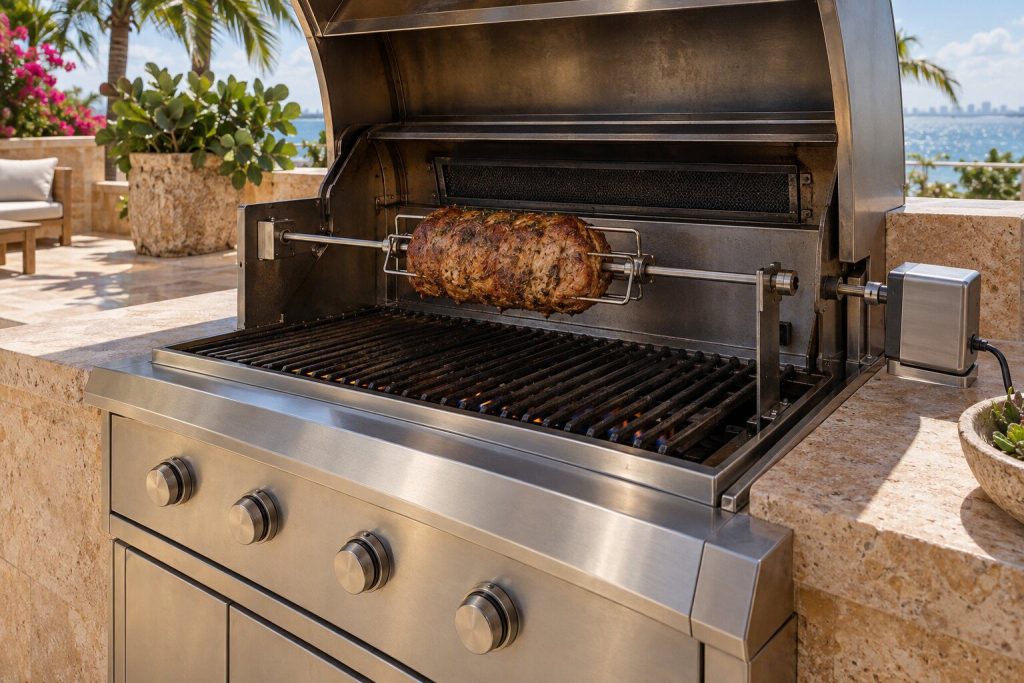
The spit stops, or the rear burner dies when the dial is released Rotisserie will not turn or stay lit
DCS rotisserie not working. Two machines share this name and they fail separately: a motor and spit that turn, and a rear burner that does the cooking. Saying which half has stopped is worth a great deal, because they go to different places. The one people live with longest is a rear burner that lights while the dial is held in and goes out the moment it is released — and that is not something to be worked around, it is a safety device doing precisely what it is for.
- Turning without heat, heat without turning, or neither — three different repairs
- A burner that dies when the dial is released cannot see its own flame
- A binding spit destroys a motor that was perfectly good before it
What we do on it
Repairs we carry out on DCS grills
Starting figures for this equipment in South Florida. The exact cost is confirmed after an on-site diagnostic — and this is not the whole list of what can go wrong, so call if your problem is not here.
-
from $95 Diagnostic visit
Establishing the problem itself, with nothing quoted until it is established. Two questions come before the symptom on this badge. Is the machine indoors or outdoors — because the indoor line answers in a decoded code and the outdoor line has no codes whatsoever, so the whole method changes. And what is it sitting in — masonry, joinery or a cart — because that, not the problem, sets the length of the visit. Whatever we find is written down with a figure beside it before a spanner is picked up. The charge comes off the repair when you go ahead; when our recommendation is to stop spending money on the machine, you get that recommendation and pay the same.
- Indoors or outdoors decides the method: a code to decode, or flame and smell to read
- Nothing quoted until the problem is established, and the charge comes off the repair
- Told plainly when the machine has stopped being worth the money
-
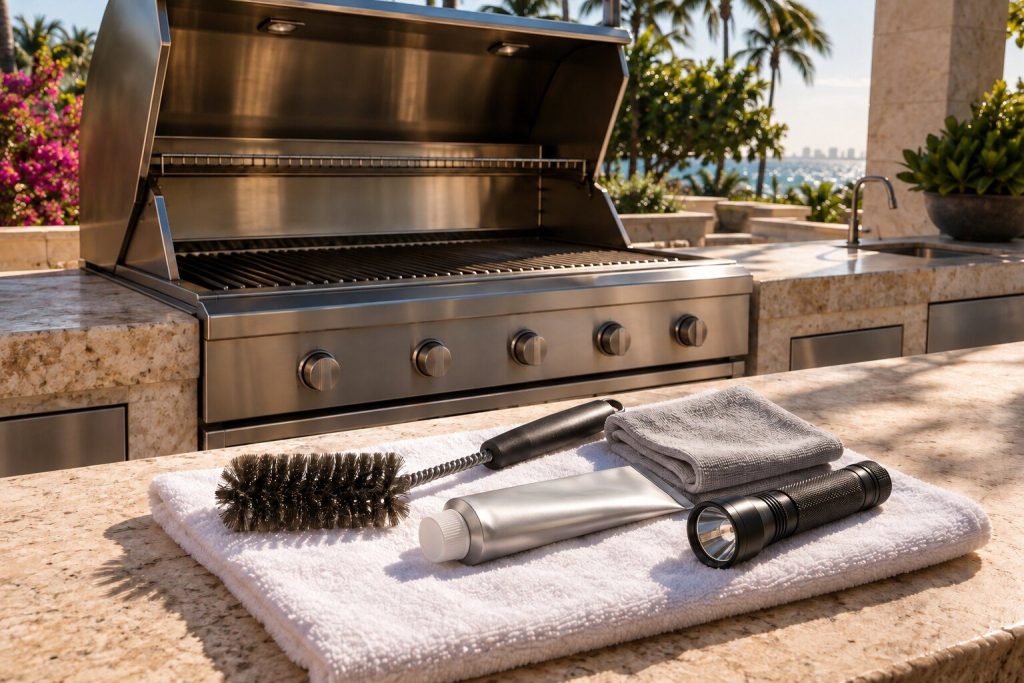
from $175 Appliance maintenance
The visit that is booked rather than called in. Outdoor cooking equipment in this market does not fail on a schedule set by hours of use — it fails on one set by salt, rain and the months it spends under a cover with humidity trapped underneath. A maintenance visit is where burners come out and get looked at before they are the reason dinner stopped, where the grease path is cleared before it is a fire, where drawer runners are treated before they pit, and where an undercounter refrigerator's condenser is cleaned before August asks it for everything. Indoors it is the ordinary and useful work: seals, hinges, sensor accuracy, filters, and the parts of a high-output range that quietly drift.
- Built around salt and season rather than around hours of use
- The grease path is treated as a fire question, because that is what it is
- Findings written down, so next year's visit starts from evidence
-
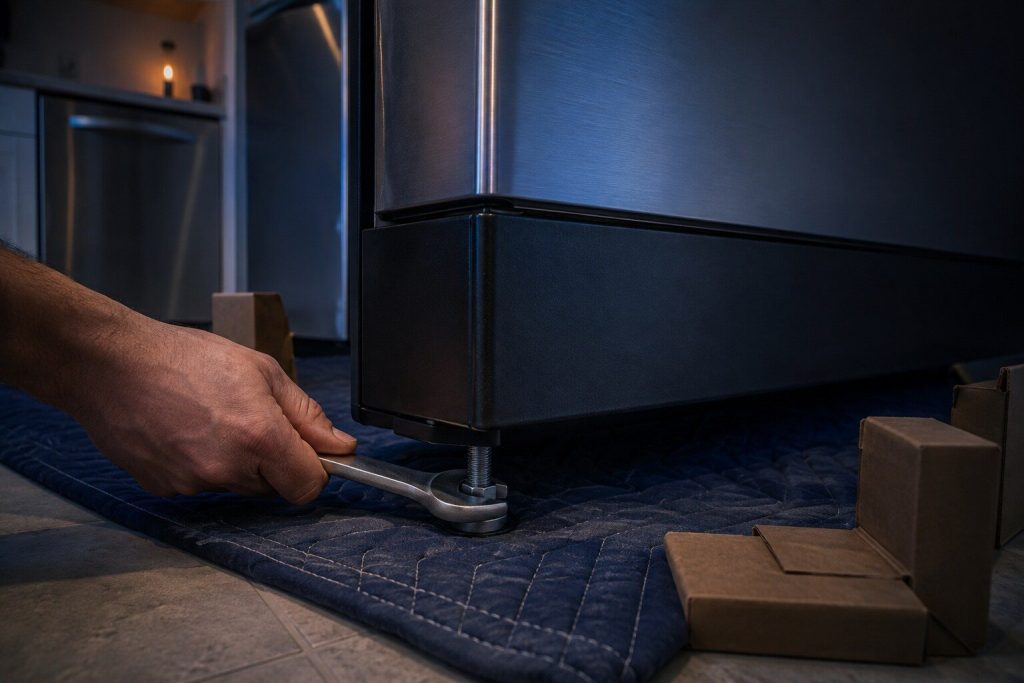
from $245 Appliance installation
Putting a machine into a space somebody else built. On this brand that is rarely a delivery and usually a fit: a grill head into a masonry cutout, a beverage center into an island with a ventilation path that has to actually work, a wall oven into a tall run, a cooktop into stone that does not forgive a second attempt. The measuring happens before anything is ordered, not after it arrives. Where an existing cutout is wrong for the machine that is meant to go into it, we say so while it is still a drawing — that conversation is cheap and the alternative is a slab with a hole in the wrong place.
- Measured against the cutout that exists, not the one in the brochure
- Ventilation and clearance treated as part of the install, because they decide whether it works
- Gas connection and leak check done properly and documented
-
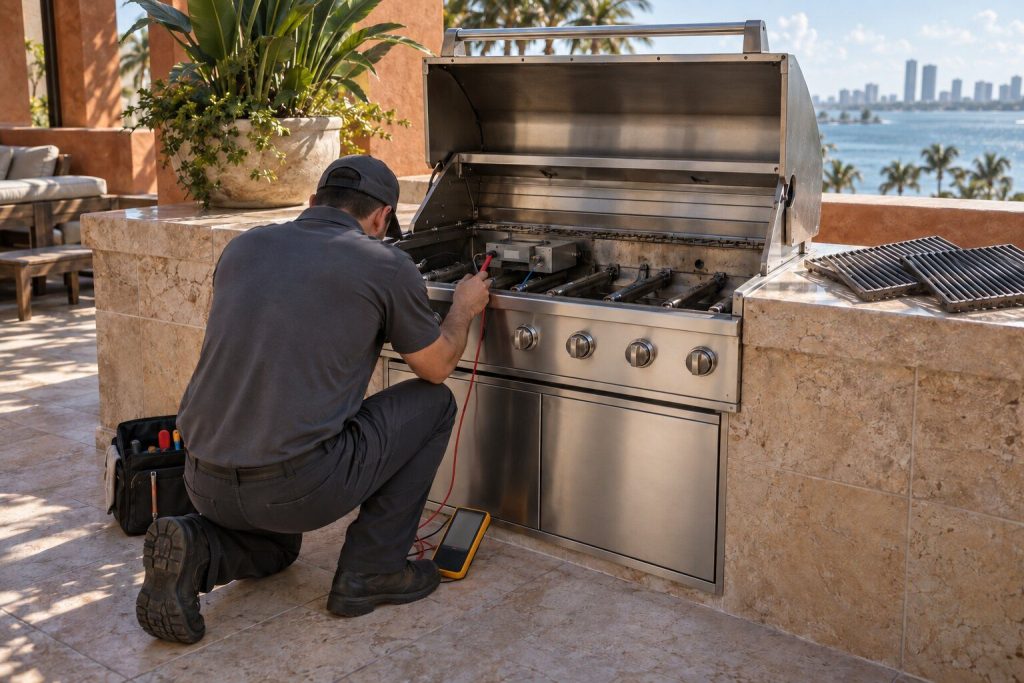
from $145 Grill will not light
The call we take most often here, and the one whose answer most often lies upstream of the grill. Before anything is opened we work backwards from the flame: is it one burner or all of them, does it light from a match, has the cylinder been changed recently, is there a smell of gas. Those four answers separate a supply problem from an ignition problem from a burner problem, and they cost nothing to establish. In this market the ignition side is a consumable — electrodes crack, ceramics absorb salt, earths corrode — and the supply side is where a surprising number of calls actually end.
- One burner dead, or the whole set — that single answer splits the diagnosis in half
- Lights from a match but not from the ignitor: that sentence halves the diagnosis
- A tripped limiting device on a cylinder imitates a dead grill
-
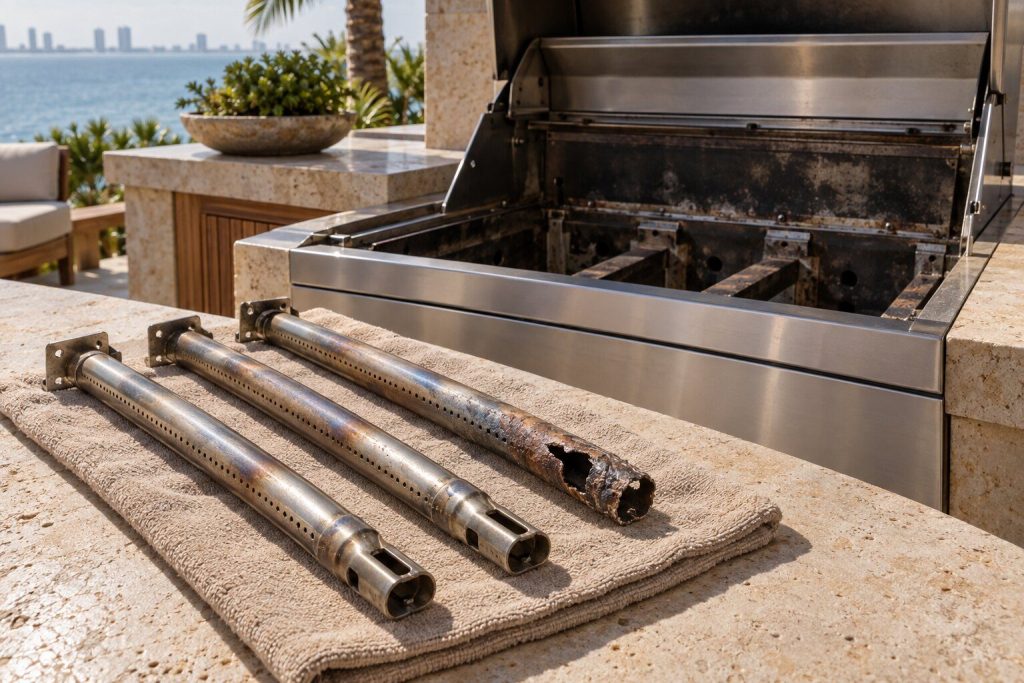
from $185 Grill burner replacement
Burners are consumables on an outdoor grill in South Florida, and the question is rarely whether one has gone but whether it has gone far enough to matter. A burner that has burned through at the ends puts flame where the design did not intend it, cooks unevenly down its length, and eventually damages the radiants and the firebox around it. We would rather replace a set at the point where the first one has failed than come back three times, and we will say when a burner still has a season in it rather than selling a set on principle.
- Burn-through at the ends is the failure to look for, not the obvious hole
- Replaced as a set when the set is the same age, one at a time when it is not
- The radiants above them are checked at the same time, because they fail together
-
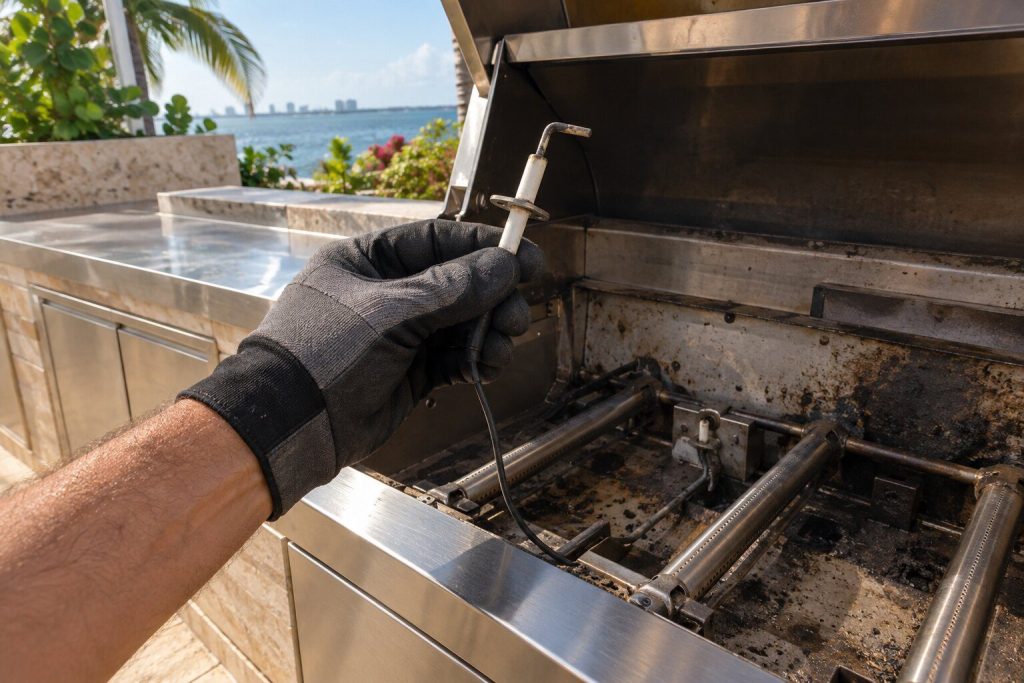
from $135 Ignition and electrode service
Everything between the button and the flame. On the coast this is the fastest-ageing system on an outdoor kitchen: ceramic insulators absorb salt and crack, electrode gaps move, earth paths corrode where they are bolted to a firebox, and battery modules sit in a damp compartment for years. The symptom is almost always the same — clicking with no light, or lighting on the fourth press instead of the first — and the cause is almost never the same twice. We service the path rather than swapping the part that is easiest to reach.
- Ceramic, electrode, wire, earth and module — a path, not a part
- Lighting on the fourth press is a problem, not a personality
- The same service covers the island's side and power burners
-
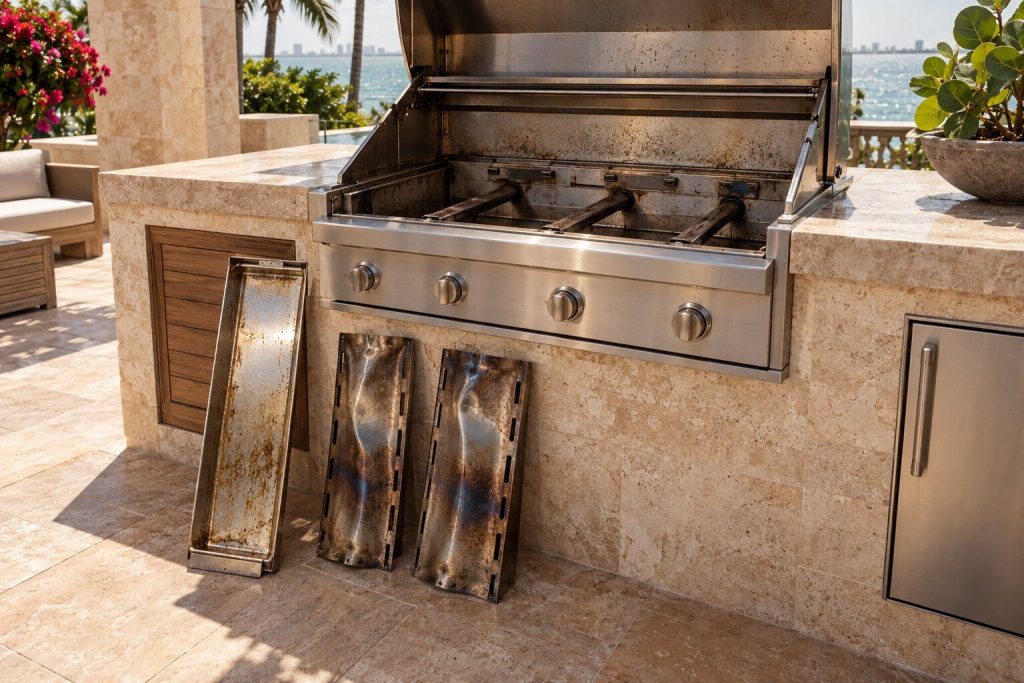
from $165 Grease management service
The service that is sold as cleaning and is really fire safety. A grill is designed to take rendered fat away from the flame — radiants spread the heat and shed the drippings, a tray collects what comes through, a channel takes it somewhere it can be emptied. When any part of that path is loaded, missing or refitted wrong, fat arrives on the burners instead, and the result is the flare-ups people describe as the grill 'getting angry'. In this market we see this most on grills that are spotless on the grates and untouched underneath. It is the cheapest work on an outdoor kitchen and the one with the highest consequence.
- Flare-ups at every cook are a grease path problem, not a cooking technique problem
- Radiants refitted the wrong way round defeat the whole design
- The single highest-consequence, lowest-cost job on this site
-
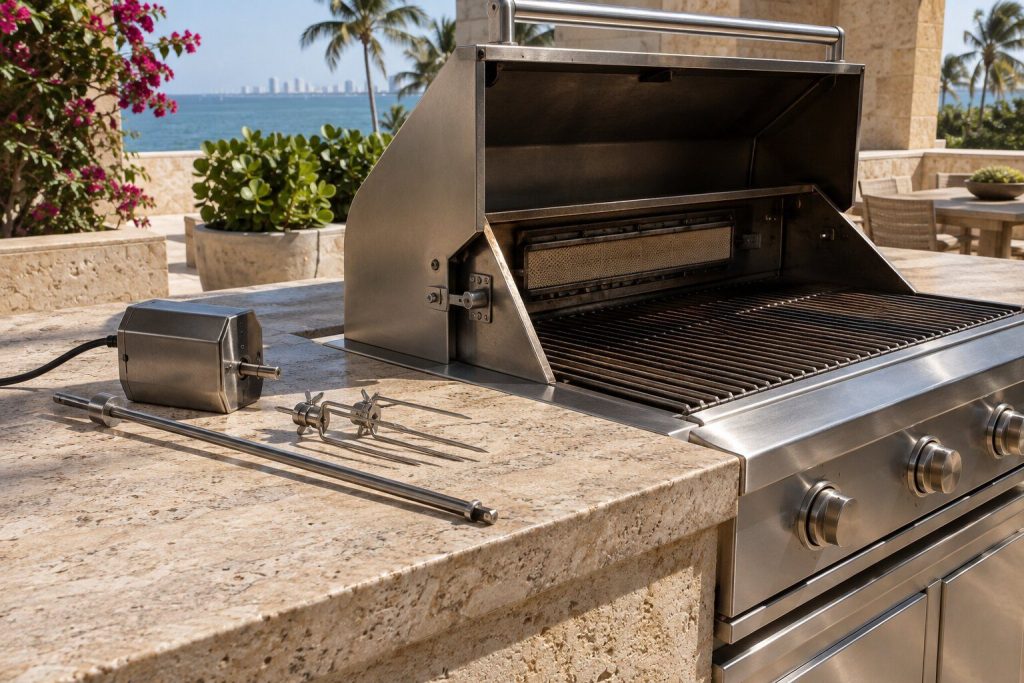
from $145 Rotisserie repair
Two separate things are called the rotisserie and they fail separately. There is the motor and spit that turn, and there is the rear burner that does the cooking, and a complaint of 'the rotisserie does not work' is worth splitting on the phone. A motor that hums and does not turn, a spit that binds in its bracket, a burner that will not stay lit when the safety valve button is released — these are three different visits. The last one is the one people live with longest and is usually the flame-supervision device rather than the burner.
- Motor and rear burner are two machines with one name
- Will not stay lit once the button is released points at flame supervision
- A binding spit ruins a motor that was fine until it did
-
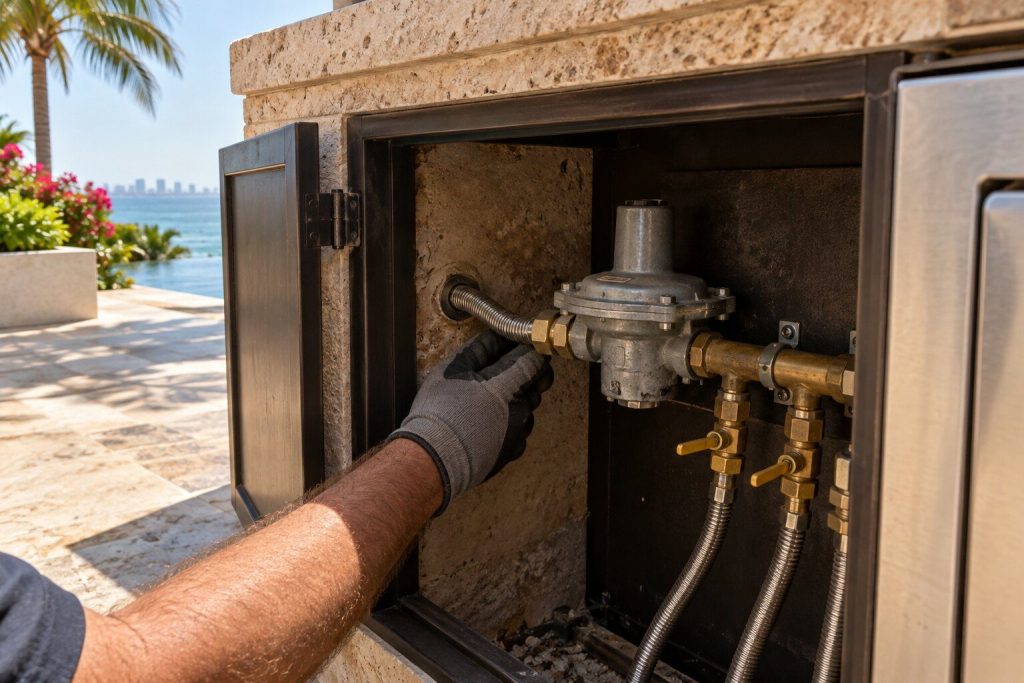
from $155 Gas supply and regulator service
Everything upstream of the burner, which is where a large share of outdoor problems actually live. Weak flame on every burner at once, a grill that will not reach temperature, a cylinder that empties faster than it should, a limiting device that trips every time the valve is opened quickly — none of those are the grill. Under an island the fittings, the flexible connector and the manifold live in a space nobody has looked at since the mason closed it, in air that corrodes. We test rather than guess, and where the answer belongs to a gas contractor rather than to us, we say that.
- All burners weak at once is a supply question, not a burner question
- The fittings under an island are the ones nobody has ever seen
- Where it belongs to a gas contractor, we say so instead of improvising
-
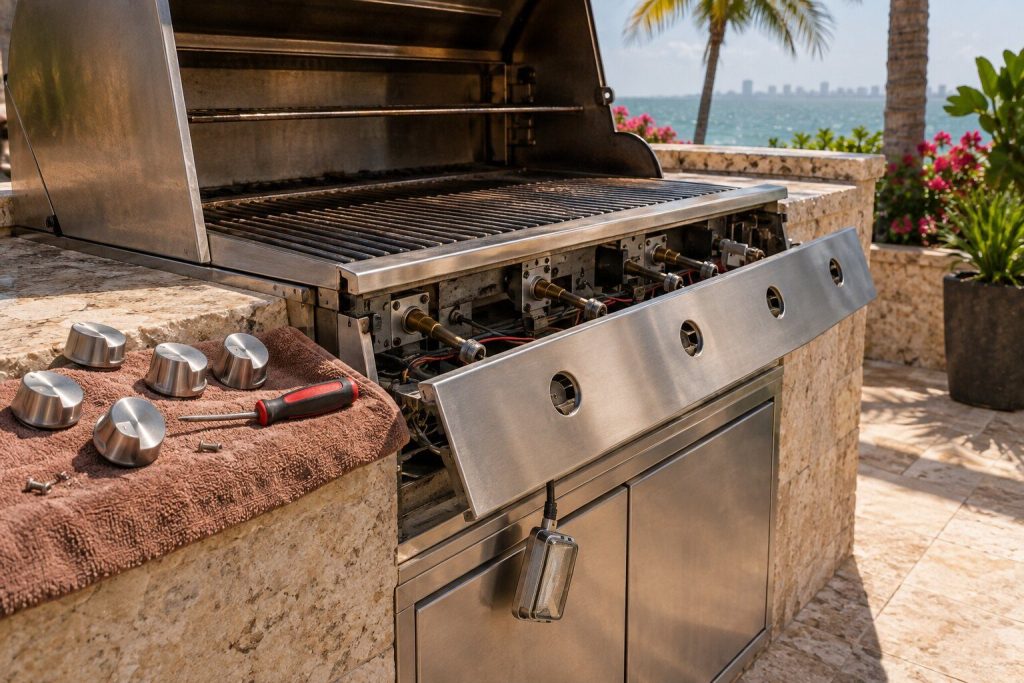
from $125 Hood light and control repair
The electrical half of an outdoor grill: hood lights, dial lighting, the switch panel and the wiring that runs through a cabinet exposed to weather. These are the problems people put up with rather than call about, which is a pity, because water in a switch housing on a terrace does not stay a lighting problem. Corroded connectors, a transformer that has taken rain, a switch that has swollen — they all read as a failed light until somebody opens the housing, and by then the corrosion has usually traveled.
- A dead light on an outdoor grill is usually water, not a bulb
- Corrosion travels along a loom — the problem is rarely where the symptom is
- Left alone it stops being an electrical problem and becomes a housing one
-
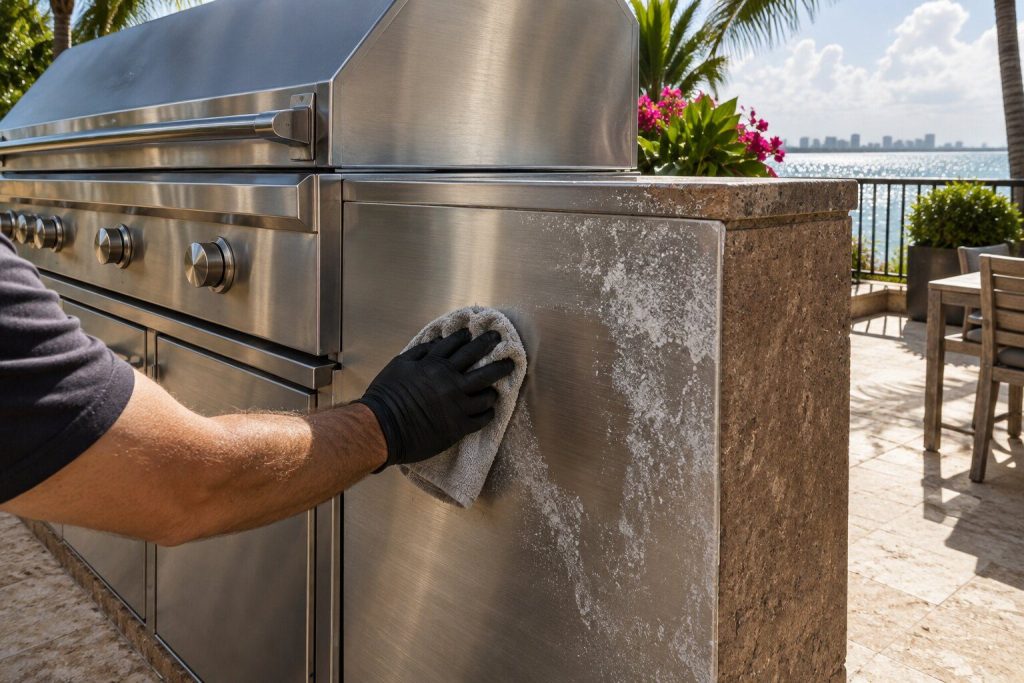
from $195 Salt air protection service
A visit that exists because of where this equipment lives. Four of the seven machines on this site stand outdoors in air that carries salt, and the difference between a kitchen four blocks from the water and one four miles inland is measured in years of service life. This is the planned, unglamorous work that changes that number: stainless cleaned and protected in the right direction, fixings inspected and replaced with the right grade before they seize, ignition components and electrical housings treated and re-sealed, hardware caught while it is stiff rather than after it is stuck. It is not a cosmetic service, although the kitchen does look better afterwards.
- Distance from the water is the real service interval on this coast
- Fixings replaced with the right grade before they seize, not after
- Not a polish — the point is the fixings, the housings and the hardware
In more detail
About DCS grills
The outdoor half of this brand has no codes, and that is not a gap
Every other make on this fleet answers the question "what is it showing?" with a string on a display. A DCS grill has no display and no error table — its own manual writes the whole troubleshooting section as questions rather than codes. So the useful things a caller can tell us are the color of the flame, how many burners are behaving that way, whether a match will light what the ignitor will not, and what changed in the week before. On this machine those sentences are the diagnosis.
Salt air is a service history, not a complaint
An outdoor grill in Miami-Dade, Broward or Palm Beach is living in conditions the factory rates it for and the owner's expectations are not. Ignitors, electrodes, burners, fixings and the underside of the hood corrode on a schedule, and a grill four blocks from the water ages differently from the same grill four miles inland. We plan a visit around that rather than around a part number.
Built into an island is a different job from standing on a cart
The cooking platform is the same; the access is not. A grill dropped into stone or block is surrounded on three sides and sometimes plumbed in place, so the sequence of what comes out first is decided by the mason rather than by the manufacturer. It is the reason we ask for a photograph of the island before an appointment on the built-in version.
This article is based on:
- Official manufacturer documentation
- Internal repair procedures
- Technician repair history
- Company quality standards

Before you book
Questions about DCS grills
Orange and lazy where it used to be blue.
That is the grill telling you the air and gas are no longer mixing the way they should, and it is worth taking seriously rather than cooking through. The usual causes are an obstructed burner inlet or venturi tube — insects nest in them, and in this climate they do it every season — a burner port blocked by grease and carbon, or a regulator that has gone into its limiting mode. Some of that is owner work with the gas off and the burner out; some of it is not. The question we put on the telephone is how many burners are doing it: a single one points inside that burner, the whole set points upstream at the supply.
It will not light at all.
Start at the far end rather than at the grill. A cylinder with its Flow Limiting Device tripped will pass just enough gas to be confusing; a natural gas supply valve half closed does the same thing. After that it is the ignition — a battery in the module, a cracked ceramic on an electrode, a corroded earth. If the burner lights from a match but not from the ignitor, that is a very useful sentence and it halves the diagnosis. Please do not keep pressing the ignitor with the dial on and gas flowing.
Flare-ups every time, and they did not use to happen.
Flare-ups are grease finding flame, and where the grease is sitting is the whole question. The radiant trays above the burners and the tray under them are a system for taking drippings away from the fire; when they are loaded or fitted wrong, everything that renders out goes straight down onto the burner instead. We see this most on grills that are cleaned on top and never underneath. It is also the single most common cause of a grill fire in this market, which is why we treat it as a safety call and not a cleaning question.
I can smell gas.
Turn every dial off, close the supply at the cylinder or the wall valve, and do not use the grill or any ignition source near it until somebody has looked. Gas with the dial on and the burner unlit is one thing; gas with everything off is another and a worse one. We do not diagnose this over the phone and we do not ask you to test it yourself. Outdoors in salt air, a fitting that was sound three seasons ago is not automatically sound today, and the joints under an island are the ones nobody ever sees.
Where we do it
Across Miami-Dade, Broward, and Palm Beach
Same terms everywhere we go: an on-site diagnostic first, the price agreed in writing, and the exact figure confirmed once we have seen the unit.
Neighborhoods people ask for by name