DCSRepair Miami

21 conditions · 13 codes and 8 signals

DCS error codes, and where there are none.

Every string here was read in the maker's own documentation. Where a machine publishes nothing, this site says so and works from evidence instead — which on this badge covers most of the equipment.

  • 13 codes published
  • 8 documented signals with no code
  • 5 machines that publish nothing
  • Every one read in the maker's own documentation

Jump to a table

By machine, and by which half of the badge it is on

Type what the panel shows and the index will find it. On the indoor equipment include the digits after the letter — they are the message, and the letter on its own matches five different conditions. On the outdoor equipment there is nothing to type, because there is nothing displayed: those rows are signals, and they are listed here so that the absence is visible rather than assumed.

5 of the 7 machines on this badge publish no code at all. If yours is one of them, the symptom pages are the honest place to start, and the signals below are what the maker documents instead.

The structural fact

Two makes wearing one badge

The outdoor half of DCS publishes no error table of any kind. Its own user guide writes the entire troubleshooting section as questions — why is the flame yellow, why will it not light, why the flare-ups, why can I smell gas. Those are signals, they are documented, and this site publishes them as signals.

The indoor half publishes decoded tables: not a list of bare numbers to be looked up, but which board, which link, which kind of error. They are not the same thing and we do not present them as one.

Start from the symptom
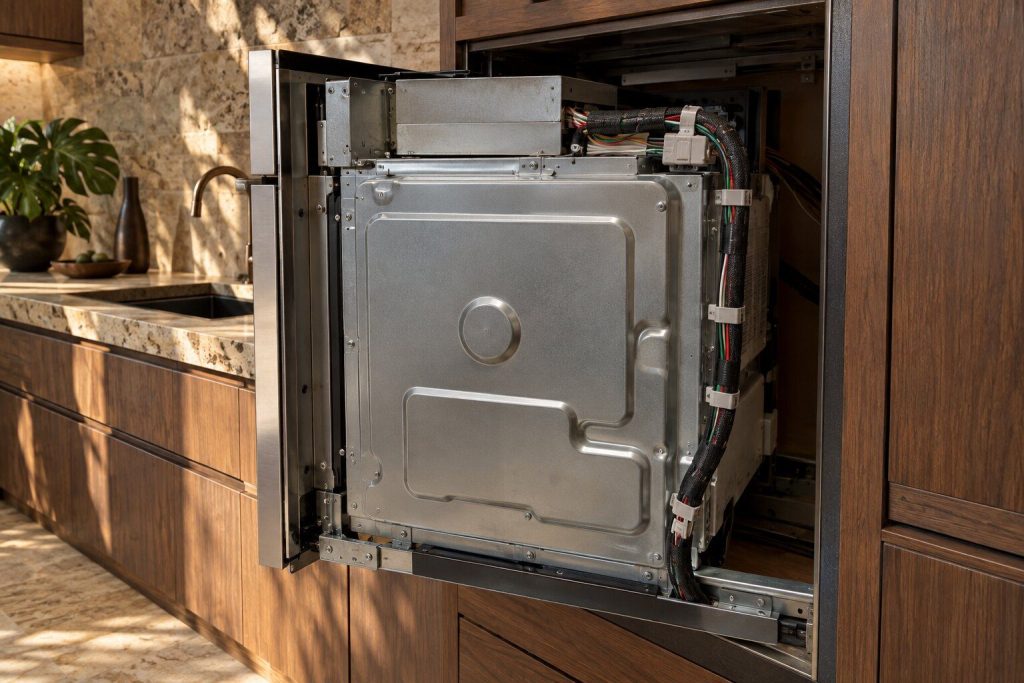
The back of a wall oven exposed in its cabinet opening with a wiring loom clipped along the frame.

Why there is no page for the bare letter

The maker has already done the decoding

On every other make we work, the value of a code page is decoding a number nobody publishes the meaning of. Here the manufacturer publishes the meaning itself, so a page saying ‘F1 means an error on your DCS oven’ would offer less than the maker does and send a reader away with nothing.

So the sub-errors have pages and the bare letter does not. One of them means the control does not recognize the model it is fitted to — a mismatch created by an earlier repair, which no amount of further replacing will clear.

Start from the symptom
An induction cooktop, dark and clear, with a pan standing to one side of it.

Before you look anything up

Four things about reading a code here

Indoors

  • Write the whole string down, digits included, before it clears
  • The letter alone narrows almost nothing
  • Power down at the breaker for a full minute, not at the appliance switch
  • Say whether anybody has replaced a part recently

Outdoors

  • There is no code and no display — that is how the equipment is built, not a defect
  • Flame color, how many burners, and what changed are the evidence
  • A match lighting what the ignitor will not is worth saying
  • A smell of gas stops everything else

Or start from the behavior

By symptom instead

Most people arrive here with a behavior rather than a string.

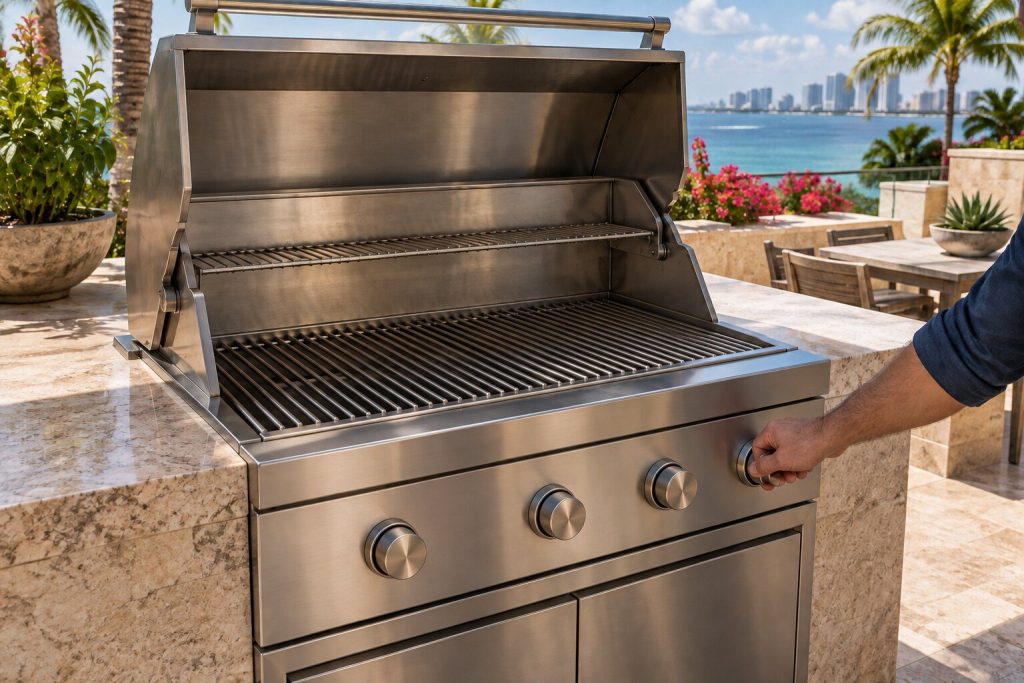
  • An open built-in grill with cold empty grates and a hand on one control dial, no flame under it, the terrace bright behind.
    Clicking, or nothing at all, and no flame

    Grill will not light

    DCS grill will not light. Nothing here displays anything, so the work is done from four things an owner already knows: how many burners are affected, what has happened at the cylinder lately, whether a match succeeds where the spark does not, and whether there is any smell of gas. That last one ends the process on the spot. The other three separate a supply problem from an ignition problem from a burner problem, and in this market the first is far commoner than people expect.

    • How many burners are affected cuts the search in half before anyone arrives
    • Lights from a match but not from the ignitor: the gas is fine, the spark is not
    • A cylinder valve opened too quickly trips a limiter and starves the whole grill
    What it usually means
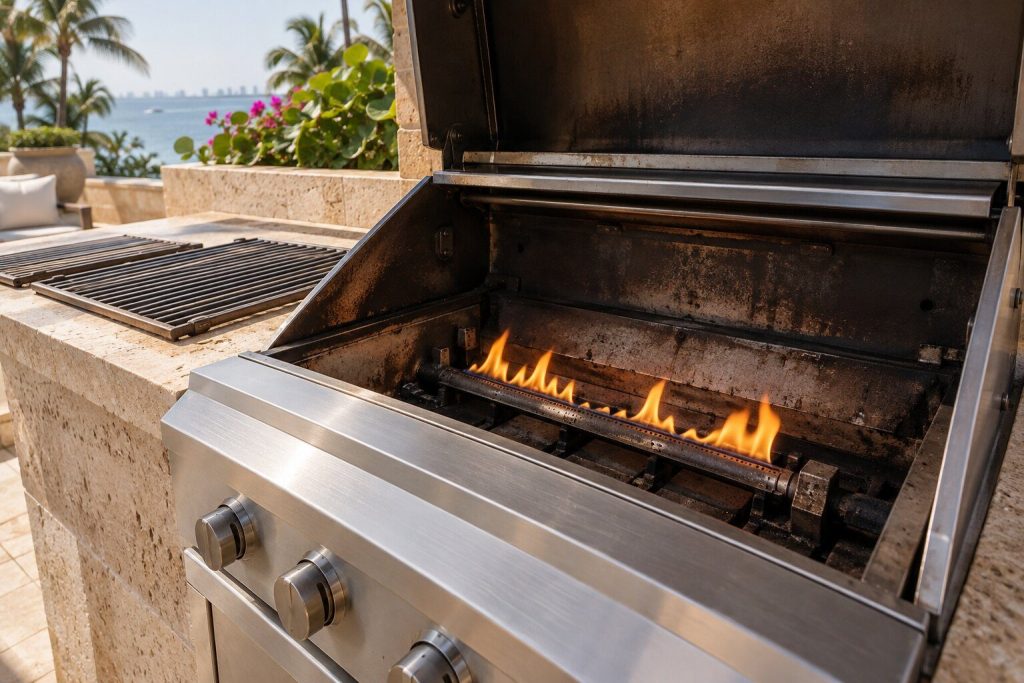
  • One grill burner alight with a lazy yellow-orange flame along its length, the grates lifted off beside it, the rest of the firebox dark.
    Blue flame gone lazy and yellow-tipped

    Grill flame is yellow or orange

    DCS grill flame yellow instead of blue. Blue is what a correctly proportioned mixture looks like; yellow says the ratio has drifted. It is worth taking seriously rather than cooking through: a badly mixing flame deposits soot on food and on the inside of the hood, and the cause is usually something obstructing the air side. In South Florida the obstruction is very often alive — insects find a venturi tube an excellent place to spend a season.

    • Nine times in ten the air side is starved, not the gas side
    • A lone offender is local; the whole set accuses the regulator
    • A grill left under a cover all summer is an invitation to a nest
    What it usually means
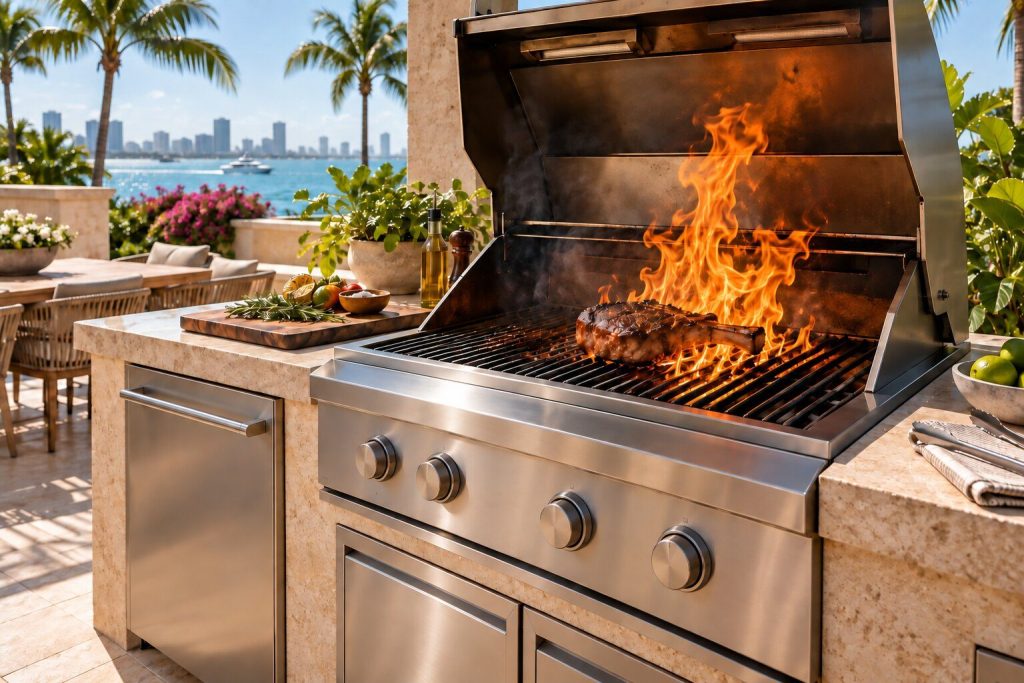
  • A sheet of flame rising through the grates of an open grill under a piece of meat, the hood standing open above it.
    Flames coming up through the grates at every cook

    Grill flare-ups

    DCS grill flare-ups every time something fatty goes on. Occasional flame when fat hits heat is cooking; a grill that burns everything on it is telling you the grease path has stopped working. That path is a design — radiants spread the heat and shed what falls on them, a tray collects it, a channel carries it to a cup — and when any part of it is loaded, missing or refitted the wrong way round, the drippings go straight onto the burners instead. In this market it is the commonest cause of a grill fire.

    • Persistent flare-ups are a grease path problem, not a cooking technique problem
    • Radiants refitted the wrong way round defeat the whole design
    • The cheapest work on an outdoor kitchen, with the highest consequence if skipped
    What it usually means
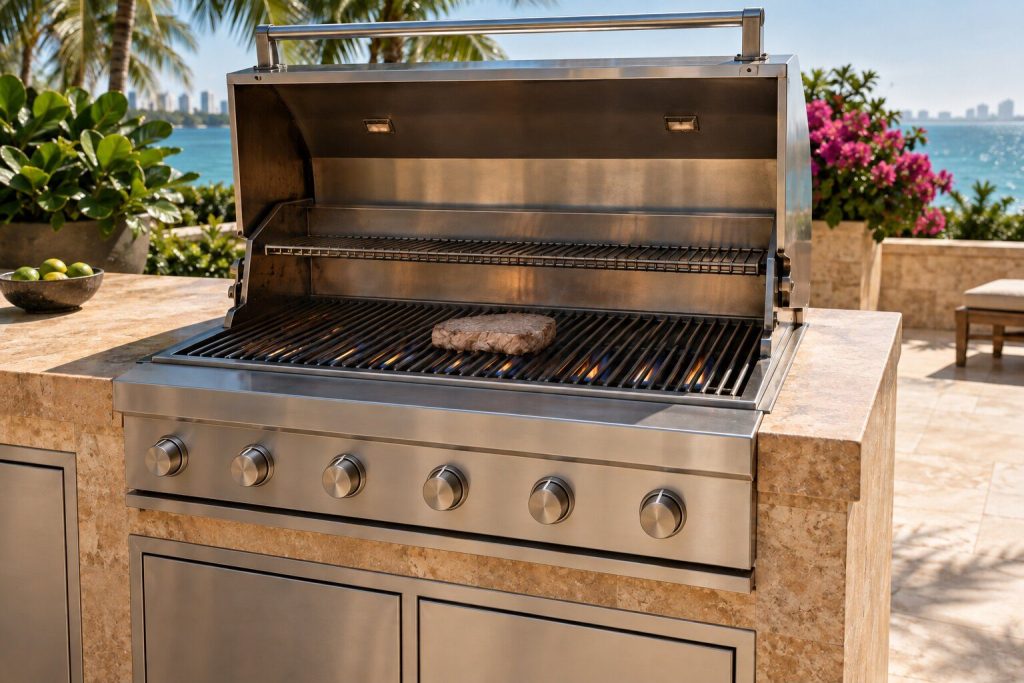
  • A grill running with every burner on high and the hood open over a steak that is gray rather than seared, the terrace in hard midday light.
    Lights and runs, but will not sear

    Grill not getting hot enough

    DCS grill not getting hot enough. Everything works and nothing is hot, which nearly always means how much gas is arriving rather than anything inside the hood. The classic version is a cylinder whose flow limiting device has activated — it passes enough to light and simmer and never enough to sear. Before any of that, though, there is a question worth settling: a grill of this size that has been preheating for five minutes is not underperforming, it is not finished.

    • Give it a full fifteen minutes with the hood down before judging it
    • A tripped limiter on an LP cylinder is the classic cause and resets in a minute
    • A supply that is fine at rest can still collapse with three burners running
    What it usually means
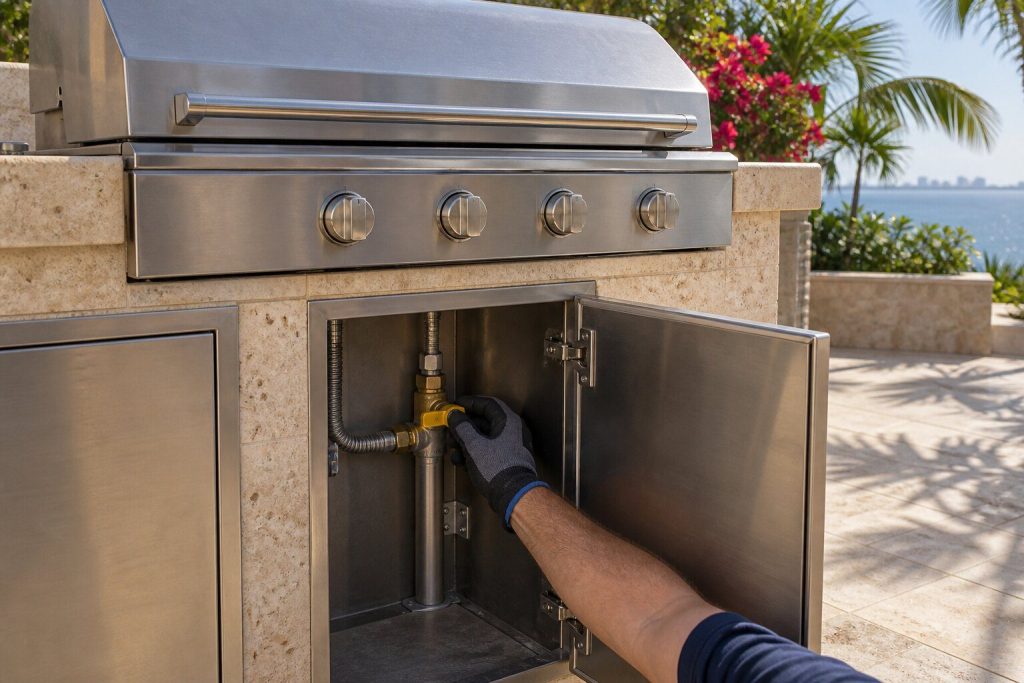
  • A gloved hand closing the gas shutoff valve inside the open cabinet of a stone outdoor island, the grill above it dark and unlit.
    Gas can be smelled with the burners off

    Smell of gas at the grill

    Smell of gas at a DCS grill or outdoor kitchen. This is the one page on the site with no troubleshooting on it. Gas with a dial on and the burner unlit is one thing; gas with everything shut off is another and a more serious one. Outdoors in salt air a joint that was sound three seasons ago is not automatically sound now, and the fittings under a stone island are the ones nobody has looked at since the mason closed it up.

    • Shut the supply off at the cylinder or the wall valve and leave it off
    • No ignition sources nearby — that includes the grill's own ignitor
    • We do not diagnose this by telephone and we do not ask you to test it
    What it usually means
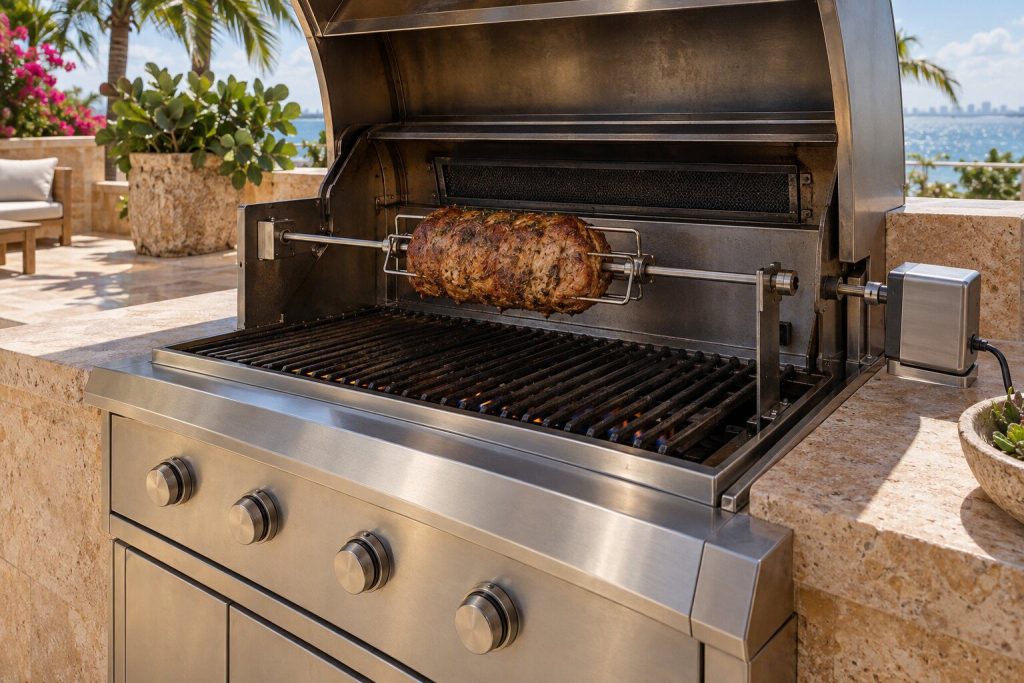
  • A rotisserie spit loaded and resting in its brackets over a grill firebox with the rear burner unlit, the motor end of the rod out of its socket.
    The spit stops, or the rear burner dies when the dial is released

    Rotisserie will not turn or stay lit

    DCS rotisserie not working. Two machines share this name and they fail separately: a motor and spit that turn, and a rear burner that does the cooking. Saying which half has stopped is worth a great deal, because they go to different places. The one people live with longest is a rear burner that lights while the dial is held in and goes out the moment it is released — and that is not something to be worked around, it is a safety device doing precisely what it is for.

    • Turning without heat, heat without turning, or neither — three different repairs
    • A burner that dies when the dial is released cannot see its own flame
    • A binding spit destroys a motor that was perfectly good before it
    What it usually means
  • A side burner on an outdoor counter with its cap in place and no flame, a pan standing on the grate above it and a hand on the dial.
    The grill is fine and the side burner is dead

    Side burner will not light

    DCS side burner not working while the grill beside it is perfect. That combination is good news for the diagnosis, because it takes the shared supply out of the picture in one sentence: a manifold feeding a working grill is a manifold that is working. What is left is the side burner's own valve, its own ignition and its own burner — and those sit lower, closer to the splash, and are used a fraction as often, which in this climate is a risk rather than a protection.

    • The grill working proves the supply, which is half the diagnosis free
    • Side burners sit low and collect what the grill never sees
    • Little use means long idle spells, and idle is when the nests arrive
    What it usually means
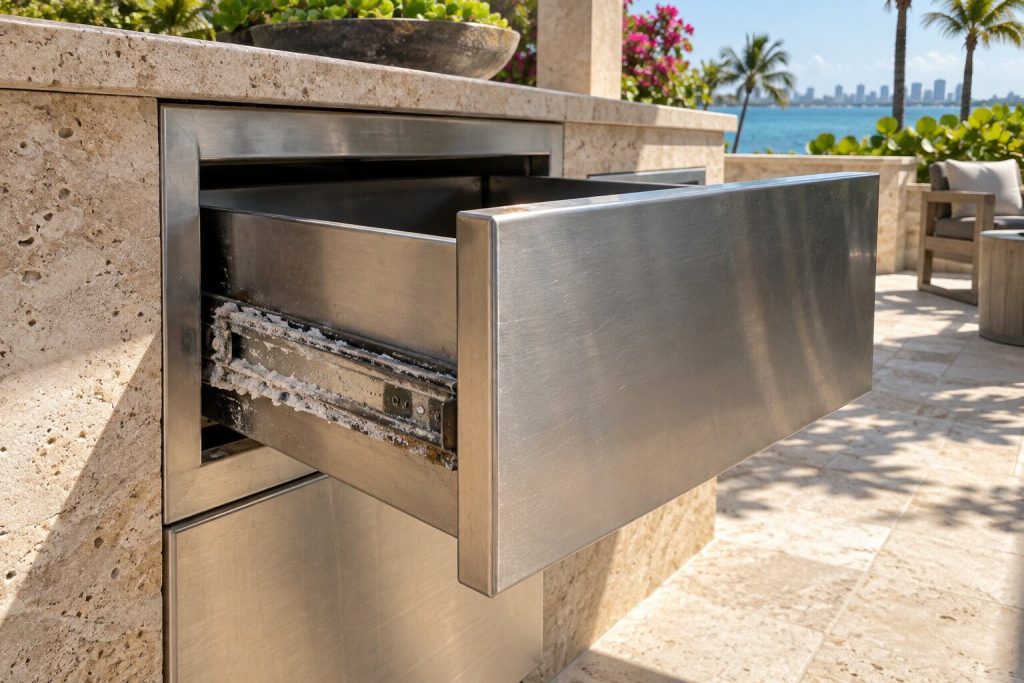
  • A stainless outdoor drawer pulled half out of a stone island and stuck at an angle, white salt crust visible along the runner in the gap.
    Stiff, sticking, or no longer opening at all

    Outdoor drawers and doors seized

    DCS outdoor kitchen drawers stuck. Hardware is what salt reaches first, and it fails in a predictable sequence: stiff, then sticky, then forced, then a bent drawer front or a frame pulled out of square. Catching it at stiff is inexpensive. Catching it after somebody has put their shoulder into a stuck drawer is a different order of work, and it is why the opening question when you ring is which of those two you have.

    • Reluctant and immovable are separate repairs at separate prices
    • A pitted runner does not come back with cleaning; it is replaced
    • Forcing one is what turns hardware into cabinet repair
    What it usually means
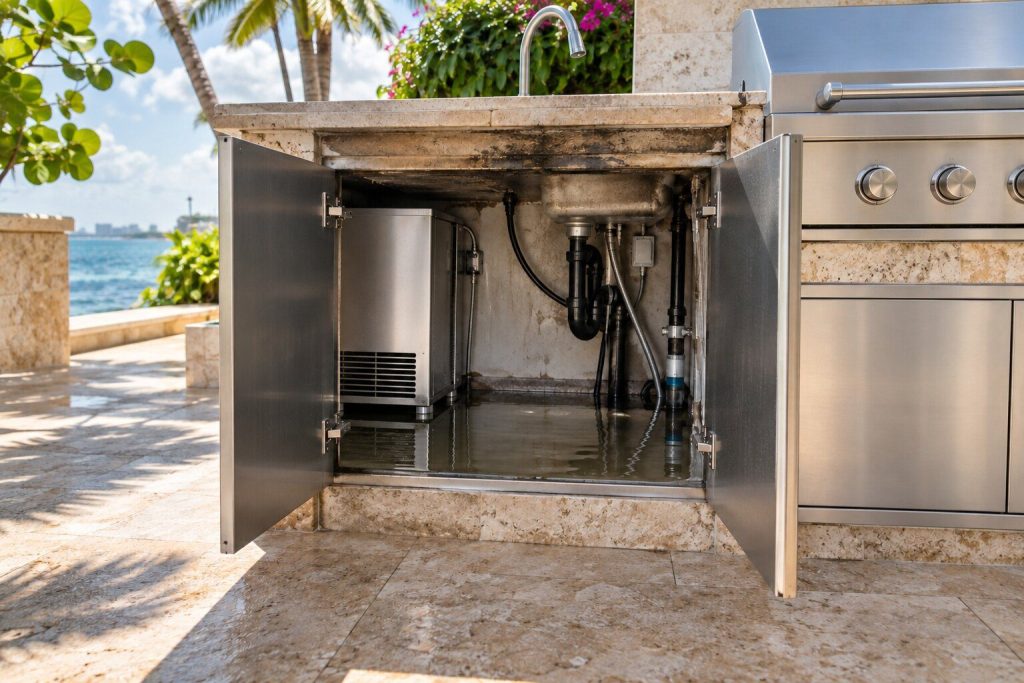
  • An inch of standing water in the floor of an open outdoor island cabinet with the doors swung back, the underside of the counter above it dark and damp.
    Standing water in the base of the island

    Water inside the outdoor cabinet

    Water in a DCS outdoor kitchen cabinet. An outdoor island is designed to shed water rather than to exclude it, so a little after heavy rain is not automatically a defect — where it collects and whether it leaves are the questions. Water sitting in the base of a cabinet that houses gas fittings and electrical connections is a different matter from water running through and away, and this is one of the few cosmetic-looking problems on the site that we would rather see sooner than later.

    • Shedding water is the design; holding it is not
    • A gas island with standing water in it is ruining fittings you cannot see
    • Constant water rather than after-rain water is usually plumbing or irrigation
    What it usually means
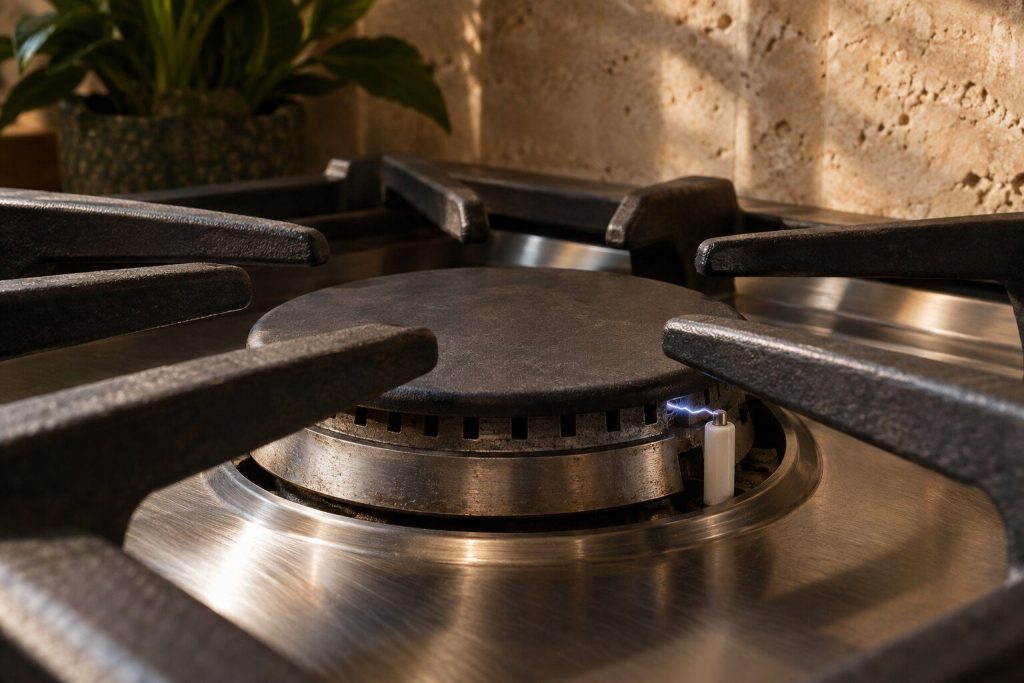
  • A gas range burner with its cap in place and the spark electrode beside it firing visibly, no flame anywhere on the burner.
    Sparking away on one ring with no flame

    Range burner clicks and will not light

    DCS range burner clicking and not lighting. On a sealed burner the list of causes is short and the first one is free: a cap set down rotated, or resting on a crumb, will spark all day and never light. After that it is a wet or cracked electrode, a port blocked by a boil-over, or the switch behind the dial. One detail separates two of those immediately — clicking that stops once the flame catches is normal, and clicking that continues afterwards is a switch.

    • Lift and reseat the cap before calling anyone — it costs nothing and often ends it
    • Clicking after the flame catches is a switch, not the ignition
    • If it started after a clean or a boil-over, that is usually the whole story
    What it usually means
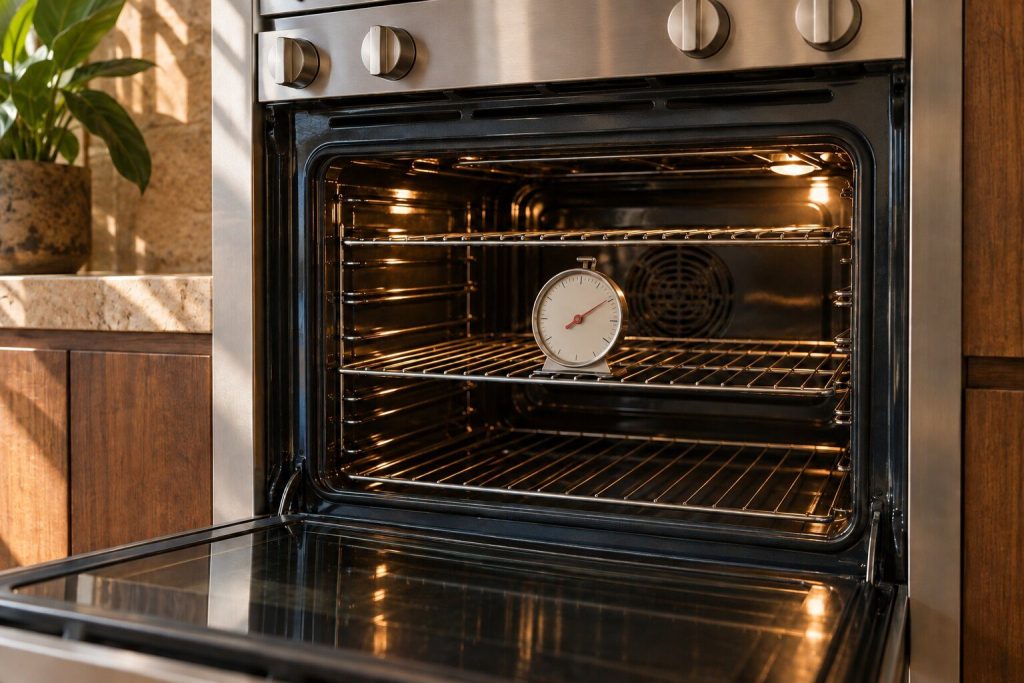
  • A dial oven thermometer standing on the middle rack of an open oven cavity in a bright kitchen, the racks otherwise empty.
    Runs hot, runs cold, or drifts during a bake

    Oven will not hold its temperature

    DCS oven not holding temperature. Running hot, running cold and failing to hold are one conversation, and it starts at the sensor rather than the element. Once a probe wanders, the control obeys it precisely and takes the cavity somewhere other than the dial says; on this much metal the error stays hidden until a cake disagrees. Doors deserve more suspicion than they get — a heavy one that has stopped pulling true bleeds heat from a corner, and that presents as a heating element on its way out.

    • Probe before element: the sequence is most of the answer
    • One cold corner indicts the door, never the element
    • If the oven shows a code, the digits after the letter are the message
    What it usually means
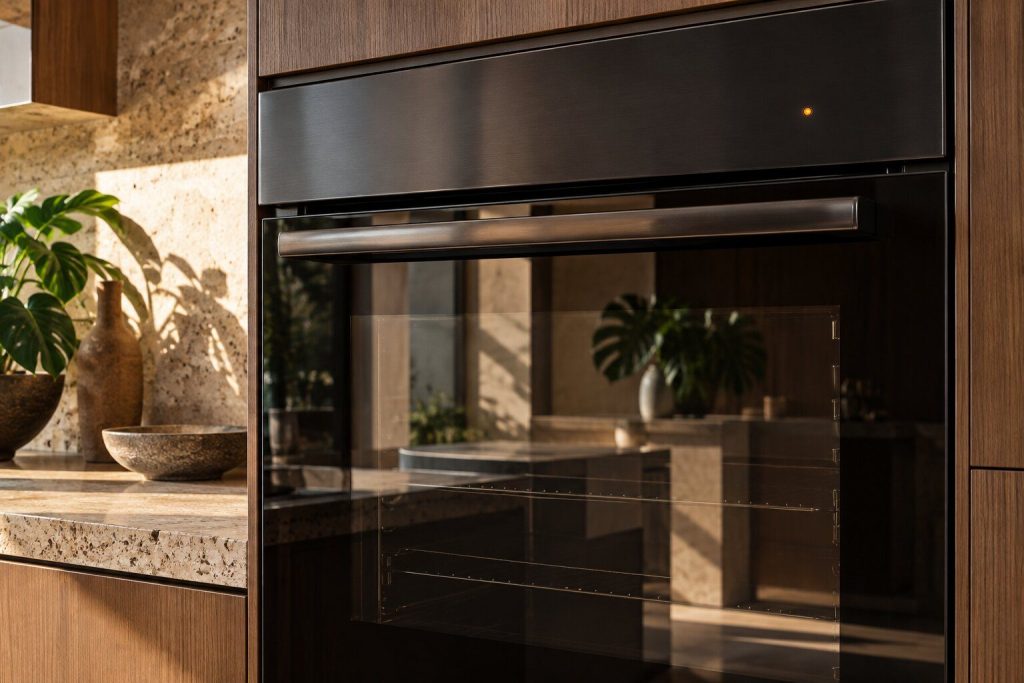
  • A dark oven control panel with one small amber indicator lamp lit on it and the door closed below, the bright kitchen reflected in the glass.
    An icon, a beep, and a letter with two digits

    Oven shows an error code

    DCS oven error code. On the indoor half of this make the codes are decoded rather than bare — the manufacturer publishes what each one means, and the two digits after the letter separate a missing power board from a software error from two different communication errors from a model identity mismatch. That last one is the interesting case: it is not a failure at all but a mismatch, usually created by an earlier repair, and no further replacing will clear it. Write the whole string down before it goes.

    • The letter alone narrows nothing — the digits after it are the message
    • One of the published codes means an earlier repair fitted the wrong variant
    • Power down at the breaker for a full minute before deciding anything
    What it usually means
  • A heavy pan standing on one zone of a black glass induction top with nothing happening under it, the other zones clear and unmarked.
    One zone dead while the others are fine

    Induction zone not working

    DCS induction zone not working. One zone dead with the rest perfect is the useful version of this problem — it takes the supply and the main control mostly out of the picture and puts that zone's own chain in front of us. But there is a free check first, and it catches a real share of these calls: a pan whose base is not magnetic, or has warped so it no longer sits flat, will fail on any zone and fail most obviously on the smallest one.

    • Test with a pan you know works before booking anything — a magnet settles it
    • Connections and sensing fail far more often than coils do
    • A zone that only drops out when others are running is a cooling problem
    What it usually means
  • A black glass induction cooktop gone dark mid-cook with a pan of water still on it, one small indicator lamp lit at the front edge and no characters anywhere on the surface.
    It stops, sometimes with a code, and cools before it will restart

    Induction cooktop shuts off mid-cook

    DCS induction cooktop turning itself off. The machine is protecting itself and the published code list says from what: a key held down, a supply outside what it will run on, a short or an interruption in the key reading, an internal communication error, or a temperature condition. Two of those clear themselves and cost nothing, and one of them is not about the cooktop at all — the voltage entry means the machine is reporting on the electricity it is being given, and in older buildings it appears for real reasons.

    • Write the code down before it clears — the list separates five quite different things
    • One published code is about the building's supply, not the cooktop
    • Shutting down at the end of a long hard cook is the machine working correctly
    What it usually means
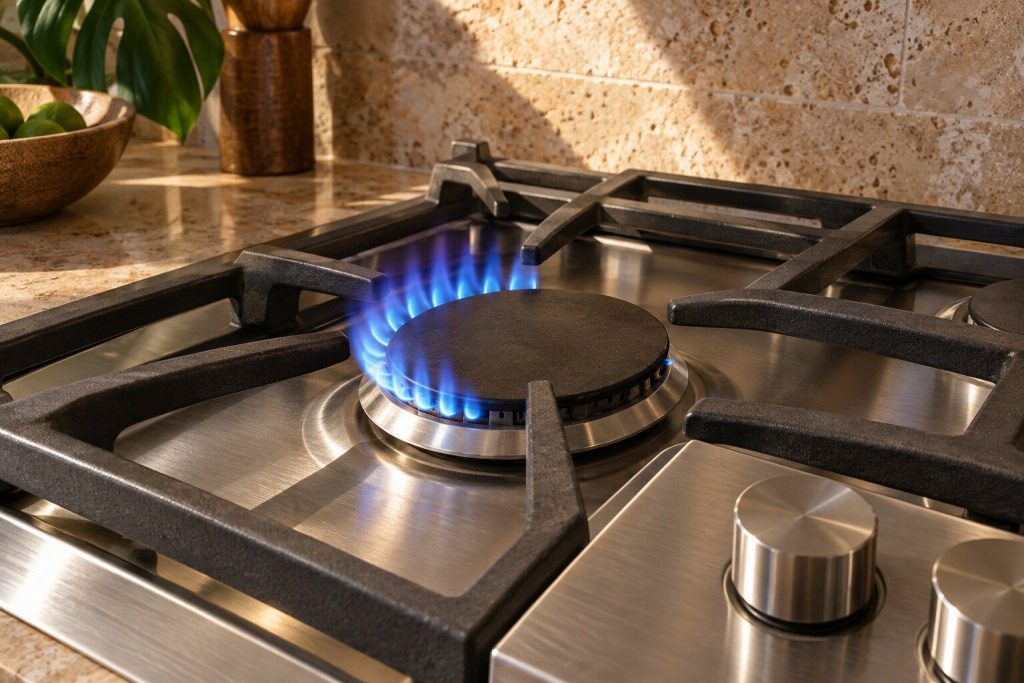
  • A gas cooktop burner alight with the flame tall on one side of the ring and almost absent on the other.
    Strong on one side of the ring, weak on the other

    Gas cooktop flame is uneven

    DCS gas cooktop uneven flame. A ring that burns hard on one side and feebly on the other is nearly always the cap or the ports rather than the burner, and both are owner-fixable with everything cold. The important distinction is how many burners are doing it: one ring is mechanical and local, every ring at once is the supply or the regulator and no amount of cleaning will change it. There is also a second symptom worth mentioning in the same call — a burner that lights well and will not hold a low flame has a different problem, and it only shows at the bottom of the range.

    • One ring uneven is the cap or the ports; every ring is the supply
    • Burner caps through a dishwasher come back permanently changed
    • A burner that will not simmer has a problem that only appears at minimum
    What it usually means
  • Smoke drifting out sideways from under a professional hood canopy over a pan on a range, the hood plainly running.
    The fan runs and the room still fills

    Hood not clearing smoke

    DCS range hood not clearing the kitchen. Before anything is opened there is a question that resolves a surprising share of these calls: where is the air actually going. Air that leaves the building behaves nothing like air that is filtered and handed back, and a large share of these calls turn out to be the second kind of hood doing precisely what it was fitted to do. On a hood that genuinely vents outside, the suspects are filters nobody has washed, ducting flattened by whoever worked in the ceiling, a wall cap whose flap has stopped lifting, or a wheel turning at a fraction of the speed it should.

    • If the air never leaves the room, steam never leaves it either — that is the install
    • Something living behind the exterior flap is an ordinary finding here
    • Over burners this size, filter grease is both restriction and fuel
    What it usually means
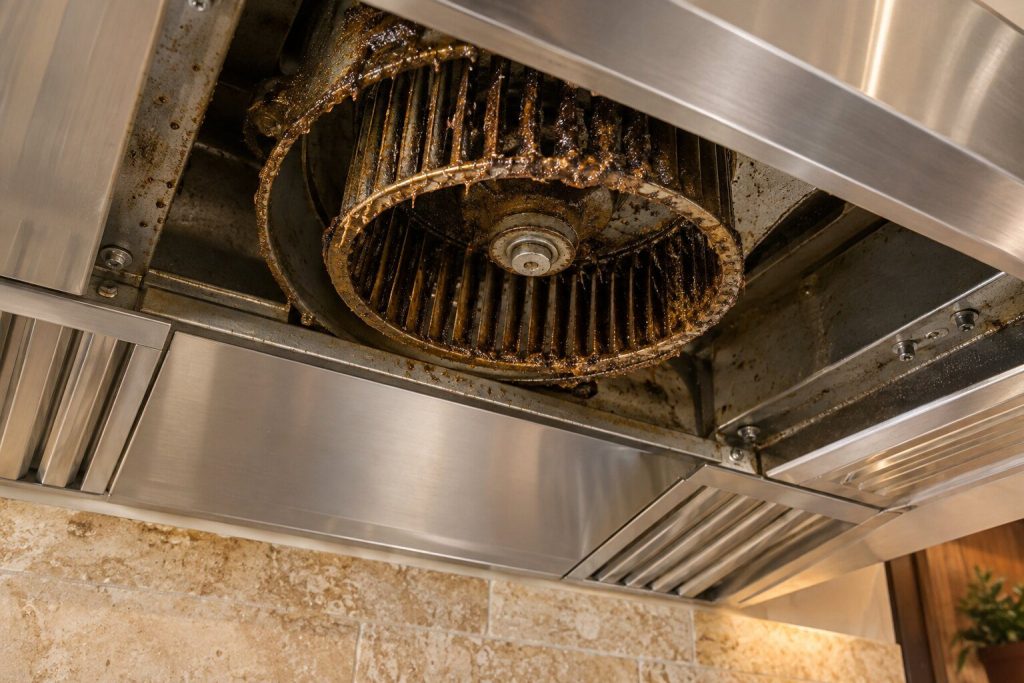
  • A squirrel-cage blower wheel inside an opened hood canopy, its vanes packed and uneven with old grease.
    A rumble, a rattle, or a rising whine

    Hood blower has become loud

    DCS range hood making noise. Noise is the early warning on a blower and it is worth using, because an out-of-balance wheel wears the housing it spins in and a housing is several times the cost of a motor. Gradual noise is usually bearings or an impeller unevenly loaded with grease; sudden noise is something loose, something in the impeller, or a mount that has let go. On an outdoor hood there is a third possibility indoors never has — the mounts have corroded, and the sound is structural.

    • Gradual and sudden noise are different problems with different urgencies
    • An unbalanced wheel damages the housing, which is the expensive part
    • Outdoors, a change in the sound can mean the mounts rather than the motor
    What it usually means
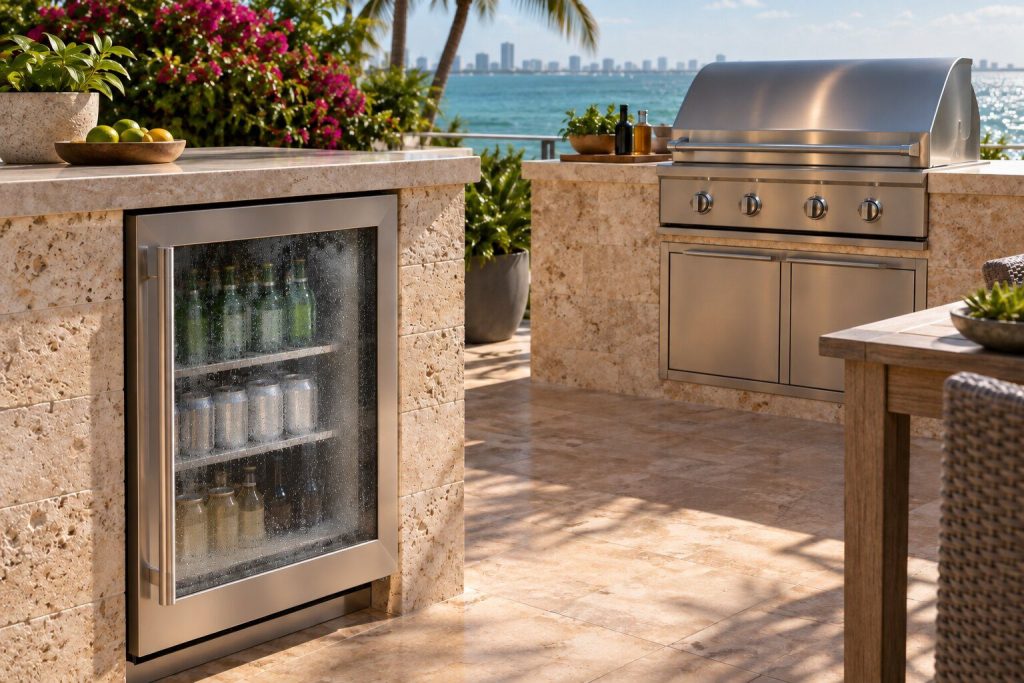
  • A stainless outdoor beverage center in a stone island a yard from a lit grill, its glass door beaded with condensation in hard afternoon sun.
    Running constantly and still warm in summer

    Beverage center not getting cold

    DCS beverage center not cooling. The first question is not about the machine. An undercounter cabinet in a closed stone island, a meter from a grill, in a Miami August, is being asked to reject heat into air that is already hot — and where the ventilation path was built tight or has since been blocked, nothing we fit will change that. Where the ventilation is genuinely adequate, the ordinary refrigeration list applies, and on this coast a condenser packed with salt and dust is near the top of it.

    • Running constantly in August is not automatically a defect
    • A condenser in an island loads with salt far faster than any indoor cabinet
    • Ventilation is a repair — and no part substitutes for it
    What it usually means
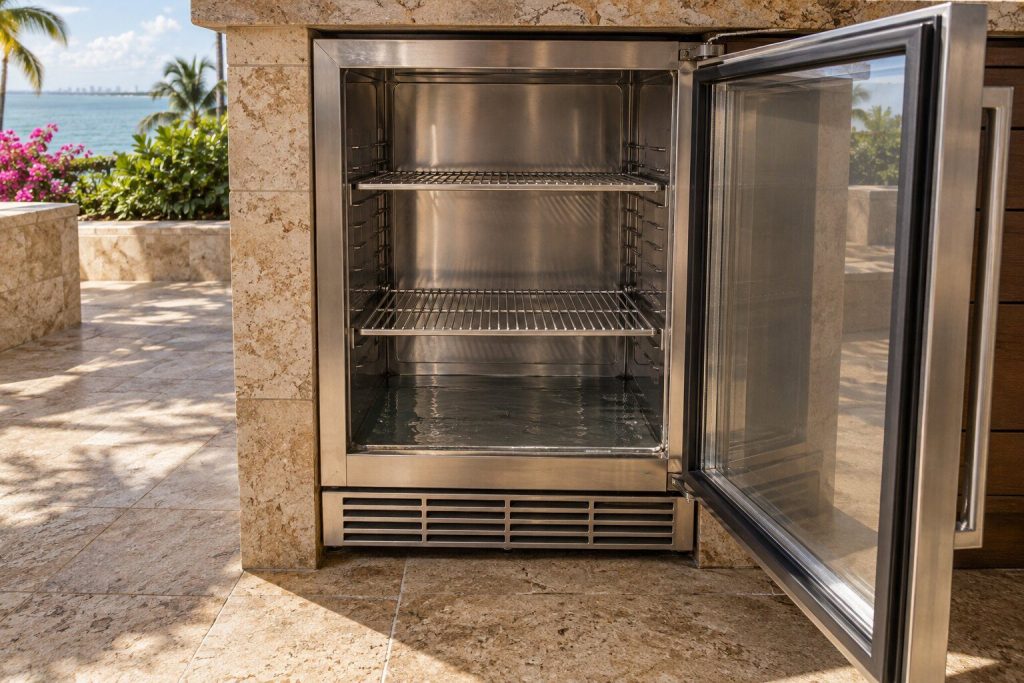
  • A shallow pool of water standing in the base of an outdoor beverage center under the lowest shelf, the door open and the interior otherwise empty.
    A pool in the base, or under the cabinet

    Water inside the beverage center

    Water inside a DCS beverage center. It is almost never a refrigerant leak — refrigerant is a gas and it does not puddle. Every cold cabinet makes water and has a planned route for it, and when that route blocks the water finds its own. Outdoors there is a second source an indoor unit never has: humid air arriving past a tired door seal, condensing on everything cold, in quantities that genuinely surprise people. The two causes look identical on the floor and feed each other.

    • Water inside is a drain or a seal, not the refrigeration
    • Humid outdoor air past a tired gasket makes more water than a drain expects
    • Treating the drain and leaving the seal means the puddle comes back
    What it usually means
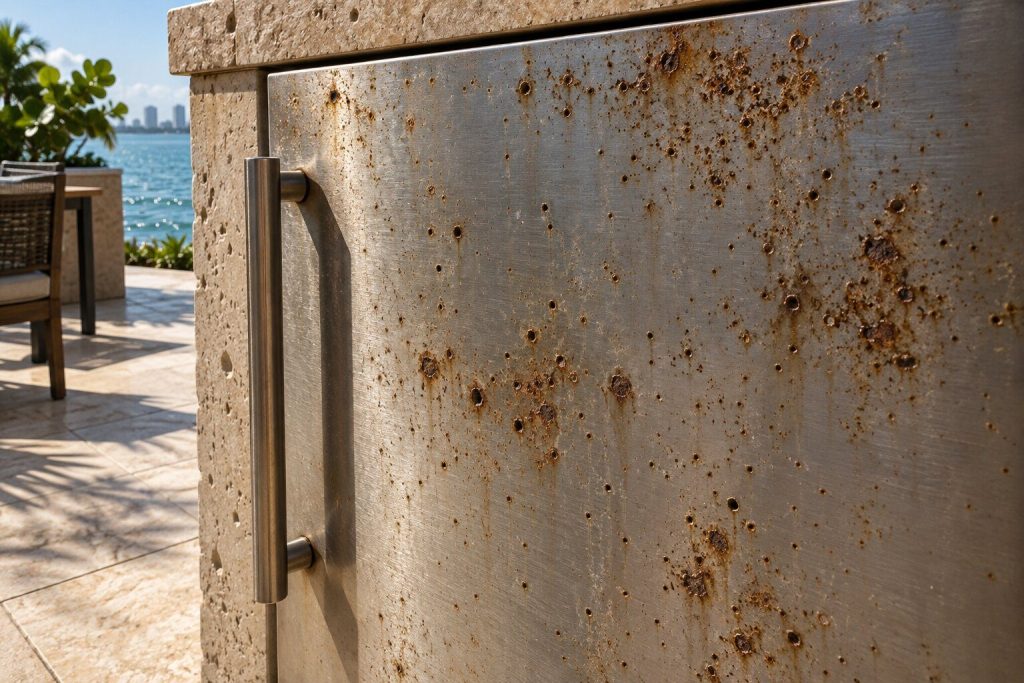
  • Brown pitting and rust blooming across the stainless face of an outdoor appliance door on a waterfront terrace.
    Brown speckling on doors, handles and fixings

    Outdoor stainless is pitting and rusting

    DCS outdoor stainless rusting. Outdoor-rated stainless resists salt; it does not ignore it. Brown speckling on a door or a handle is cosmetic and is slowed a great deal by rinsing with fresh water and drying, and there is no shame in a waterfront grill showing it. What is not cosmetic is corrosion around the vents, the hinges, the mounts and the fixings — those are the parts holding cabinets square and seals true, and they are the ones worth acting on.

    • Speckling on a face is cosmetic; corrosion at a fixing is structural
    • Fresh water and drying does more than any polish
    • Distance from the water is the real interval — four blocks is not four miles
    What it usually means

Worth saying

Two published articles are missing from this archive on purpose

DCS publishes separate error-code articles for the WOS and WOSD wall oven generation and for the WOSV230 and WODV230 alert codes. We know they exist and we have not read them, so nothing from them appears here and none of it has been guessed at from the pattern of the table we did read. If your oven shows a string this archive does not carry, that is why — tell us and we will look it up properly rather than improvising.

Before you book

The questions this page is asked

My grill shows no code at all. Is something wrong with the display?

There is no display. The outdoor equipment on this badge has no control panel to show a code on and no table behind it, and that is how it was built rather than something that has failed. The symptom pages are where the answers for that half of the brand live.

Why do some pages here have no code in the title?

Those are signals — documented symptoms from the maker's own guide, with no code attached because none exists. A yellow flame and a tripped limiting device are as real as any string on a display; they are simply reported by the machine in a different language.

What does the code about the model identity mean?

That the two boards inside the oven disagree about which oven they are in. It follows a repair rather than a failure: a replacement fitted from the wrong variant, or fitted without its identity being set. The cure is configuration, and buying a second board does not help.

In more detail

What is not in this archive, and why

Nothing invented, and nothing borrowed

13 codes across 4 platforms, every one read in the maker’s own documentation. Two articles are known to exist and have not been read, and they are named here rather than quietly left out. Nothing has been inferred from the shape of a table we do read.

And nothing pretending to be a code

5 of the machines on this site publish nothing at all, and each of those absences was read in the documentation rather than concluded from a blank display. Where a page here has no code in its title, it is a signal — a real, documented symptom that this make reports without a string.

Not sure which of these it is?

Tell us what the machine is doing, whether it is indoors or out, and what it is built into. That is usually enough for us to say which page you are on. Where a diagnostic is the right next step it is from $95, credited toward the repair.

This article is based on:

  • Official manufacturer documentation
  • Internal repair procedures
  • Technician repair history
  • Company quality standards
Call (305) 526-4714